



Aconite Root (Fu Zi)
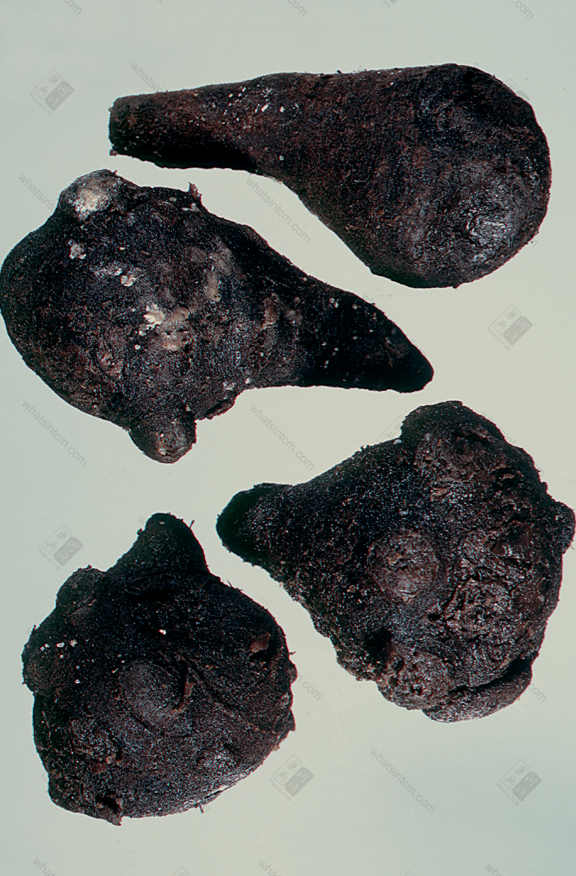 Salt Aconite Root (Fu Zi) (Ding Jiao, squatting upright) (Black conical surface, salt crystal grains)
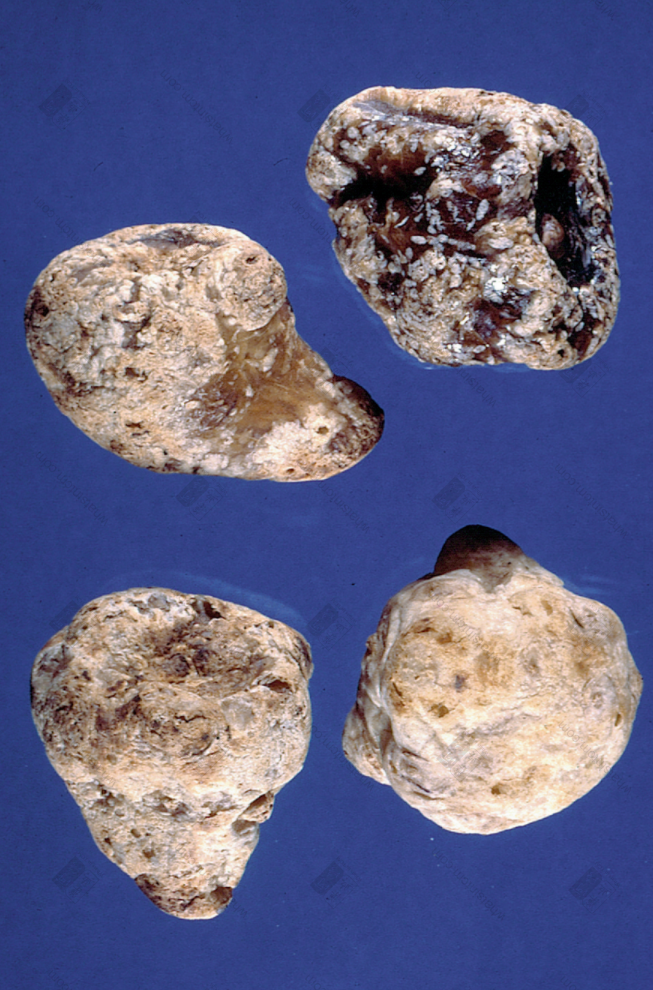 Processed Aconite Root (Fu Zi)
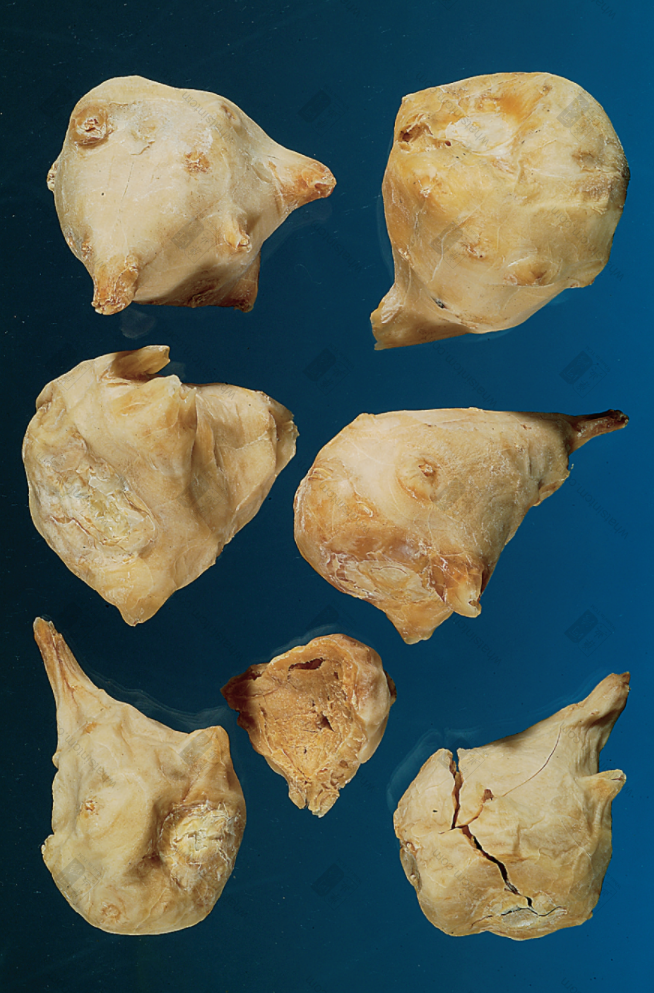 Processed Aconite Root (Fu Zi)
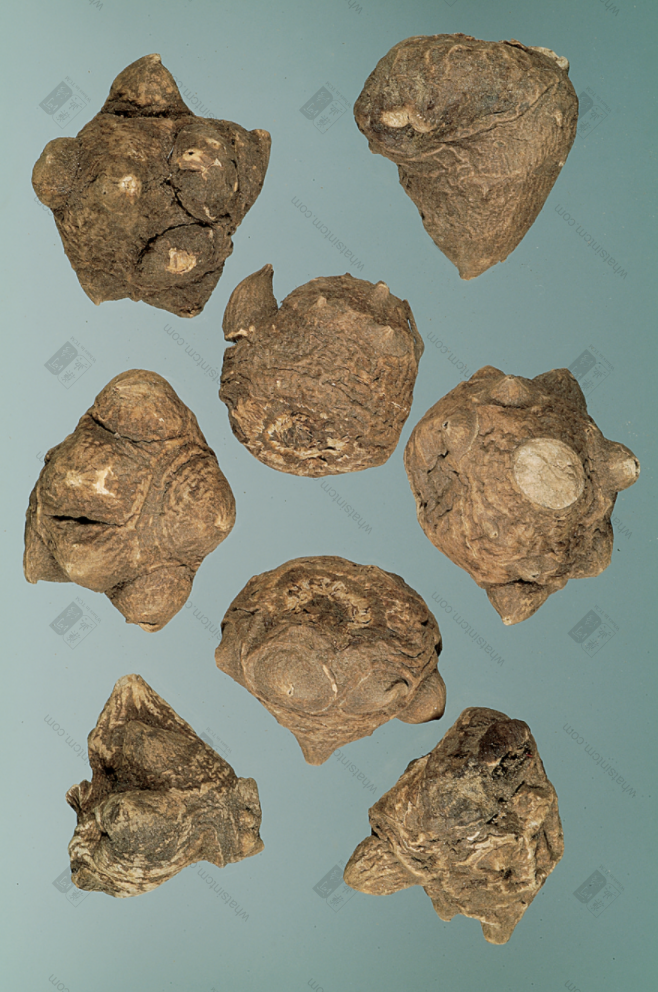 Processed Aconite Root (Fu Zi) (Depressed bud scar, surrounding nodular raised corners)
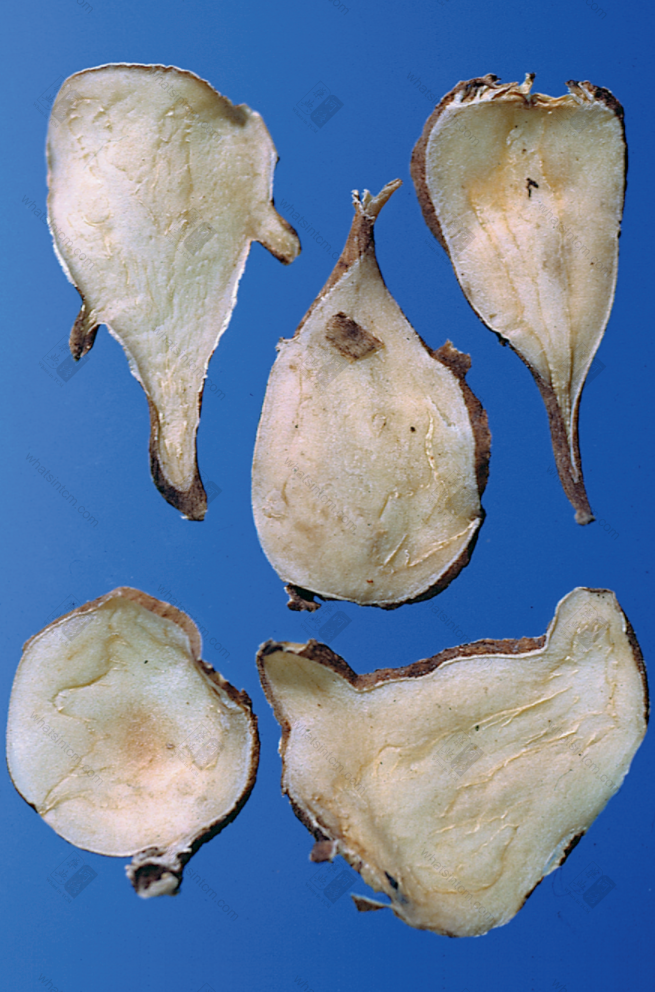 White Aconite Slice (Yellowish-white translucent, horny, numbing and spicy)
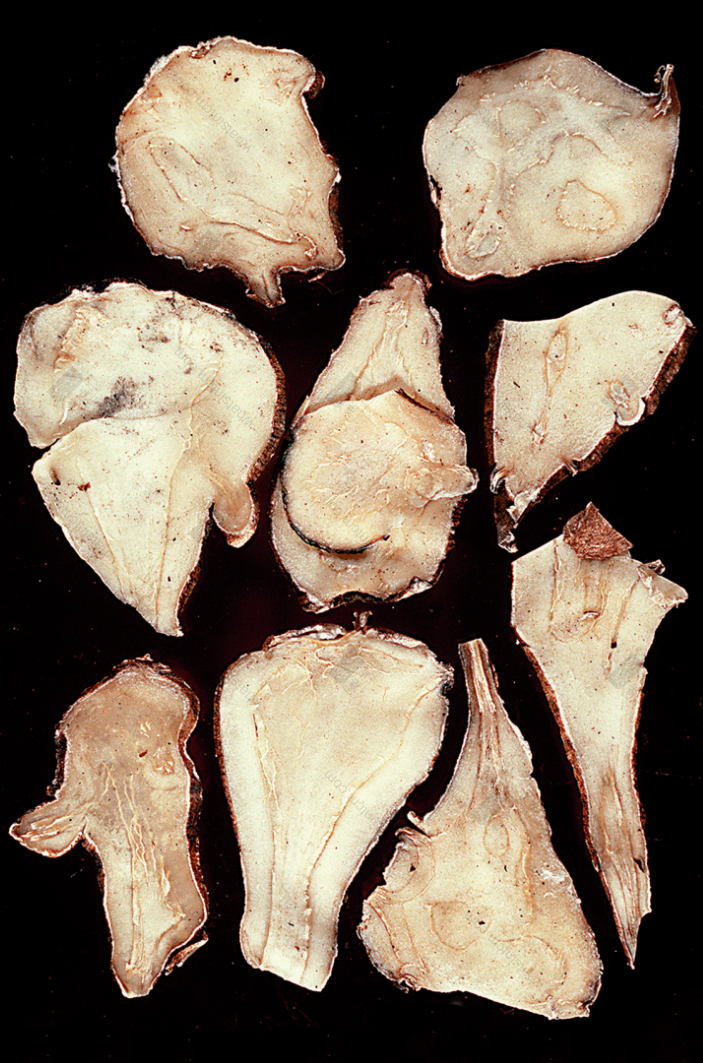 Second Grade White Aconite Slice
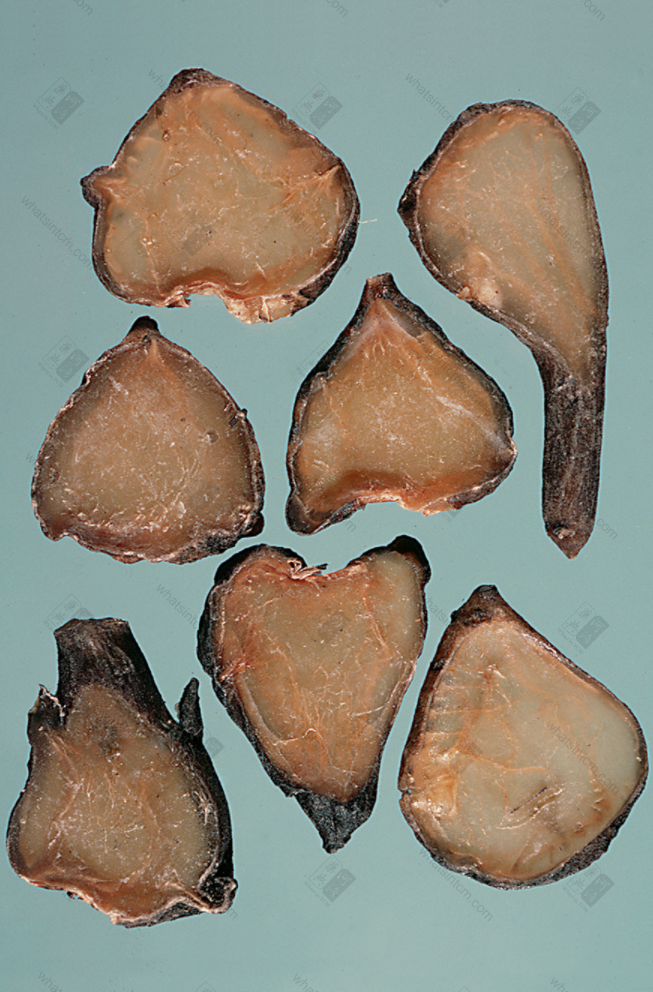 First Grade Black Aconite Slice (Tian Xiong) (Longitudinal section, triangular dark yellow core)
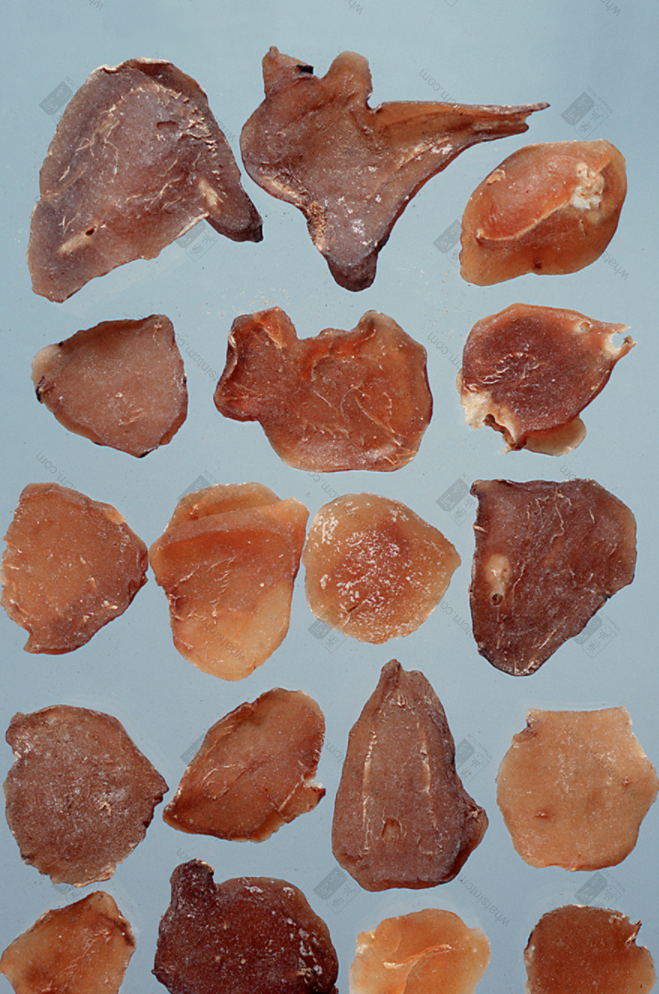 Second Grade Black Aconite Slice (Hei Shun Pian)
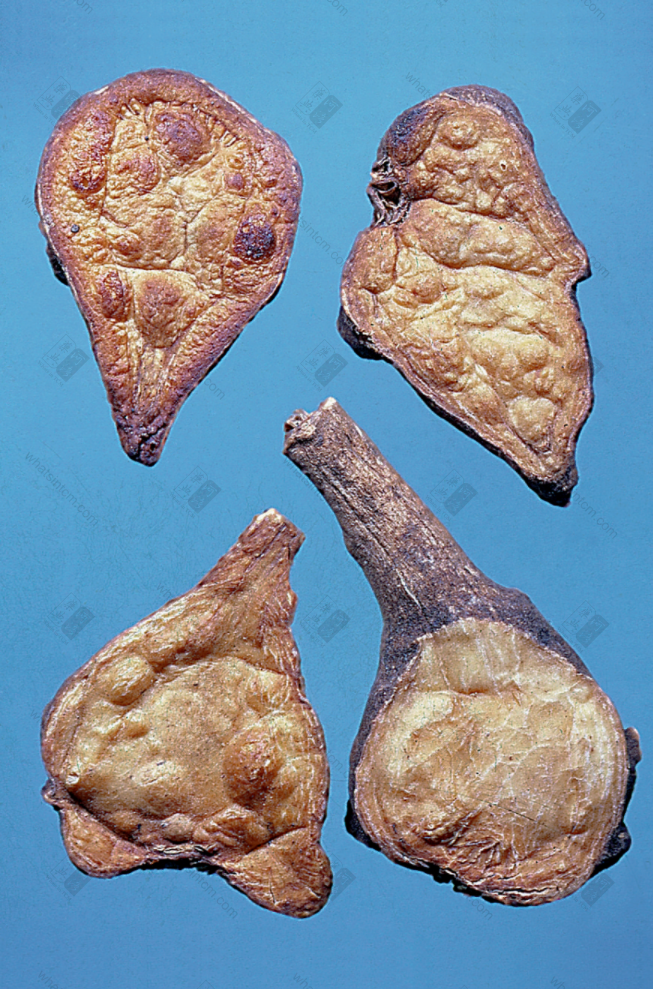 Pao (Baked) Aconite Root (Fu Zi)
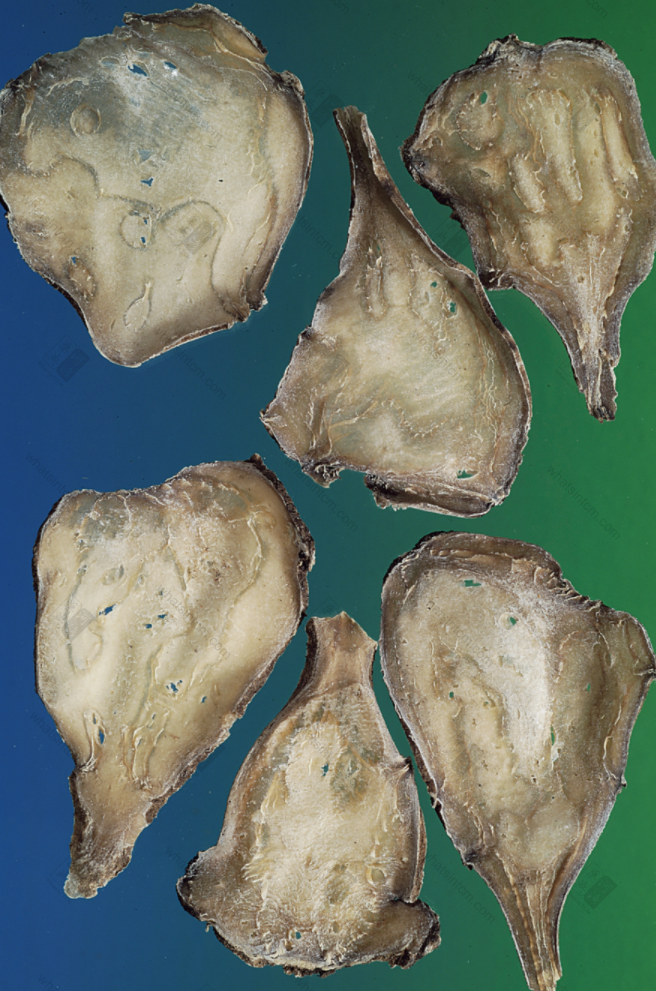 Bei (Roasted) Aconite Root (Fu Zi)
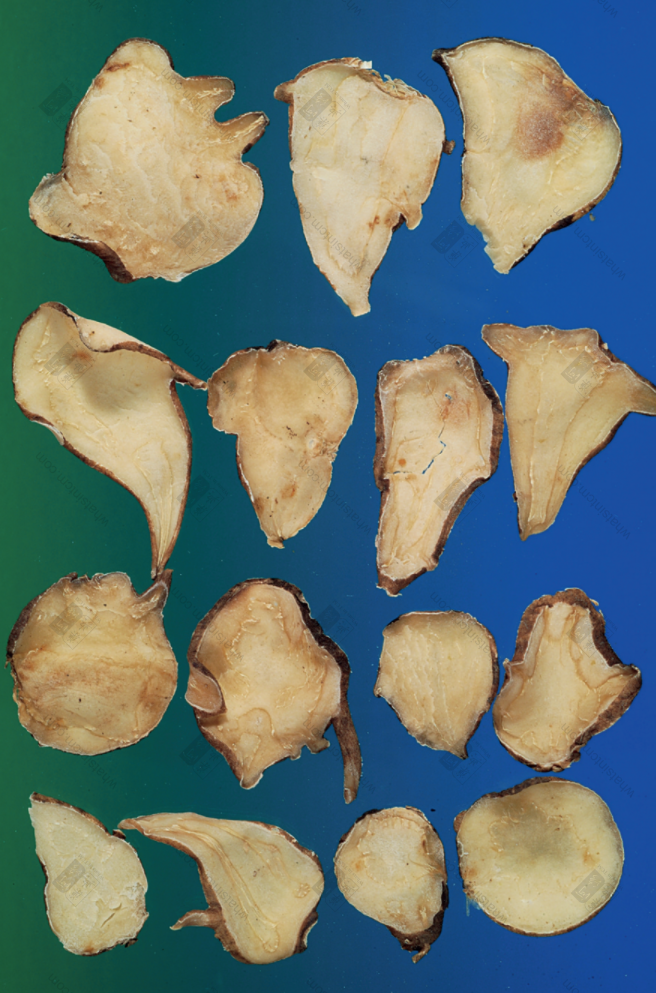 Pao (Planed) Aconite Slice
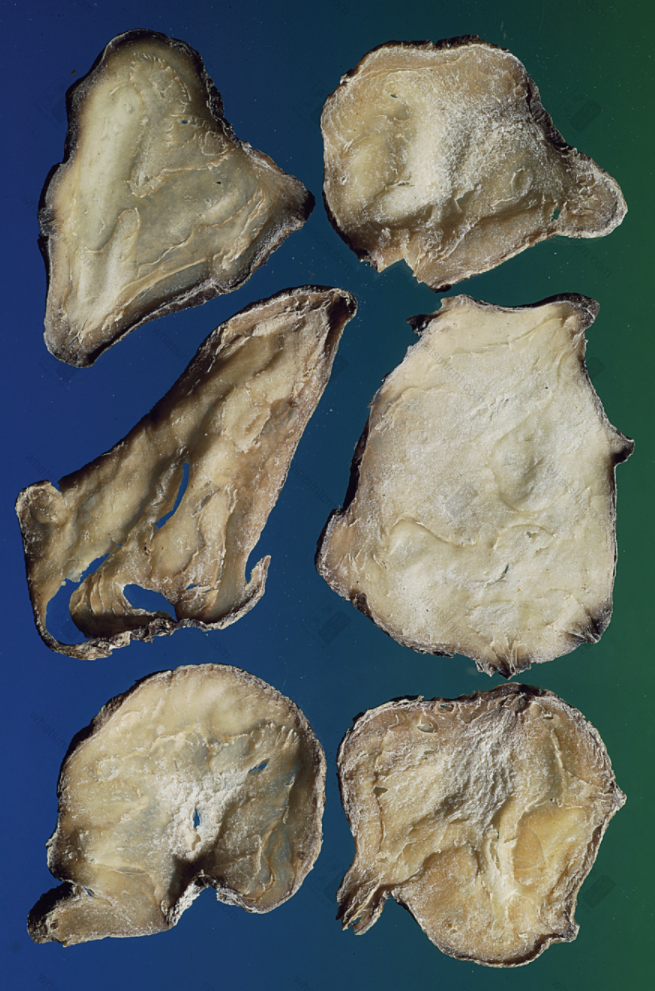 Pao (Planed) Aconite Slice
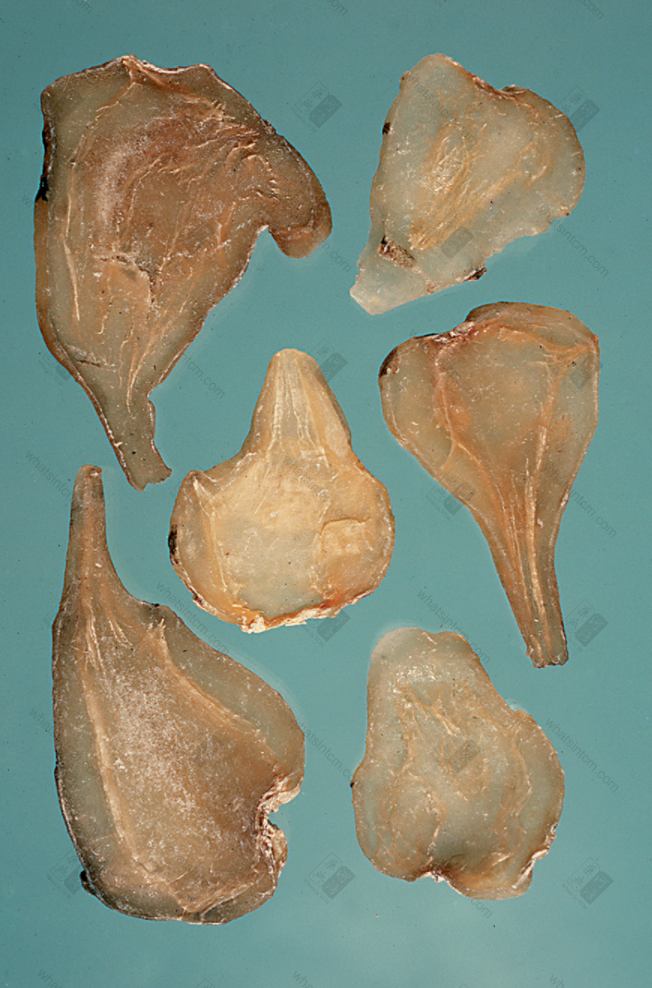 White Aconite Slice (In Taiwan, mistakenly considered Bai Aconite Root (Fu Zi))
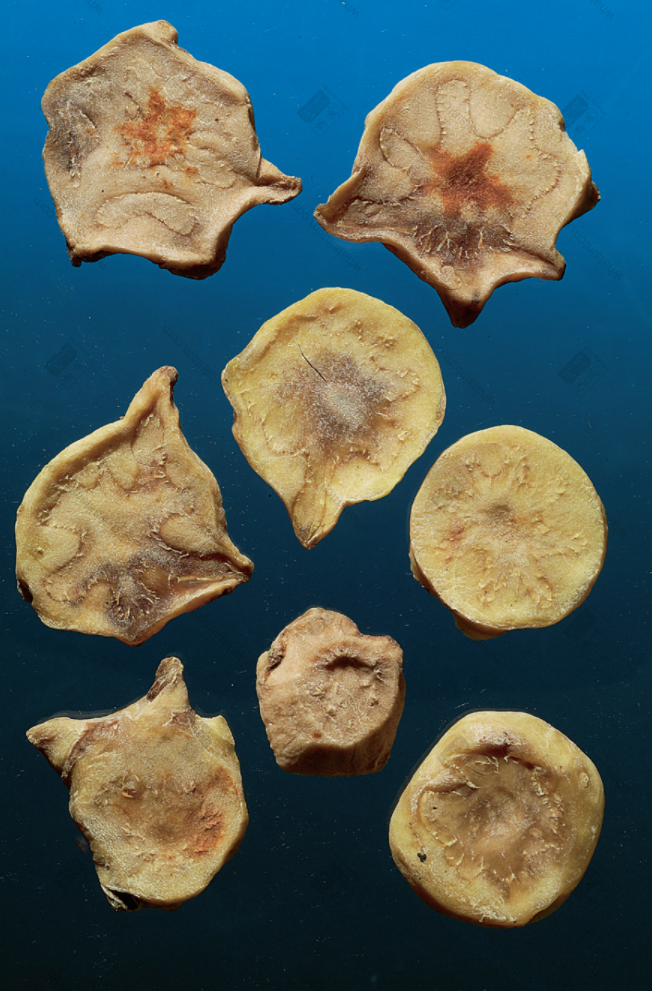 Yellow Aconite Slice
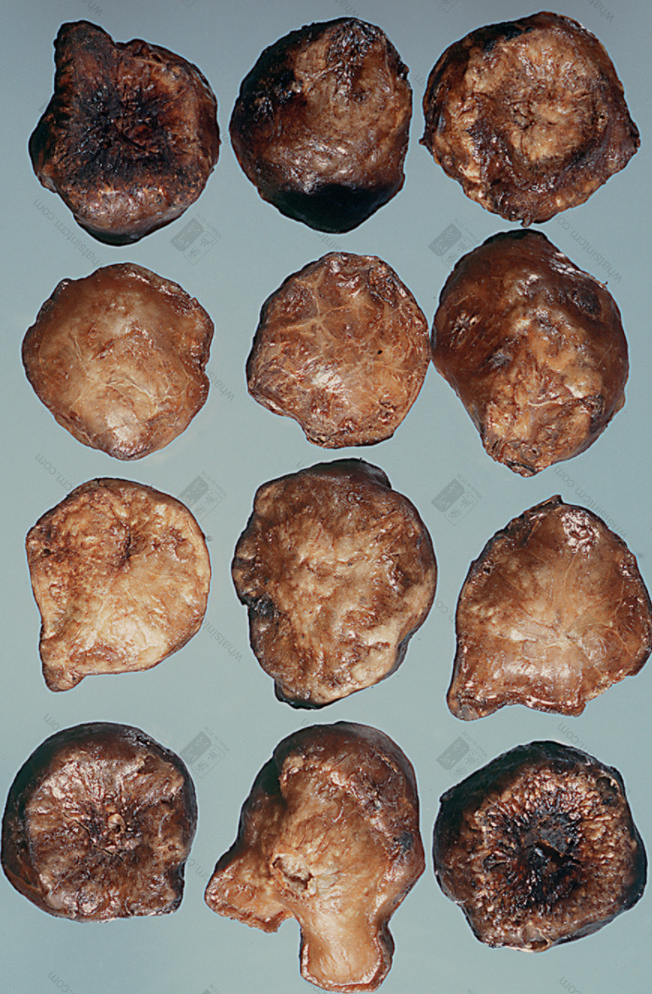 Gua Pian (Divination Slice) (Hanging Slice, nearly round)
【Naming】
【Source】
Shen Nong’s Herbal Classic of Materia Medica, Lower Grade
【Common Usage Level】
A
【Botanical Origin】
Lateral root tubers (daughter roots) of Aconitum carmichaeli Debx. and Aconitum chinense Paxt. of the Ranunculaceae family, after processing.
【Characteristics】
Aconite Root (Fu Zi): Conical in shape, 1.5~5㎝ long, grayish-brown surface with fine longitudinal wrinkles. The upper end has a depressed bud scar, surrounded by multiple nodular raised branch roots, commonly called “Jiao Ding” (corner nails). The side has a scar left from being detached from the mother root. The texture is firm, the cross-section is grayish-white, and powdery.
Salt Aconite Root (Fu Zi): Larger in shape, conical, about 5~8㎝ long and about 3~4㎝ in diameter. The surface is grayish-black, covered with salt frost. The top end is wide and has a central depressed bud scar. The upper part of the body is plump, surrounded by nodular raised branches, commonly called “Ding Jiao” (corner nails). The body is heavy and hard, difficult to break. It becomes soft when damp. The cross-section is grayish-brown, with small gaps full of salt frost and polygonal ring patterns (cambium) visible. Muscle points (vascular bundles) are arranged neatly within the pattern, taste salty, numbing, and spicy.
Processed Pieces: Due to different processing methods, there are several types, including Ming Fu Pian (clear aconite slice), Hei Fu Pian (black aconite slice), Bai Fu Pian (white aconite slice), and Huang Fu Pian (yellow aconite slice).
(1) Bai Fu Pian (White Slice): A transverse slice with the outer skin removed, about 5㎜ thick, appearing yellowish-white to light brownish-yellow, horny, semi-transparent, with visible meridians. The taste is numbing and intensely toxic to the tongue.
(2) Hei Fu Pian (Hei Shun Pian, Black Slice): Irregular longitudinal slices, wide at the top and narrow at the bottom, slightly curled around the edges, 2.5~4㎝ long, 1.5~2.5㎝ wide, and about 5㎜ thick. The outer skin is dark brown, and the inside is dark yellow and semi-transparent, oily, and shiny. The cambium has a conical texture, and the xylem vascular bundles are striped, with longitudinal meridian lines (vascular bundles) visible. The texture is hard and brittle, with a horny fracture surface. Odorless and tasteless.
(3) Pao Fu Pian (Baked Aconite Slice): The surface is slightly swollen and blistered.
(4) Huang Fu Pian (Yellow Aconite Slice): A transversely cut round slice, about 0.4㎝ thick, with a yellow surface.
(5) Shu Pian (Ming Fu Pian, Cooked Slice): Longitudinal or transverse slices, about 3~4㎜ thick, with the outer skin removed, whitish or beige, shiny, horny, and semi-transparent. When viewed against the light, the cambium exhibits conical meridian patterns.
(6) Gua Pian (Divination Slice, Hanging Slice): Aconite Root (Fu Zi) that has been cut in half, with the skin removed. The surface is rock candy-like or brownish, with a smooth, glossy, semi-transparent, and evenly divided block.
【Processing】
1. Salt Aconite Root (Fu Zi) 2. Light Aconite Slice 3. Pao (Baked) Aconite Slice 4. Black Aconite Slice 5. White Aconite Slice 6. Yellow Aconite Slice 7. Gua Pian (Divination Slice, Hanging Slice) 8. Shu Pian (Cooked Slice)
【Identification】
“Zheng Lei Ben Cao” (Classified Materia Medica): “The ones with eight corners are superior.”
“Zheng Lei Ben Cao” (Classified Materia Medica): “Harvest in the first ten days of August, the ones with eight corners are good.”
“Yi Fang Lei Ju” (Collection of Medical Formulas): “Aconite Root (Fu Zi) weighing half a tael is good. Smaller ones are weak, and larger ones are evil. They are not suitable for prescriptions. It is only good to praise their size, but it is unknown if the ancients had rules for this.”
“Yi Fang Lei Ju” (Collection of Medical Formulas): “One black Aconite Root (Fu Zi) weighing one tael is good.”
“Ben Cao Gang Mu” (Compendium of Materia Medica): “The shape of Aconite Root (Fu Zi) is superior when squatting with upright joints and fewer corners.”, “Tian Xiong, Wu Tou, and Tian Xiong are all superior when they are plump and can be grasped.”
“Ben Cao Xin Bian” (Newly Compiled Materia Medica): “Soak thoroughly, no need to remove the skin, navel, or tip. It is best to use the whole thing.”
“Pao Zhi Quan Shu” (Complete Book of Processing): “The ones with a round and upright top and a flat bottom are good.”
“Jing Yan Dan Fang Hui Bian” (Compilation of Experienced Elixir Prescriptions): “Aconite Root (Fu Zi), with a flat top, flesh like iron, and moist is good.”
“Ben Cao Qiu Zhen” (Seeking Truth in Materia Medica): “The ones with black skin, a round body, a flat bottom with eight corners, and weighing three taels are good.”
“Liang Lie Jian Bie” (Discriminating Good and Bad): “The large ones are like chicken eggs, and the small ones are like Bai Xie (Garlic Bulbs), and the large ones are more valuable. The best is sixteen pieces per catty, and the small ones with white interiors are also good.”
1. Salt Aconite Root (Fu Zi) is good when it is large, firm, and has salt frost on the surface.
2. Hei Shun Pian (Black Aconite Slice) is good when the slices are uniform and have an oily and shiny surface.
3. Bai Fu Pian (White Aconite Slice) is good when the slices are uniform, yellowish-white, oily, and semi-transparent.
【Identification Terminology】
1. Da Fu (Large Aconite): Specifically refers to first-class Salt Aconite Root (Fu Zi).
2. Tian Xiong (Celestial Male): Currently refers to third-class Salt Aconite Root (Fu Zi), Aconite Root (Fu Zi) that is 10~13㎝ long. This has a different meaning from the ancient “Tian Xiong.” The ancients referred to large and long Aconite Root (Fu Zi) tubers. Modern “Tian Xiong” refers to smaller Aconite Root (Fu Zi). In Hong Kong, Tian Xiong refers to large Aconite Root (Fu Zi).
3. Ba Er (Plucking Ears): Refers to small Aconite Root (Fu Zi) that sprout and regenerate from the Aconite Root (Fu Zi) and rhizome. Two Aconite Root (Fu Zi) slices processed from these are called “Ba Pian” (Plucking Slices) or “Ba Er Pian” (Plucking Ear Slices).
4. Bai Ding Pian (White Top Slice): A processing specification of Aconite Root (Fu Zi), which is thin Aconite Root (Fu Zi) slices processed from small Ni Fu (mud aconite), and are semi-transparent.
5. Ni Fu (Mud Aconite) (Sheng Fu, Raw Aconite): Refers to raw Aconite Root (Fu Zi) herbs that have just been dug out.
6. Ding Jiao (Corner Nails): Generally refers to the nodular raised branches surrounding Aconite Root (Fu Zi), Chuan Wu (Radix Aconiti), and Cao Wu (Radix Aconiti Kusnezoffii), commonly called “Ding Jiao.”
7. Ge Gao Zi: Refers to tubers that grow in even numbers on the left and right sides of the Aconite Root (Fu Zi), a historical term.
8. Ce Zi: Refers to small tubers attached to Tian Xiong and growing, a historical term.
9. Chao Xiong: Specifically refers to second-class Salt Aconite Root (Fu Zi).
10. Hei Ding Pian (Black Top Slice): A processing specification of Aconite Root (Fu Zi), which is thick Aconite Root (Fu Zi) slices processed from medium-sized Ni Fu (mud aconite).
11. Lou Lan Zi (Leaky Basket): Refers to small, newly grown Aconite Root (Fu Zi). It is named because it is too small to be placed in a basket and can leak out.
12. Dan Aconite Root (Fu Zi): A processing specification of Aconite Root (Fu Zi), which is made by soaking washed Ni Fu (mud aconite) in bile water (a magnesium chloride solution).
13. Dun Zuo Zheng Jie (Squatting Upright Joints, Sitting Securely): Good quality, when placed on a table, it sits steadily and securely. This is a saying from the “Gang Mu” (Compendium).
14. Salt Aconite Root (Fu Zi): A processing specification of Aconite Root (Fu Zi), which is made by soaking washed Ni Fu (mud aconite) in a mixed solution of bile water and salt water.
【Chapter】
Roots
Related Products
