



Lotus Root Node
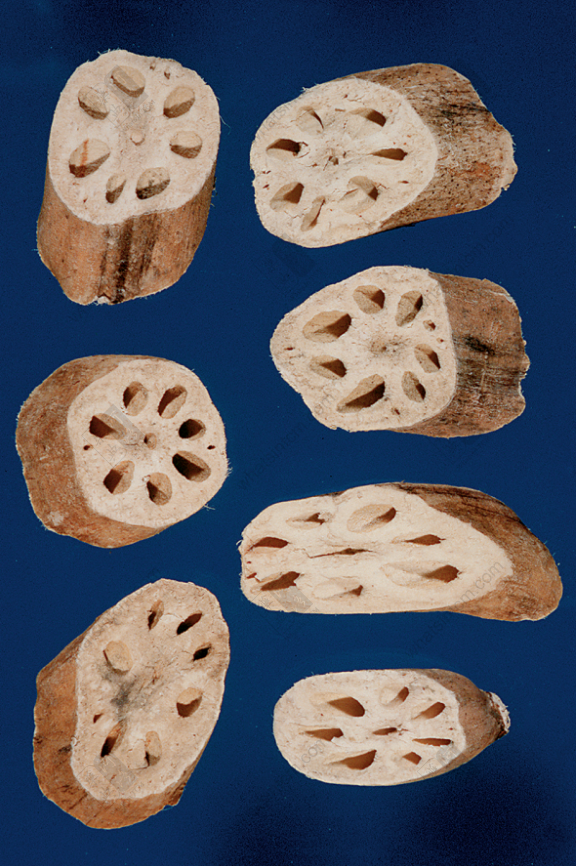 Lotus Root Node (mostly large round holes)
[Naming]
[Source]
Shen Nong’s Classic of Materia Medica, Superior Class
[Common Usage Level]
C
[Botanical Origin]
The rhizome nodes of the lotus plant Nelumbo nucifera Gaertn. (family Nymphaeaceae).
[Characteristics]
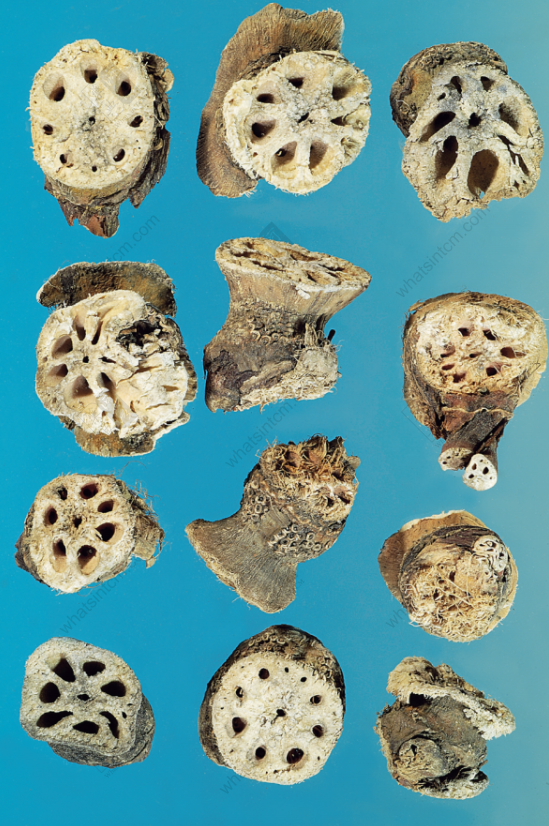
The dried lotus root node is a short cylinder, about 2-4 cm long and about 2 cm in diameter. The surface is yellowish-brown to grayish-brown, and the central node is slightly enlarged, with many residual fibrous roots and root scars. The surface of the internodal part remaining at both ends of the node has longitudinal lines.
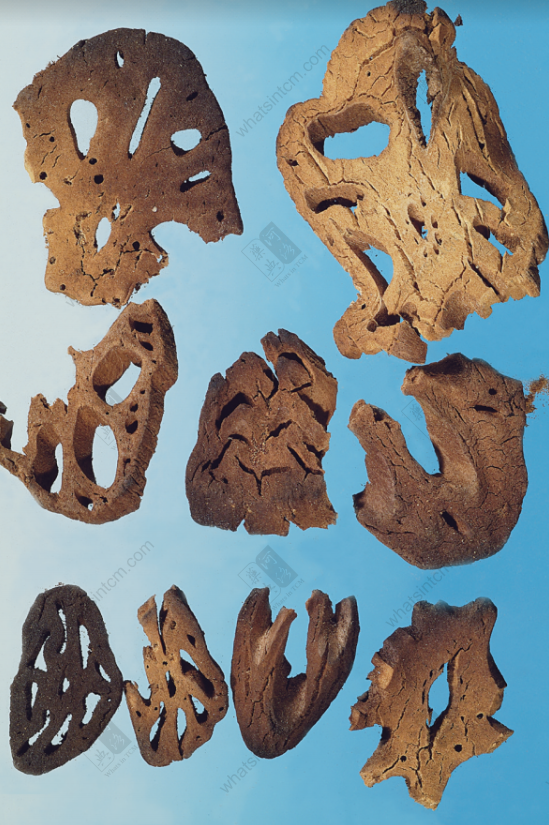
Prepared slices are oblique, grayish-yellow or yellowish-brown. The cut surface has many large round holes, the body is light, odorless, and the taste is sweet and astringent. Charred lotus root node has a charcoal black surface and a brownish-yellow interior.
[Processing]
1. Fresh Lotus Root Node 2. Lotus Root Node 3. Charred Lotus Root Node
[Identification]
Ming Yi Bie Lu: “Lotus root stems are found in ponds and marshes everywhere, but those grown in Yuzhang and Runan counties are the best.” Zheng Lei Ben Cao: “White lotus roots are the best.”
The best are those with dark brown nodes, white ends, dry, and without fibrous roots or mud.
[Category]
Rhizomes