



Rhinoceros Horn
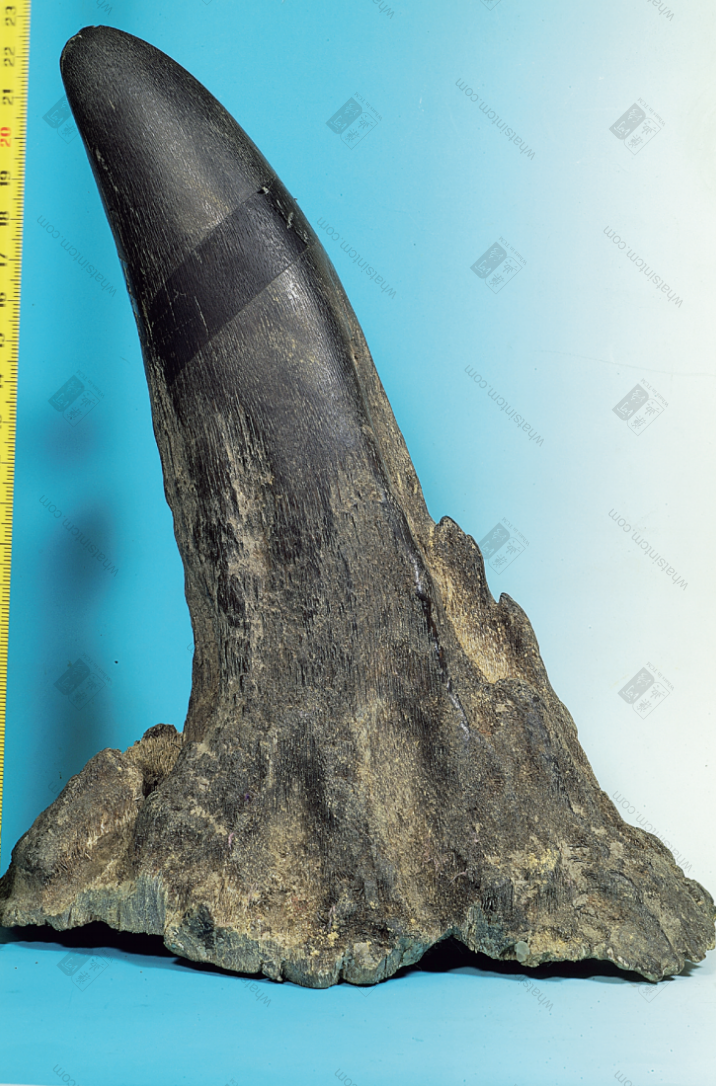 Indian Rhinoceros Horn (Tooth-like edge, Celestial groove, Terrestrial prominence, Sesame seed spots) (Actual height 23cm, Total height 27cm, 905gm)
【Name】
【Source】
Listed as a medium-grade herb in the Classic of Herbal Medicine
【Common Usage Level】
B
【Botanical Origin】
Horns of Rhinoceros unicornis L. (Indian rhinoceros), Rhinoceros sondaicus Desmarest (Javan rhinoceros), Rhinoceros sumatrensis Cuvier (Sumatran rhinoceros), Rhinoceros bicornis L. (African rhinoceros), or Rhinoceros sinus Cottoni (White rhinoceros). Indian and Javan rhinoceros have one horn; Sumatran, African, and White rhinoceros have two horns.
【Characteristics】
1. Fire Horn (also known as Black Horn or Loro Horn): This is the horn from Asian rhinoceroses such as the Indian rhinoceros, Javan rhinoceros, and Sumatran rhinoceros. The horn is conical, tapering from the base upwards, slightly curved, and varies in length, with larger ones reaching up to 30 cm. The surface is black, gradually becoming lighter towards the lower part, appearing grey-brown. The base has tooth-like serrations around the perimeter, known as “tooth-like edges,” about 3 cm high, with an uneven surface. Above the “tooth-like edges” towards the middle, there are longitudinal lines and cleaned, hard, straight thorns, commonly known as “bristles,” sometimes with cracks. The middle part is smoother upwards, with the horn tip rounded and shiny, showing bristle-like round dots. On the front of the horn, there is a longitudinal groove, about 9-15 cm long and 3 cm deep, commonly known as the “celestial groove.” Below it, on the opposite base, there is a prominent high ridge, about 6-7 cm long and 2-4 cm high, commonly known as the “terrestrial prominence.” The base is relatively large, oblong, narrow at the front and wide at the back, shaped like a turtle shell, 13-20 cm long, 11-14 cm wide, grey-black or black-brown, gradually lightening outwards to grey-brown or grey-yellow. The bottom surface is concave by 3-6 cm, commonly known as the “socket,” and is covered with bristle-like round dots, commonly known as the “sandy base.” The horn material is hard, but when split longitudinally, it is always along the grain, without any twisted strands. Shavings are grey-white, with sesame flower spots or short line patterns. The odor is slightly fragrant and not fishy, with a slightly salty taste.
2. Water Horn (also known as Broad Horn, Pillar Horn, or Heavenly Horse Horn): This is the horn of African or White rhinoceroses. The horn shape is large, reaching about 60 cm, tapering from the base upwards, rounder in the middle, and slightly curved at the top, with the tip slender and slightly flattened. The upper part is grey-black, and the lower part is grey-yellow; commercial products are often painted glossy black. The base is round, the socket is shallow, the sandy base is not obvious, and there are coarse hairs around the base, sometimes with scorch marks. There are no celestial groove, terrestrial prominence, or tooth-like edges, the upper part is grey-black, and the lower part is grey-yellow. The longitudinal section also mostly has straight grains, but with twisted strands. It has a fishy smell. It is also sometimes sawn into irregular small pieces.
Side pieces: Mostly sawn longitudinally on both sides, the cross-section is slightly smooth, and the grain is dense and fine. The middle is grey-black, and the surrounding area is bluish-white or yellowish-white, translucent. Broad horn petals: These are irregular pieces sawn from the horn during the processing of utensils.
3. Small Rhinoceros Horn: Also known as “Mushroom Head,” it is the small horn on top of the rhinoceros, found in both Asian Fire Rhinoceros and African Water Rhinoceros.
The Sumatran rhinoceros has a small horn growing from the top. The base is round, 3-9 cm in diameter, and the top is round, resembling a “small steamed bun,” dark black and shiny, with the lower half lighter in color and often with longitudinal cracks. The “socket” is shallow, and the “sandy base” is finer. The longitudinal section has coarse grains, showing straight grains, without cloudy grains, and is mostly grey-black. Shavings are mostly curved. The taste is slightly turbid.
【Processing】
1. Rhinoceros Horn Slices 2. Rhinoceros Horn Powder
【Identification】
“Only the raw (unprocessed) is the best” – *Annotations to the Materia Medica*.
“All rhinoceros horns that have become finished products have been steamed and boiled, making them unsuitable for medicinal use. Only raw ones are the best,” and “the superior ones are good” – *Newly Revised Materia Medica*.
“The value depends on the coarseness of the grain. The most valuable horns have through-heaven patterns.” – *Illustrated Materia Medica*.
“There are nose horns and head horns, with the nose horn being superior,” and “it is best to have black, coarse-textured, wrinkled, cracked, and shiny surfaces,” and “rhinoceros horn tips are best ground for oral administration,” and “those from the Western Regions are good,” and “rhinoceroses have two horns, with the one on the forehead being superior,” and “black ones are superior.” – *Classified Materia Medica*.
“Rhinoceros horn tips are best ground for oral administration.” – *Materia Medica Derivatives*.
“Generally, black is considered the true color, and it is valued for its likeness to objects.” – *Compendium of Materia Medica*.
“[Song says] All rhinoceros horns used in medicine are of two types, black and white, with black being superior,” and “it is best to grind raw rhinoceros horn from the Western Regions for oral administration,” and “raw rhinoceros is not only unprocessed by water and fire, but also those that are captured and killed are superior.” – *Compendium of Materia Medica*.
“For medicinal use, use the black tip, raw ones are the best.” – *Complete Book on Preparation and Roasting*.
“True rhinoceros horn is bright and fragrant.” – *Compilation of Experienced Prescriptions*.
“Siam rhinoceros horn, pound it, add <a href='https://whatsintcm.com/dt_articles/硃砂/’>Cinnabar and grind it with water, the one with the Guanyin face is good.” – *Continued Medical Case Records*.
“Pound it into shavings and rub it with a hot palm, the fragrant one is genuine.” – *Essential Materia Medica*.
“White rhinoceros horn, the one that is white all over is good.” – *Miraculous Life-Saving Formula*.
“For medicinal use, raw, male rhinoceros horn tips are the best.” – *Concise Essential Formulas*.
“When using, select those with black horn material, wrinkled, cracked, and shiny surfaces. Grind it finely in a mortar, or filter the powder directly, or take the tip and grind it with water to extract the juice, which is especially good.” – *Differentiation of Added Herbs*.
The best ones are black, shiny, complete without cracks, with a grey-black sandy base, large bristles, and a fragrant odor. Fire rhinoceros horn is firm and heavy, with a rough exterior, high gelatin content, and brittle. It is dark brown in color, easy to split open, with straight, coarse grains, and clear texture. Its longitudinal section is fibrous with longitudinal grains, without intertwined threads. The rhinoceros horn base is complete, and the edge of the base does not have drum nails. When shaved into thin slices along the longitudinal grain and viewed against sunlight, transparent spots (called sesame spots) can be seen. The quality of rhinoceros horn can also be determined by its patterns. The top-grade has “through-heaven” patterns, and the extremely high-grade has “hundred-bird” patterns. Horn shavings are smooth and brown on both sides; horn base shavings are yellow-gelatinous and shiny. The thin slices are easily broken, almost tasteless and odorless, and have a special aroma when ground or burned. When a small piece or fine powder is placed in water and heated, it emits a very special gelatinous odor.
Water rhinoceros does not have the above characteristics. When split open, the color is light grey-yellow, the grain is straight and finer, and the grain lines are whitish. Numerous colorless, transparent, small round bodies can be seen. For fire rhinoceros horn, the diameter of the round bodies is 500-1000 microns (a unit for measuring length under a microscope, called micron, abbreviated as μ, which is 1/1000 millimeter), with a small hole in the center, and the space between the round bodies is brown. For water rhinoceros horn, the round bodies are smaller, with a diameter of about 200-400 microns, and the space between the round bodies is light brown. If using a high-magnification magnifying glass, prepare standard samples of fire rhinoceros and water rhinoceros for comparison to distinguish them.
The main differences between fire rhinoceros and water rhinoceros: the tip of fire rhinoceros is slender and round. The base is turtle-shell-shaped (narrow in front and wide in back), with a celestial groove, terrestrial prominence, and tooth-like edges. The tip of water rhinoceros is slender and slightly flattened, the base is round, and there are no celestial groove, terrestrial prominence, or tooth-like edges. Fire rhinoceros horn has a brittle texture, easily splitting open with a knife, with vertical grains and coarse strands. Water rhinoceros has a harder texture, not easily split open, and has solid, cohesive fine strands after splitting, with a slight curve. The following terms are all characteristics of fire rhinoceros (Asian rhinoceros).
【Identification Terms】
1. Celestial Groove: A longitudinal groove on the front of the rhinoceros horn, near the base to the middle, above the tooth-like edges.
2. Terrestrial Prominence: A ridge-like elevation protruding along the front-to-back direction on the base of the rhinoceros horn, opposite the celestial groove.
3. Sesame Seed Spots: The tips of the rhinoceros horn strands have dense round bristle spots, or there are dark brown small dots on the shaved surface of the grey-white shavings, which are transparent when viewed against light and have a sesame fragrance when rubbed or soaked in boiling water, called “sesame seed spots.”
4. Bristles: Hard, prickly, hair-like or bristle-like substances exposed on the circumference of the base of the rhinoceros horn (tooth-like edges).
5. Tooth-like Edges: The circumference of the base of the rhinoceros horn is blunt-toothed, uneven, shaped like horse teeth.
6. Coarse Strands: The rhinoceros horn strands are coarse, straight, and cohesive, easily splitting longitudinally, without intertwined strands.
7. Smooth Horn: Another smaller horn growing on the top of the rhinoceros’s head.
8. Honeycomb Base (Sandy Base): The bottom of the rhinoceros horn socket is covered with needle-hole-like fine holes, bristle-like round dots, called “sandy base.” Shaped like a honeycomb.
9. Socket: The inside of the rhinoceros horn base is concave towards the center, shaped like a funnel.
10. Turtle-Shell Base: Refers to the rhinoceros horn base being oval, wide, narrow in front and wide in back, shaped like a turtle shell.
11. Bristle Eyes: Fine needle-hole-like eyes on the bottom of the rhinoceros horn socket.
12. Mushroom Head (Mushroom Horn, Small Rhinoceros Horn): The small horn on top of the rhinoceros, found in both Fire Rhinoceros and Water Rhinoceros.
【Category】
Vertebrate Animals