



Magnetite
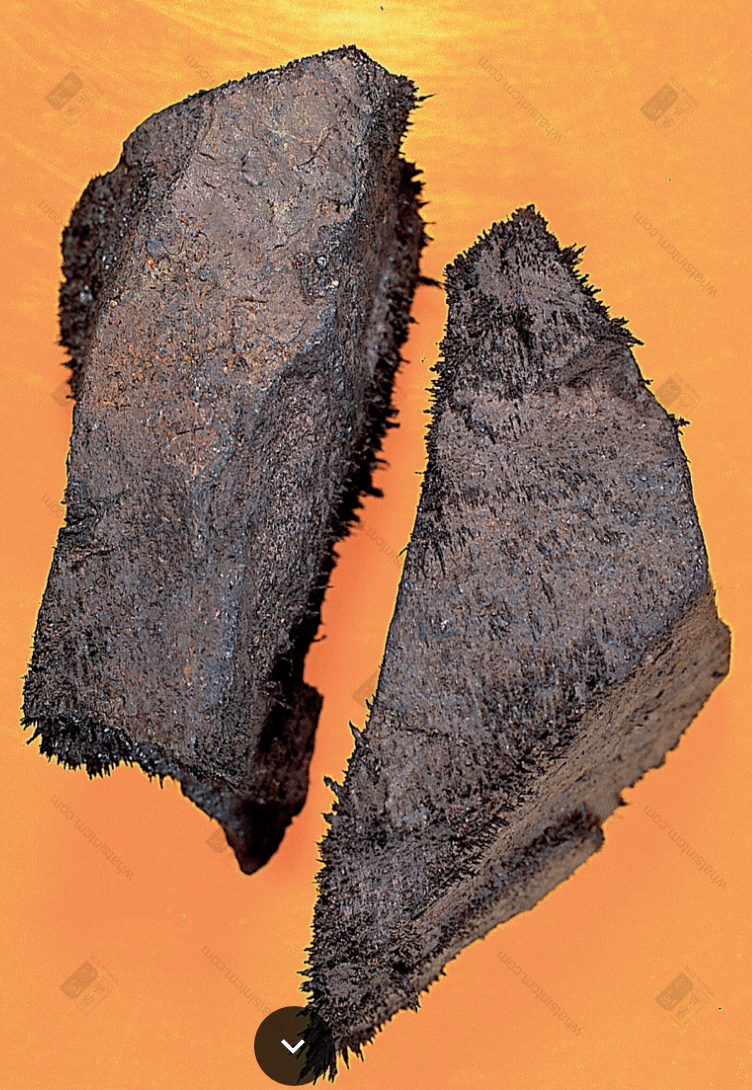 Magnetite (Magnetic) (Blocks, polyhedral, iron-black, uneven granular fracture, magnetic, attracts iron powder into a furry upright shape)
【Name Origin】
【Source】
Shen Nong’s Classic of Materia Medica, Middle Grade
【Frequency of Use】
D
【Botanical Source】
Magnetic iron ore.
【Characteristics】
It occurs as irregular masses, mostly with edges and corners; the outer surface is iron-black to brownish-black, opaque, with a metallic luster; it shows bright spots like fine wrinkles. It is heavy (specific gravity 5.17~5.18) and hard, with a hardness of 5.5~5.6; it is brittle, dense, has a earthy odor, and is tasteless. If iron powder is placed on it, it is immediately attracted into a furry upright shape, hence the name “live magnetite.” A reddish-brown color without luster is due to rust from moisture and often has no iron-attracting ability.
Calcined magnetite: It is irregular small pieces, unequal in size, some are granular, brownish-brown, and have a slight vinegar smell.
【Identification】
《Annotations to Materia Medica》: “It can suspend and attract needles, preferably connecting three, four, or five in a chain.”
《Compendium of Materia Medica》: “It can suspend and attract needles, preferably connecting three or four.”
《Essential Uses of Medicinal Properties》: “The best is the one that can attract iron.”
《Seeking Truth in Materia Medica》: “The true one is black in color and can attract iron.”
The stronger the ability to attract needles and sand, the better; those that cannot attract are not qualified.
【Identification Terminology】
(Modern) 1. Magnetism: Refers to the property of a mineral that can be attracted by a magnet or electromagnet, or can itself attract iron objects, such as magnetite.
【Category】
Minerals