



Sappan Wood
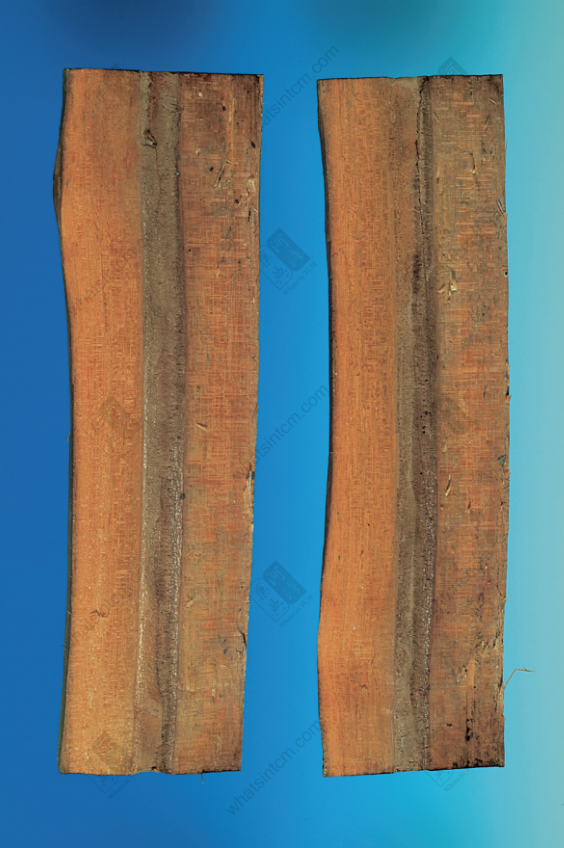 Sappan Wood (Heartwood is hard, red-orange-yellow-brown, with alternating red and yellow longitudinal stripes, pigment oil pores)
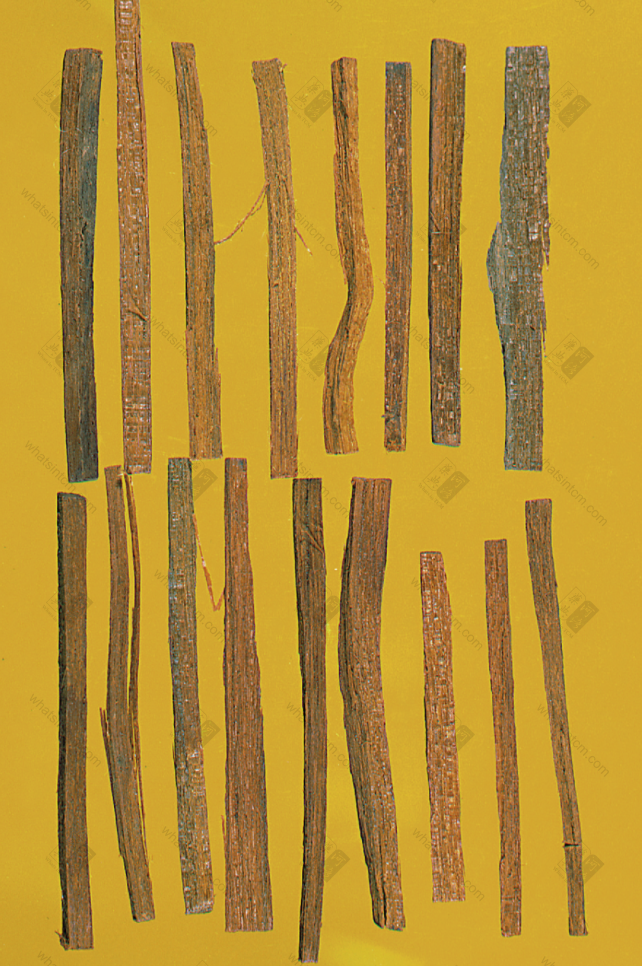 Sappan Wood Slices
【Naming】
【Source】
Newly Revised Materia Medica (Xin Xiu Ben Cao)
【Common Usage Level】
C
【Botanical Origin】
The dried heartwood of the legume Caesalpinia sappan L.
【Characteristics】
This product is in the form of a long, cylindrical stick, varying in length, generally about 10~40cm long, with a few around 5cm, and a diameter of 3~6cm. The outer surface is reddish-yellow to dark red in color. It is hard and heavy in texture, with knife marks. The cross-section is reddish-yellow with strong fibrousness, and the central part has a dark red pith. The transverse (sawn) section has concentric rings in a roughly circular shape, with a yellowish-white pith in the center and visible sparkling small silver stars. It has no odor and a slightly sweet taste.
Processed slices: These are irregularly shaped, elongated shavings, about 0.5mm thick and varying in width, usually around 1cm wide. The entire piece is reddish-yellow or yellowish-brown, with some pieces having whitish sapwood. The surface has longitudinal striations and is brittle and easily broken. It turns peach-red when placed in hot water.
【Identification】
《Zheng Lei Ben Cao》: “For breaking blood, it is best to boil it in wine.” 《Yi Fang Lei Ju》: “Sappan wood. For breaking blood, it can be boiled in wine.” 《Liang Lie Jian Bie》: “The wood with a deep red heart inside is superior, and the young wood with a yellowish-red color is useless.”
It is best to use branches that are thick, solid, and completely red. The decoction of this product is reddish-yellow when fresh, and turns red when left for a long time or when exposed to alkali, and turns yellow when exposed to acid. This is the reaction of Brazilin (Sappan Wood pigment).
【Category】
Vines and Wood