



Castor Seed
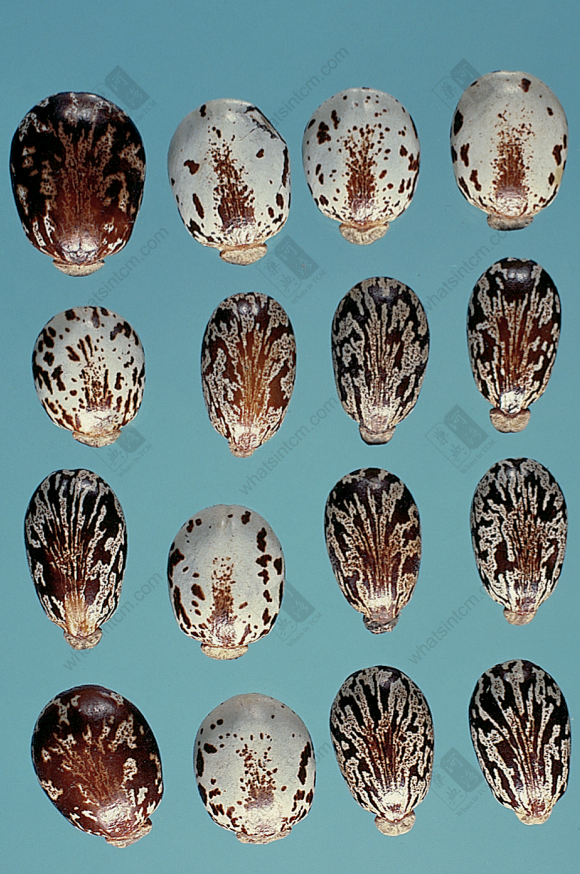 Castor Seed (Oval, ovoid, slightly flattened, smooth surface with mottled patterns, one end protruding like a sponge, hard and brittle with a thin seed coat, hilum and chalaza ridge are obvious)
[Naming]
[Source]
Newly Revised Materia Medica
[Common Usage Level]
E
[Botanical Origin]
Dried ripe seeds of Ricinus communis L. of the Euphorbiaceae family.
[Characteristics]
The seeds are slightly flattened, broadly ovoid, 8-18mm long, and 6-9mm in diameter. The ventral surface is flat, and the dorsal surface is slightly raised. One end has a sponge-like protruding caruncle, and the seed ridge between the hilum and the chalaza is obvious. The outer seed coat is smooth, shiny, and displays alternating light reddish-brown mottled patterns. The texture is hard and brittle. The inner seed coat is a white thin membrane that encloses the white, oily endosperm. The cotyledons are two, thin and flimsy. The odor is faint, and the taste is oily.
[Identification]
《Hui Zhitang’s Experienced Prescriptions》: “Castor seed kernel, the red-shelled ones are better.”
The large, plump, reddish-brown, and shiny ones are considered the best.
[Identification Terminology]
1. Mottled Pattern: Generally refers to the patterns on the surface of fruits or seeds used as medicinal materials, such as the marble-like mottled pattern on the surface of Castor seeds.
[Category]
Seeds