



Otter Liver
【Naming】
【Source】
Annotations to the Materia Medica Classic (Bencao Jing Ji Zhu)
【Common Use Degree】
F
【Origin】
It is the liver of the otter, *Lutra lutra Li aeus*, an animal of the Mustelidae family.
【Characteristics】
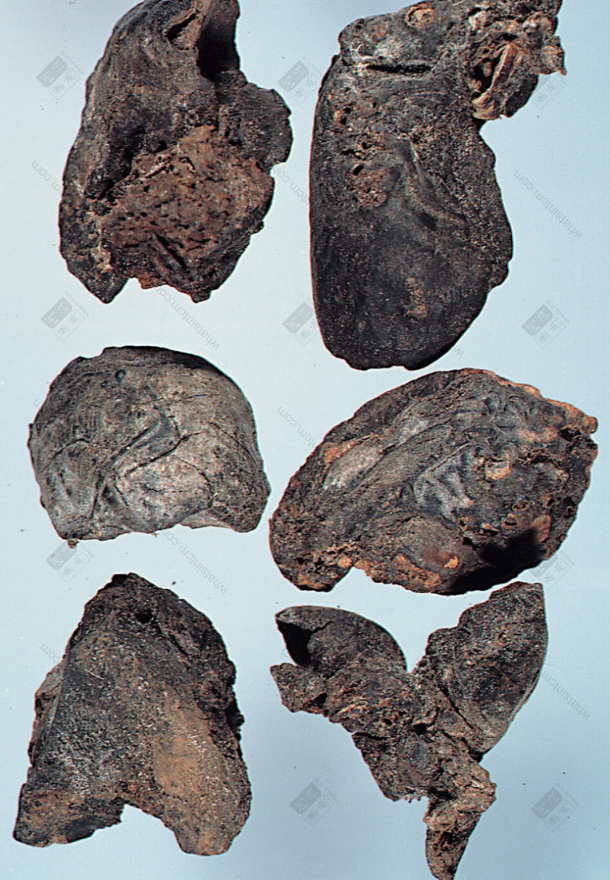
The dried liver appears as masses of varying sizes, often connected to the heart, lungs, and part of the trachea, reaching about 13cm in length (including the heart and lungs). The liver is located below the heart and lungs, connected by a large blood vessel in the middle. The liver is divided into 6-7 lobes, each 4-6cm long and 2-4cm in diameter, dark brown, flat and round, with thinner edges. Viewed from the front, the left and right sides are symmetrical with three lobes, while the other two lobes are smaller and grow below the right side. In the middle of the three lateral liver lobes on both sides is an artery, approximately 1cm in diameter. Above the artery, towards the back, there is a pair of orange-segment-shaped nodules, tightly arranged from 5-20 small nodules. This is a characteristic feature of the product. The lungs are located above the liver, divided into 6 lobes (2 on the left and 4 on the right), gray-brown in color, with a thicker trachea in the middle. Behind and below the trachea is the heart, which is dark brown. The texture is hard and not easily broken, with a dark brown, gelatinous cross-section. It has a fishy odor.
In addition to the above-mentioned species, the liver of the Asian small-clawed otter, *Aonyx cinerea Illigen*, is also used in medicine.
【Identification】
The best quality is dry, purplish-red, whole or in pieces, without broken or residual meat.
【Category】
Vertebrates