


Plants Common in Christmas Wreaths Are Also Common Chinese Medicines for Strengthening Bones
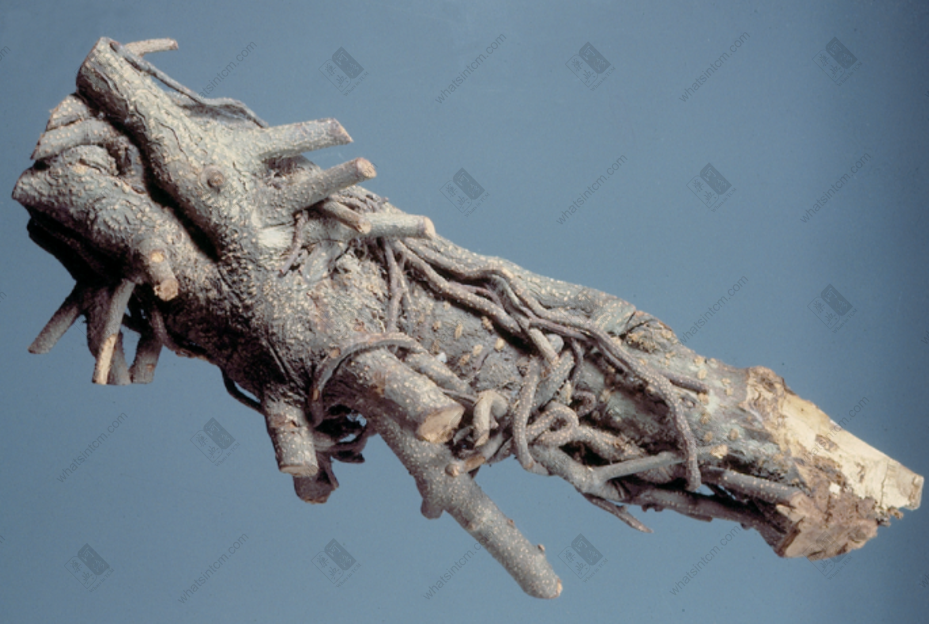 Mulberry Mistletoe: Cylindrical and twisted, reddish-brown, young branches are hairy, and the texture is hard.
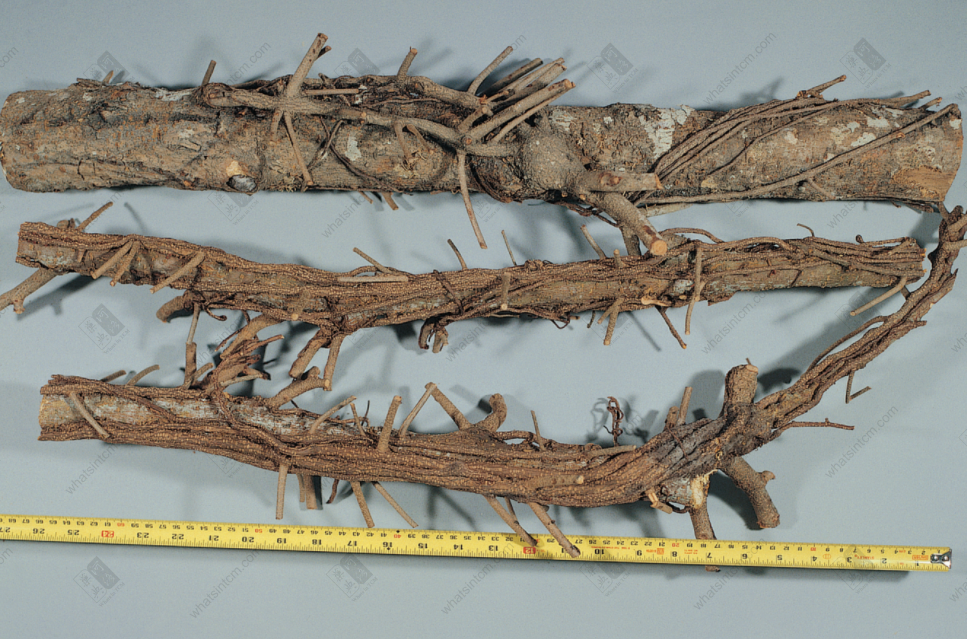 Raw Mulberry Mistletoe.
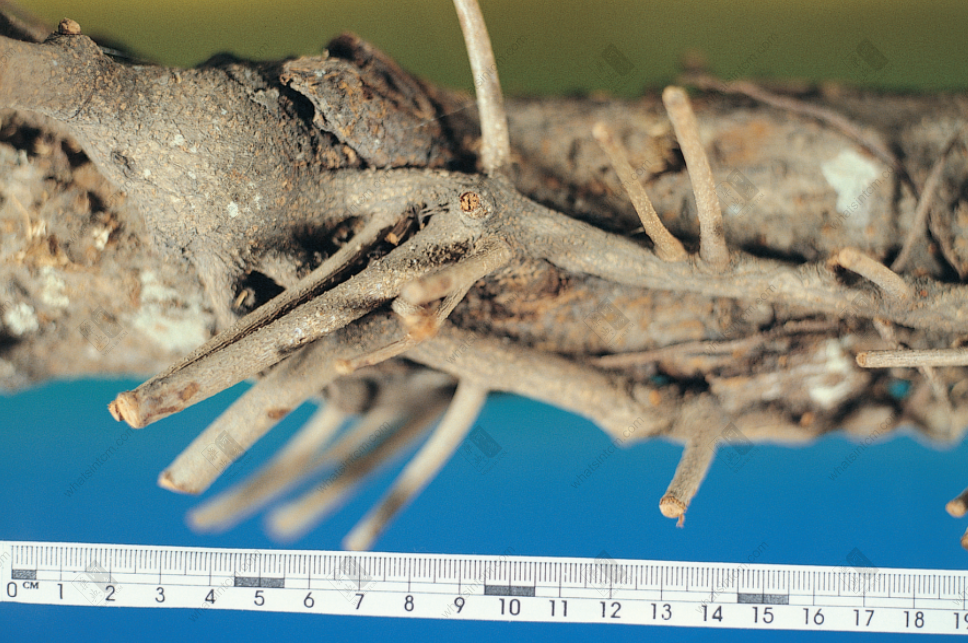 Mulberry Mistletoe: The surface is reddish-brown or grayish-brown, with numerous small raised brown lenticels.
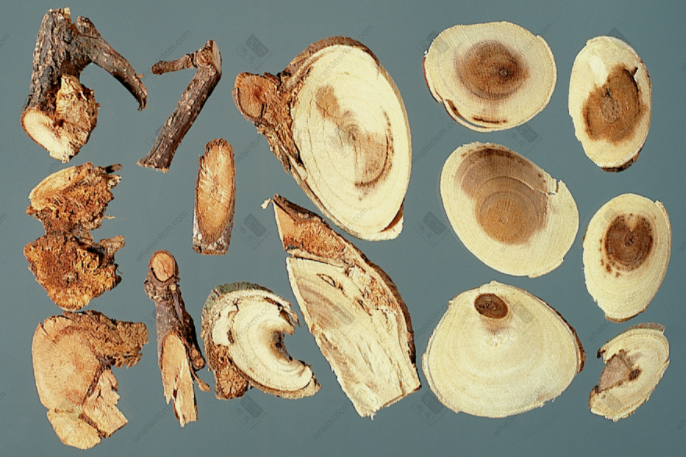
Left: Section of Mulberry Mistletoe. Right six slices: Section of parasitic Mulberry branches.
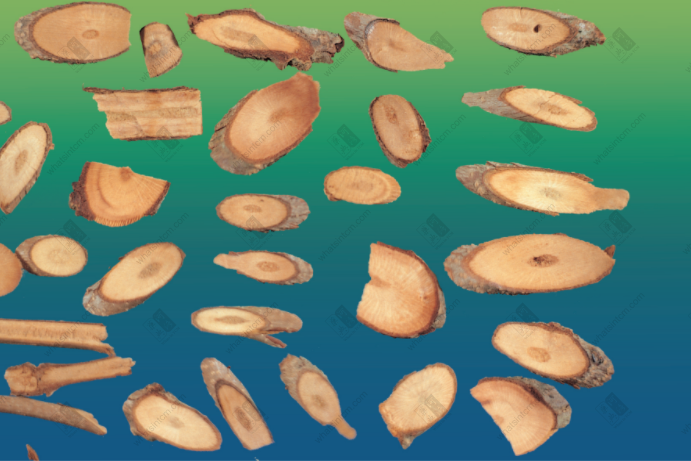
Section of Mulberry Mistletoe.
“The clouds have dispersed, and the shadows of trees have shifted. It is the time for the master to lean on his staff. The old wolf walks with its new-born cub, and parasitic branches emerge from the empty mulberry. Do not think that the physician only carries medicine in his bag. The diviner predicts the future with his蓍(yarrow stalks). Who says there is no suffering in the human world? Yet, the ancient customs remain peaceful and harmonious.” Lu You (Southern Song Dynasty)
The first four lines of this poem depict the vitality of nature, with “parasitic branches emerging from the empty mulberry” highlighting the belief in self-improvement. The last four lines express the poet’s concern for the nation and its people.
According to the fourth edition of the Taiwanese Pharmacopoeia, Mulberry Mistletoe (https://whatsintcm.com/en/dt_articles/sang-ji-sheng-taxillus-chinensis/) is the dried, leaved branches of the *Taxillus chinensis* (DC.) Danser, a plant in the Loranthaceae family. Mulberry Mistletoe is primarily produced in Guangdong, Guangxi, Fujian, Taiwan, and other regions. It is usually harvested in winter or early spring of the following year. Coarse stems are removed, fine branches are cut into sections, and then sun-dried directly or steamed before drying. Because it grows parasitically on mulberry trees, it is also called “parasitic on mulberry.” The *Shen Nong Ben Cao Jing* (Classic of Materia Medica) records: “It tastes bitter and is neutral in nature. It treats lumbar pain, stiff back in children, carbuncles, secures the fetus, plumps up the skin, strengthens hair and teeth, and promotes the growth of beard and eyebrows.” This shows its diverse efficacy. The medicinal material’s stems and branches are cylindrical and vary in thickness, with a reddish-brown or grayish-brown surface, numerous small raised brown lenticels, and young branches that may have brown villi. The cross-section shows a reddish-brown cortex and a lighter-colored xylem. The leaves are mostly fragmented and curled, usually yellowish-brown, with young leaves covered in fine villi. The smooth leaf margin indicates the genuine product. Easily confused varieties may have stems without obvious lenticels, a cross-section that is almost entirely yellowish-white, and yellower leaves with serrated margins, so identification requires caution.
According to the Taiwanese Pharmacopoeia, Mistletoe (*Viscum coloratum* (Kom.) Nakai) refers to the dried, leaved stems and branches of the *Viscum coloratum* (Kom.) Nakai, a plant in the Loranthaceae family. Mistletoe is mainly produced in Hebei, Liaoning, Jilin, Henan, Anhui, and other regions. As it is primarily found in Northeast and North China, it is also called “Northern Parasitic Herb.” Since it remains green through winter, it is called “Wintergreen.” It is also known as “Yellow Parasitic Herb” because the harvested medicinal material is yellowish-green. It is usually harvested in winter or early spring of the following year. After removing the coarse stems, it is cut into sections and dried directly, or steamed before drying. It tastes bitter and is neutral in nature, with the efficacy of dispelling wind and dampness, tonifying the liver and kidneys, strengthening bones and tendons, and securing the fetus. The medicinal material’s stems and branches are cylindrical, brittle, and light, easily broken, with an uneven fracture surface. The surface is yellowish-green or brownish-yellow, the cortex of the cut surface is yellow, and the xylem is pale yellow. The leaves are yellowish-green or yellow, with smooth margins, fine wrinkles, and often fall off, exhibiting a leathery texture. It tastes slightly bitter and is sticky when chewed. Generally, tender branches, yellow-green color, and abundant leaves are considered superior. Easily confused varieties may have flattened rather than rounded stems, or stems that are round but black instead of yellow, so extra care should be taken to avoid confusion.
In summary, Mulberry Mistletoe is not inherently toxic. However, if it grows on a poisonous plant, it will contain corresponding toxic components. For example, if it parasitizes on plants of the Apocynaceae family, it will exhibit a clear cardiac glycoside reaction and be toxic. If it parasitizes on *Melicope pteleifolia* (Ma Sang), it will be highly toxic, and extreme caution should be exercised when using it.
Furthermore, depending on the host plant, it may have different names and effects. For instance, mistletoe parasitic on peach trees is called Peach Mistletoe, which has a bitter taste, is non-toxic, and treats infantile蠱毒 (gu poison), abdominal pain, sallow complexion, and bone emaciation. Mistletoe parasitic on willow trees is called Willow Mistletoe, with a bitter and neutral taste, is non-toxic, and treats chest pain caused by qi stagnation. Mistletoe parasitic on camphor trees is called Camphor Mistletoe, with a bitter and warm taste, is non-toxic, and treats evil qi, damp-cold arthralgia, blood stasis, children unable to walk, various malignant sores, and carbuncles. Although Mulberry Mistletoe and Mistletoe belong to the same family, their main components are different: Mulberry Mistletoe’s main component is quercetin, while Mistletoe’s main component is oleanolic acid. Their components and pharmacological mechanisms differ, and they should be used as separate medications to ensure their efficacy.
In addition to its medicinal use in the East, Mistletoe is also an important plant in Western Christmas wreaths. In Norse mythology, Balder, the god of peace, was killed by an arrow made of mistletoe by the evil god Loki. Balder’s mother, Frigga, the goddess of love, was heartbroken and finally revived him. She then promised to bestow a kiss upon anyone who stood beneath the mistletoe, thus originating the custom of kissing under the mistletoe at Christmas. The love, peace, and forgiveness it symbolizes will be preserved forever, becoming the spiritual essence of Christmas.
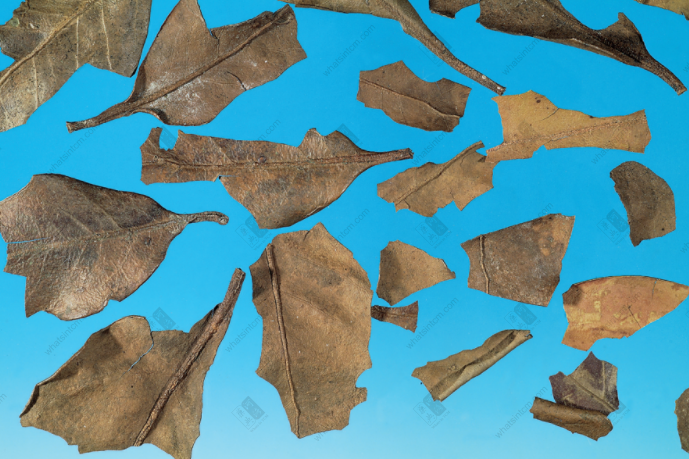
Mulberry Mistletoe Leaf: Oblong, often curled, noticeably leathery, with smooth edges.
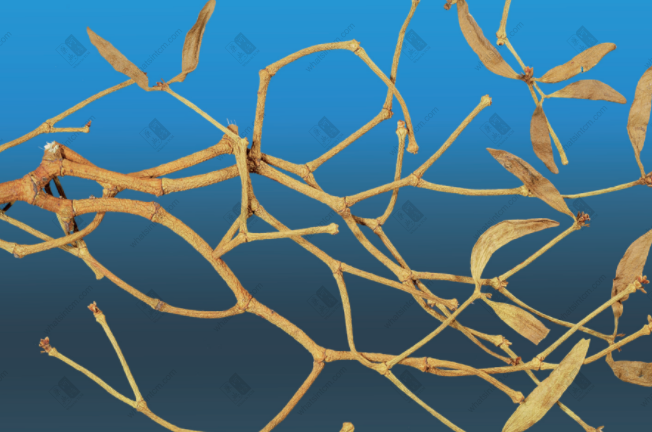
Northeast Yellow Mistletoe: Branch tips with leaves, 2-3 branches, yellow in color.
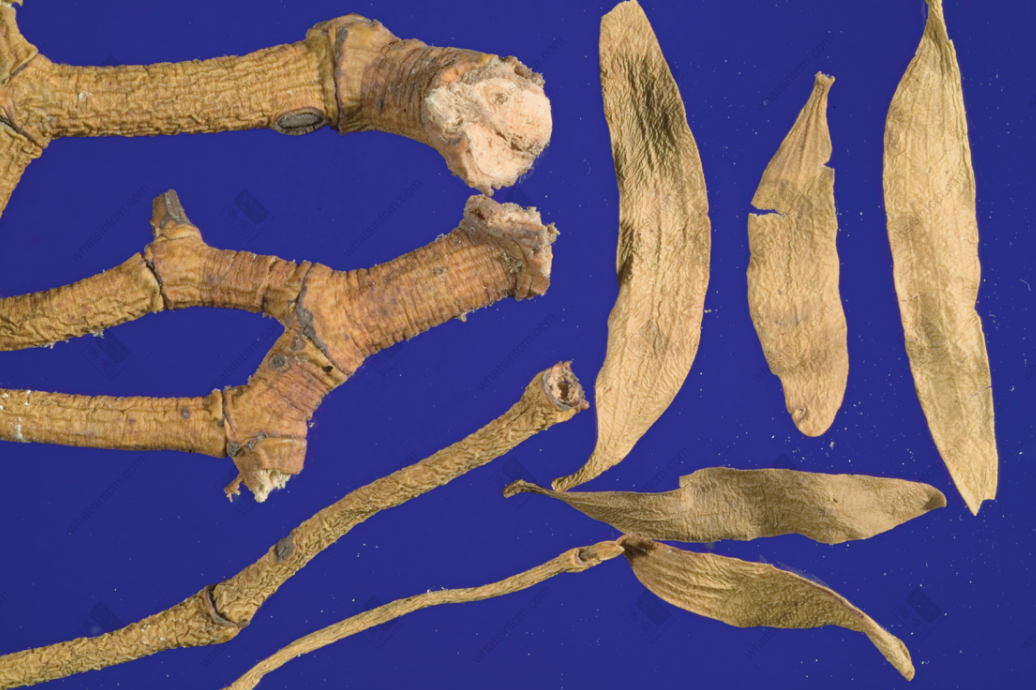 Northeast Yellow Mistletoe Slice: Branches are cylindrical with enlarged nodes, yellowish-brown, leaves are opposite, with petioles, and shriveled berries.
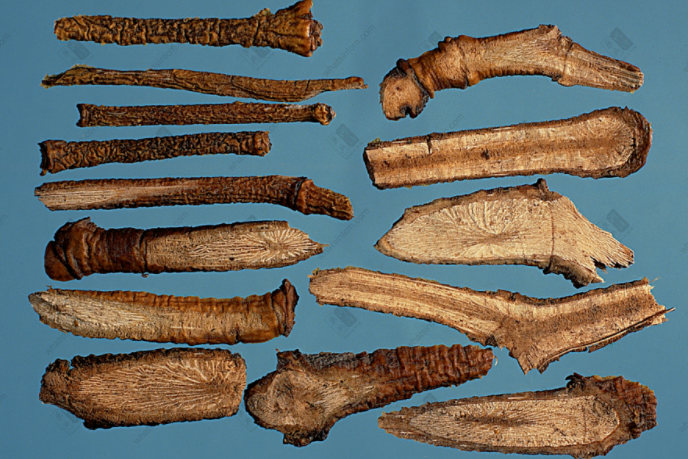
Yellow Mistletoe Slice: Ring-shaped layers are evident, rays are whitish.
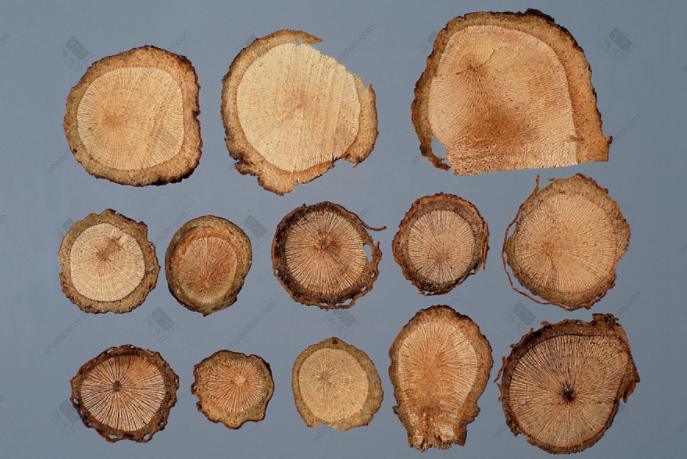
Yellow Mistletoe Slice.
【Image Provided By】 Professor Zhang Xianzhe, “Illustrated Guide to Authentic Chinese Herbal Medicine,” https://whatsintcm.com