



Do All ‘Jue Ming’ Varieties Benefit the Eyes? There’s Also a Lesser-Known Function
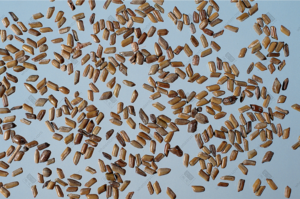
Raw Cassia Seed (Sheng Jue Ming Zi): Rhomboid, resembling a horse’s hoof, yellowish-brown, obliquely truncated at both ends with a small hilum, ridgelines on both dorsal and ventral sides, smooth, glossy, and hard.
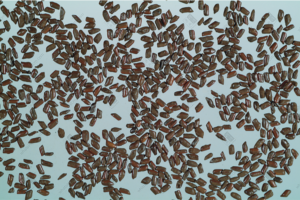
Stir-fried Cassia Seed (Chao Jue Ming Zi): Darker in color, upon closer inspection, it has varying degrees of scorch marks, along with a rich aroma and a slightly bitter taste.
“Amidst the autumn rain, all grasses rot and die, but the Cassia beneath the steps remains fresh and vibrant.
Its branches are covered with emerald leaves like feathered canopies, and countless golden coin-like flowers bloom.
The rustling cool wind blows hard upon you, I fear you will find it hard to stand alone later.
The white-haired scholar in the hall, inhaling your sweet fragrance in the wind, sheds tears.”
–Du Fu, Tang Dynasty
This poem describes how, despite all grasses rotting and dying in the rain, the Cassia (Jue Ming) still flourishes with vibrant green leaves, and its golden-yellow flowers bloom in the wind and rain, inspiring both respect and pity. The Cassia in the rain displays extraordinary vitality, becoming a symbol of unwavering perseverance and a dreamer in the hands of literati.
According to the third edition of the Taiwan Herbal Pharmacopoeia, Jue Ming Zi (Cassia Seed) (https://whatsintcm.com/en/dt_articles/jue-ming-zi-cassia-seed/) refers to the dried mature seeds of the leguminous plants Cassia obtusifolia L. or Cassia tora L. It is mainly produced in regions such as Jiangsu, Guangxi, Sichuan, and Yunnan. Basically, most tropical regions, including Taiwan, also produce it. It is harvested after maturing in autumn, and the seeds are sun-dried and stored for later use. Due to the horse-hoof-like shape of its medicinal seeds, it is also called “Horse-Hoof Cassia” (Ma Ti Jue Ming). And because it is a herbaceous plant, it is also known as “Herbaceous Cassia” (Cao Jue Ming). However, the traditional Chinese medicine Celosia Seed (Qing Xiang Zi) is also called Cao Jue Ming. It is a plant of the Amaranthaceae family and differs in origin from Jue Ming. It mainly treats problems of liver-heat-induced red eyes and has the effect of dilating the pupils, thus requiring careful differentiation in its use. Jue Ming is also known for its remarkable effects in clearing liver fire and improving vision, hence also called “Thousand-Mile Light” (Qian Li Guang). However, in TCM, Qian Li Guang also refers to another plant from the Asteraceae family, whose medicinal part is the whole herb, and which has good efficacy for wind-heat common colds. Therefore, extra attention is needed in its use. Another relatively common TCM material is Shi Jue Ming (Abalone Shell) (https://whatsintcm.com/en/dt_articles/shi-jue-ming-abalone-shell/). According to the third edition of the Taiwan Herbal Pharmacopoeia, it refers to the shell of abalone species such as Haliotis diversicolor Reeve, Haliotis discus hannai Ino, Haliotis ovina Gmelin, Haliotis rubra Leach, or Haliotis laevigata Donovan. Although named Shi Jue Ming, it is primarily an animal-derived medicinal material – a shell. It is mainly used to treat problems like glaucoma (Qing Mang) and pterygium (Mu Yi). Because the names are easily confused, it is important to distinguish between Cao Jue Ming, Jue Ming Zi, Shi Jue Ming, and Qian Li Guang. When purchasing, it is best to explicitly state that you wish to buy the Cassia seeds of the Leguminosae family to avoid confusion.
After clarifying the name, one must also be careful not to purchase confused medicinal materials in the market. A commonly confused material is “Wang Jiang Nan” (Sicklepod or Coffee Senna), which was recorded as a substitute for Jue Ming Zi in the Ming Dynasty text “Jiu Huang Ben Cao” (Herbal for Famine Relief), thus earning the name “Fake Jue Ming.” However, nowadays, there should be a clear distinction in their use. Basically, distinguishing between the two is very simple: the shapes of Jue Ming (Cassia obtusifolia) and Xiao Jue Ming (Cassia tora) are primarily rhomboid, cylindrical, or obliquely conical, while Wang Jiang Nan (Sicklepod) is flattened-ovoid. On the seed surface, Jue Ming shows linear depressions with brownish speckles, while Xiao Jue Ming shows brownish speckles and light yellowish-white linear patterns. The surface of Wang Jiang Nan seeds shows irregular light yellowish-white patterns and brownish-black speckles. Therefore, there are significant differences in their appearance, allowing for definite identification.
Furthermore, in terms of use, Jue Ming Zi (Cassia Seed) has differences between its raw form and processed (Pao Zhi) form, depending on its intended purpose. Raw Jue Ming tends to be greenish-yellow and more uniform in color; after stir-frying, the color darkens, and varying degrees of scorch marks appear, along with a rich aroma and a slightly bitter taste. Stir-fried Jue Ming Zi can mitigate its laxative effect, and its efficacy in calming the liver and nourishing the kidneys is more pronounced. The raw, unprocessed form has a stronger effect in moistening the intestines and promoting bowel movements. The traditional black tea often found in markets or restaurants has a unique aroma, which comes from brewing it with stir-fried Jue Ming Zi. In addition to clearing heat and moistening the intestines, modern research also shows that Jue Ming Zi has a blood-pressure-lowering effect. Therefore, moderate consumption is very beneficial for health. However, due to the potential for name confusion, attention should be paid when purchasing. Furthermore, Taiwanese regulatory authorities have strict controls over the heavy metal content and aflatoxins in Jue Ming Zi, so everyone can safely purchase and use it.
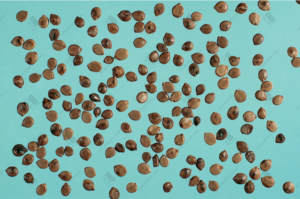
Wang Jiang Nan: Flattened-ovoid in appearance.
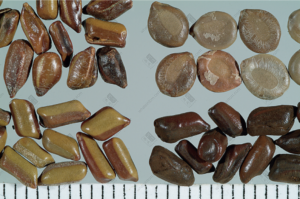
Top left: Lightly stir-fried Cassia seeds; Top right: Wang Jiang Nan seeds; Bottom left: Raw Cassia seeds; Bottom right: Heavily stir-fried Cassia seeds.
【Image Source】Professor Chang Hsien-Che, “Illustrated Guide to Authentic Medicinal Materials” https://whatsintcm.com
【Author Profile】
Chen Da-Zhen, Ph.D. in Traditional Chinese Medicine, China Medical University.
Current Position: Assistant Research Fellow, Medical Intelligence Center, China Medical University Hospital.
Compiling Committee Member, Materia Medica Department, National TCM Colleges & Universities Common Textbook Editorial Committee.
Distinguished Lecturer, Industrial Technology Research Institute.
Adjunct Lecturer, Post-Baccalaureate Program in Traditional Chinese Medicine, China Medical University.
Adjunct Assistant Professor, Department of Pharmacy, Chianan University of Pharmacy and Science.
Heluo Materia Medica www.whatsinTCM.com Co-founder
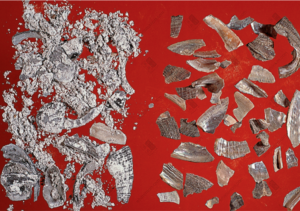
Left: Shi Jue Ming slices; Right: Calcined Shi Jue Ming.
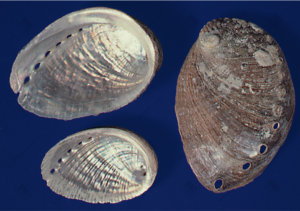
Shi Jue Ming: Coarse, the left side shows iridescent colors and pearly luster inside the shell.