Red Xinshi and Cinnabar: Not Quite the Same, Yet Xinshi is the Raw Material for Arsenic Trioxide (Pishuang)
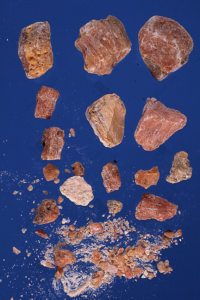
Author: Professor Chen Dazhen Image Source:Professor Zhang Xianzhe’s《Illustrated Guide to Authentic Medicinal Materials》
After introducing cinnabar (https://whatsintcm.com/post2/) and red lead as toxic mineral-based Traditional Chinese Medicines, we will now introduce another dreaded toxic mineral TCM: Pishuang. Pishuang is also known as Bai Pi, Pishi, Xinshi, etc. Because the character ‘信’ (xìn) can be split into ‘人’ (rén, person) and ‘言’ (yán, speech), it is sometimes referred to as ‘人言’. It gained notoriety in the Yuan Dynasty novel *Water Margin*, where Pan Jinlian used it to poison Wu Dalang. Li Shizhen’s *Bencao Gangmu* (Compendium of Materia Medica) from the Ming Dynasty records: ‘Pishi, when raw, is called Pihuang. When refined, it is named Pishuang.’ This indicates that its medicinal properties change after processing, and its name differentiates it.
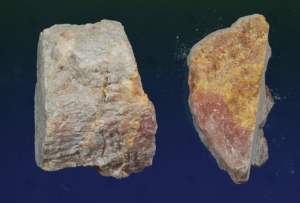
The main component of Pishuang is arsenic trioxide (As2O3). It is primarily found in crystalline rocks and schists, often coexisting with antimony ore, proustite, realgar, and sphalerite, mainly produced in Jiangxi, Hunan, Guangdong, and other regions. It has a pungent taste, is extremely hot in nature, and is highly toxic. After mining, the sand, gravel, and earth impurities are finely ground and then purified by levigation (水飛) for use. Two types of Xinshi, red and white, can be found on the market. Red Xinshi appears red due to impurities such as arsenic trisulfide (As2S3). The best quality red Xinshi is block-shaped, with clear straight veins and a vibrant red color. Because it contains sulfides, it will turn a silver needle black upon contact, which is why ancient people often used silver needles to test food for toxicity. White Xinshi, on the other hand, is considered higher quality when it has clear straight veins and a white color, consisting mainly of pure arsenic trioxide (As2O3). For detailed information, please see (https://whatsintcm.com/en/dt_articles/arsenic-trioxide-pi-shi/). In the market, it is typically called Pishi or Xinshi before purification, and after purification, when it becomes white, it is called Pishuang.
Pishuang is highly toxic. The internal daily dosage is 0.003 to 0.006 grams. Due to its very small dosage, excipients are usually added for easier administration. Pishuang, being extremely hot in nature, is primarily used internally for problems such as asthma, cold malaria, epilepsy/mania, or dysentery. The *Taiping Shenghuifang* (Formulas of the Great Peace Imperial Grace Pharmacy) from the Song Dynasty records: ‘Ganqi Pills, using Pishuang formulated with Ganqi (dried lacquer), Cinnabar, Musk, and Croton seeds, ground into a fine powder, mixed with soft rice and taken as pills, can cure all types of dysentery that have been intractable for a long time.’ For external use, it has certain effects on scrofula, swollen hemorrhoids, corns, alopecia areata, eczema, and other conditions. However, an overdose can lead to gastrointestinal poisoning symptoms such as vomiting, abdominal pain, and diarrhea. Victims of poisoning primarily die from heart failure, and do not exhibit symptoms like bleeding from the seven orifices as depicted in novels.
Although Pishuang is highly toxic, it has recently been used in modern medicine to treat cancer with excellent results, even obtaining FDA market approval in the United States. In Taiwan, the currently used drug is an injectable, with the brand name Asadin (Arsenic Trioxide Injection), whose main component is arsenic trioxide (As2O3). It is primarily used for the treatment of Acute Promyelocytic Leukemia (APL) with very good efficacy. However, it is contraindicated for pregnant women, lactating women, and individuals with impaired liver or kidney function to avoid severe harm to the body. Recently, there was a popular rumor in Taiwan that consuming vitamin C and shrimp together would convert non-toxic pentavalent arsenic into highly toxic trivalent arsenic, leading to poisoning and death. However, this claim has been proven to be entirely baseless, and relevant health authorities in Taiwan immediately came forward to debunk the rumor, serving as an excellent example of safeguarding public health and medication safety.