

Confusing Minium with Cinnabar? An Introduction to TCM Minium (Red Lead) and Management of Lead Poisoning Symptoms
Author: Professor Chen Da-zhen Image Source:Professor Zhang Xian-zhe’s“Illustrated Guide to Authentic Medicinal Materials”
In our previous article, we introduced the source, processing, application, and toxicity issues of TCM Cinnabar. For details, please refer to this webpage (https://whatsintcm.com/post2/). This time, we will introduce **Minium (Red Lead)**.
Tang Xianzu’s “The Peony Pavilion” from the Ming Dynasty records: “Longing for Han Guang, washing away the leaden splendor, with elegance and transformation, suitable for home and family.” Here, “washing away the leaden splendor” (洗盡鉛華) means washing off all the facial makeup. It is used as a metaphor for a person transitioning from a splendid life to a simple one, because ancient cosmetics often contained lead. ‘Leaden splendor’ (鉛華) refers to lead powder, which was used in ancient times as a cosmetic to whiten the skin, and also metaphorically describes a woman’s beautiful appearance.
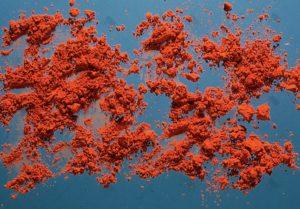
The main ingredient of TCM Minium (Red Lead) (https://whatsintcm.com/en/dt_articles/minium/) is Lead Tetroxide (Pb3O4). Due to slight variations in its appearance and color, it is also known as Huangdan (Yellow Lead), Hongdan (Red Lead), Zhudan, and has many other aliases such as Zhendan, Songdan, Zhangdan, and Qianhuang (Lead Yellow). The “Shennong Ben Cao Jing” (The Divine Farmer’s Materia Medica) from the Qin and Han Dynasties records it in the inferior category of the “Jade and Stone” section: “Minium, pungent and slightly cold in taste. Primarily treats cough, vomiting, convulsions, epilepsy, eliminates heat, and descends qi. Refined, it transforms into nine glows. Prolonged use enhances spiritual clarity. Grows in marshes.” This indicates that Minium has been in use since the Qin and Han Dynasties, with a very long history of use and discovery. Currently, Minium found on the market is usually an orange-red or orange-yellow powder. It is heavy in texture, opaque, and lusterless. It is insoluble in water or alcohol but can dissolve in hydrochloric acid or nitric acid. When heated, it releases oxygen, and some parts will turn into a white precipitate of lead oxide.
The processing (Paozhi) of Minium (Red Lead) primarily involves melting black lead and alum together and stirring them. After cooling, the mixture is removed, forming blocks of lead oxide. These blocks are then ground, water is added and stirred, and the fine powder floating on the water is collected and placed in another vat to settle. This water-refined powder is then sun-dried, slowly heated in an iron pot for a day, then removed and ground into a fine powder for use. Good quality Minium is characterized by not forming lumps when mixed with water. Another common mineral-based TCM, Mituoseng (Litharge) (https://whatsintcm.com/en/dt_articles/mit%e9%99%80%e5%83%a7-lead-monoxide/), is a similar substance, and care must be taken to differentiate them in use.
Modern pharmacological research on Minium (Red Lead) indicates that it can kill bacteria and parasites, and also has a mucin secretion inhibitory effect. It is effective for astringing, promoting tissue regeneration, relieving pain, calming the mind, treating traumatic bleeding, acid reflux, and diarrhea, among other conditions. However, concerns may arise due to the lead content in the medicine. Overdosing or long-term use may cause hepatomegaly (enlarged liver) or elevated jaundice index. Therefore, Taiwan’s Traditional Chinese Medicine regulatory authorities prohibited the manufacture, dispensing, and supply of oral TCM containing Minium in 1991. Early symptoms of lead poisoning may include nausea, vomiting, constipation, tremors, and convulsions. If these symptoms are present, one can further check for grayish-black linear lead deposits visible on the gums. If lead poisoning is suspected, one should go to the hospital for kidney function, liver function, and blood tests. If “blue-stained red blood cells,” specifically red blood cells with basophilic stippling, are observed in a blood smear, it is likely lead poisoning.
However, because Huangdan (Minium) has excellent effects in promoting tissue regeneration and astringing, it is still added to external applications like “Jia Jian Wei Tai Yi Gao” (Modified Tai Yi Ointment), a common topical plaster. It is used to treat symptoms such as bruises, sprains, muscle soreness, and joint pain. To prevent adverse reactions from excessive use on the body, Taiwan’s Traditional Chinese Medicine regulatory authorities announced in 2015 that all TCM preparations containing Minium and Orpiment (雄黃) must include a warning on their outer packaging and package inserts: “This product is not suitable for long-term use.” This ensures consumers can use the products with peace of mind. Therefore, effective management of Traditional Chinese Medicine is the greatest guarantee for public well-being.