
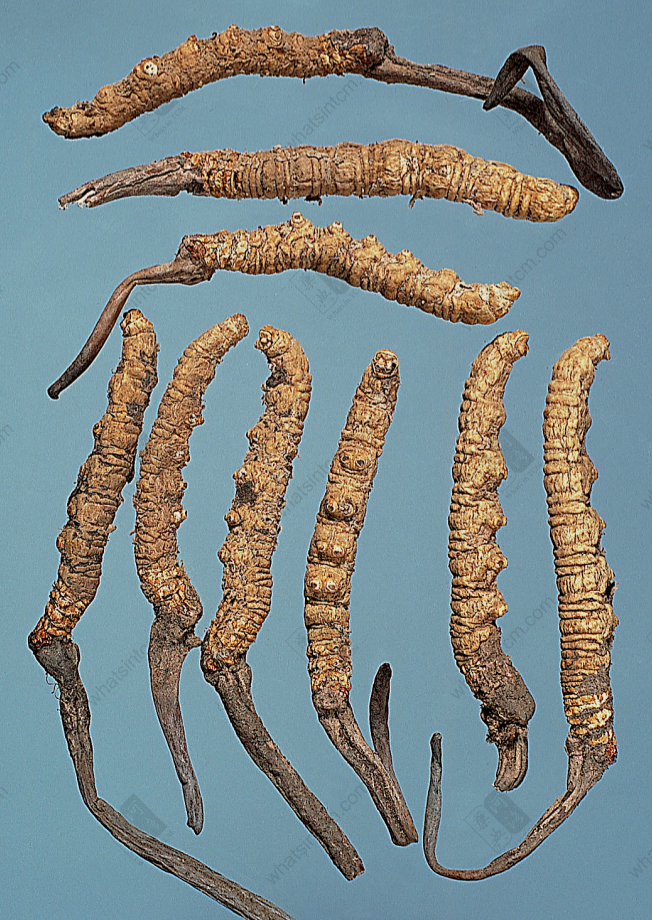
 Cordyceps (Insect body with fungal stroma, old silkworm-like, deep yellow, rough, with many transverse wrinkles on the back, stroma club-shaped, curved, upper part of the ascus slightly enlarged, black-brown)
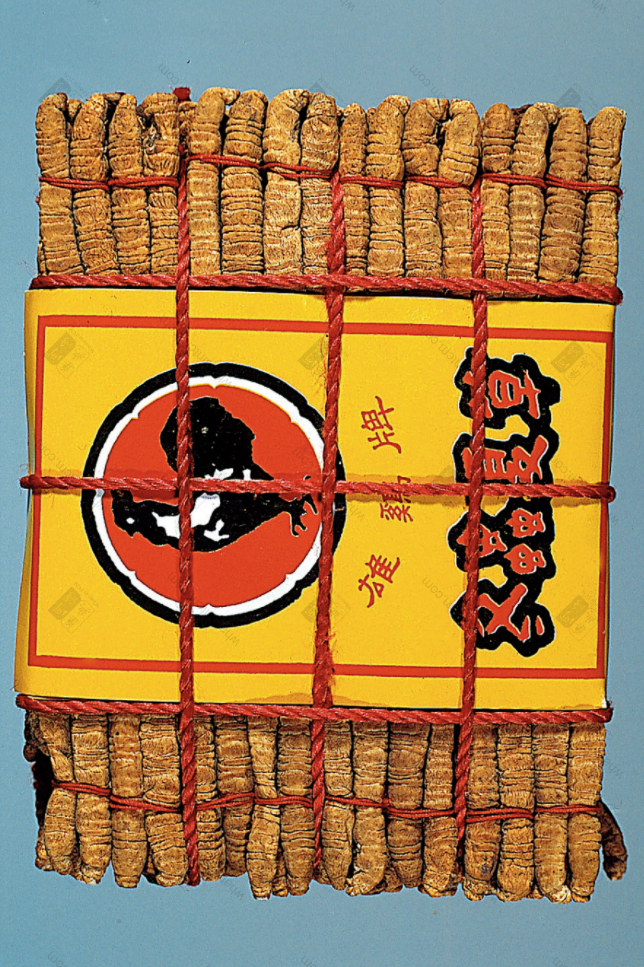 Cordyceps (Insect body plump and stout, golden yellow, resembling a silkworm, with yellow-white flesh inside being the best)
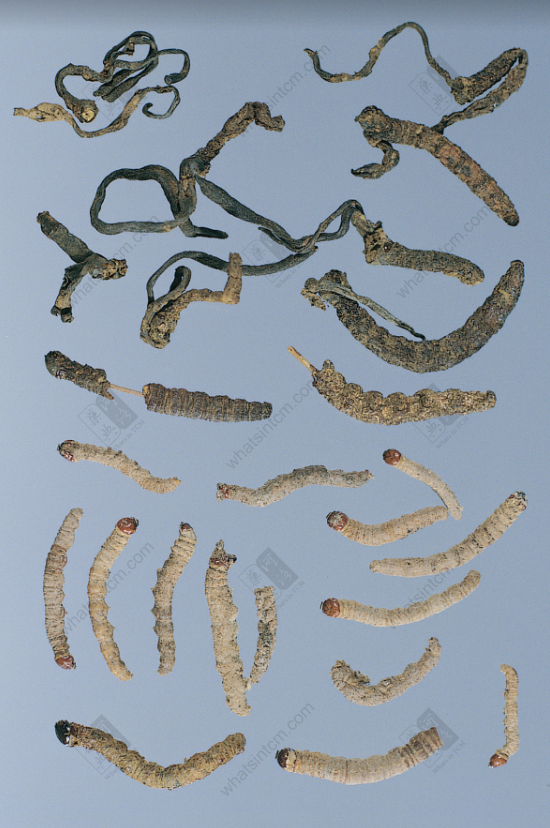
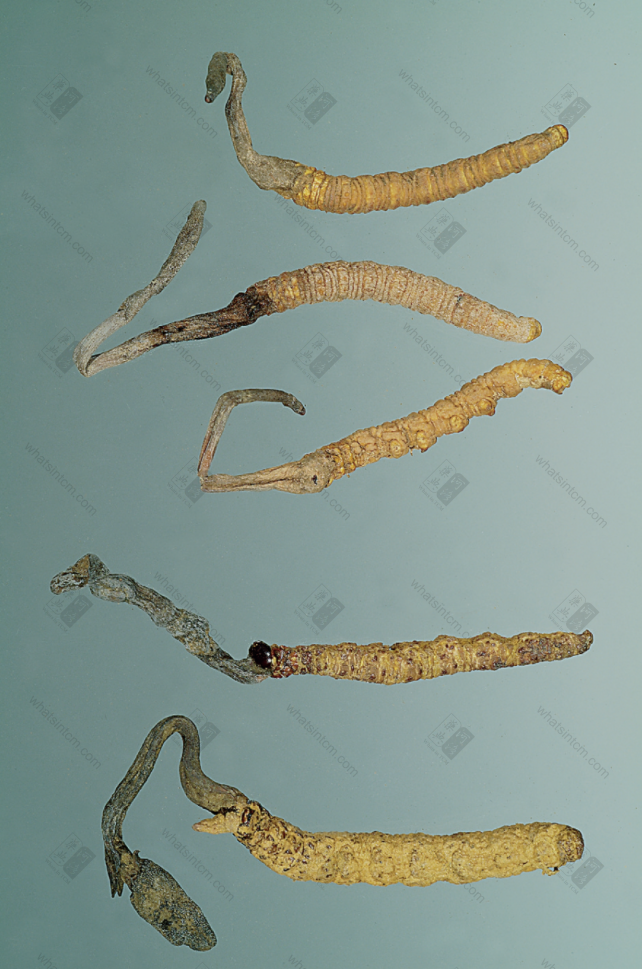 Two types of Sichuan Cordyceps
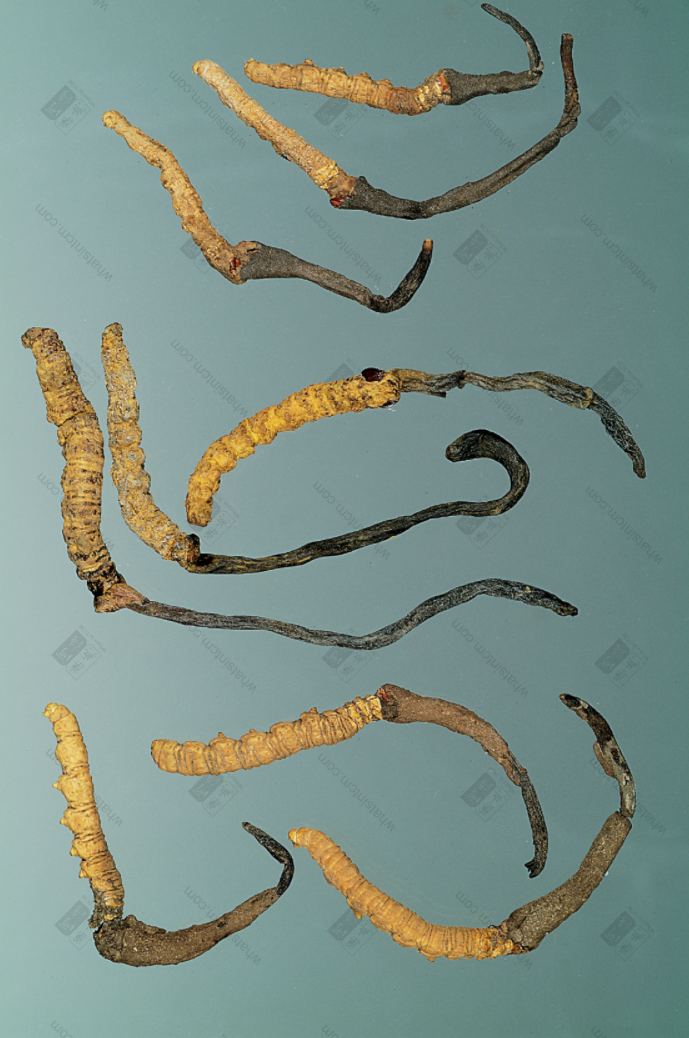 Three types of Sichuan Cordyceps
 Qinghai Cordyceps
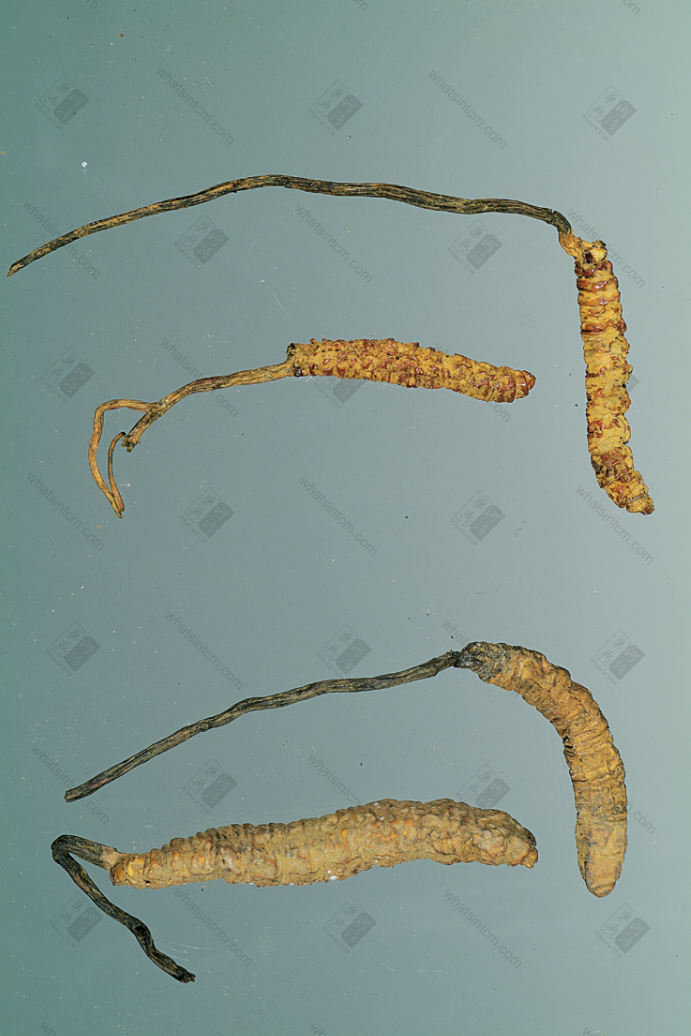 Xinjiang Cordyceps
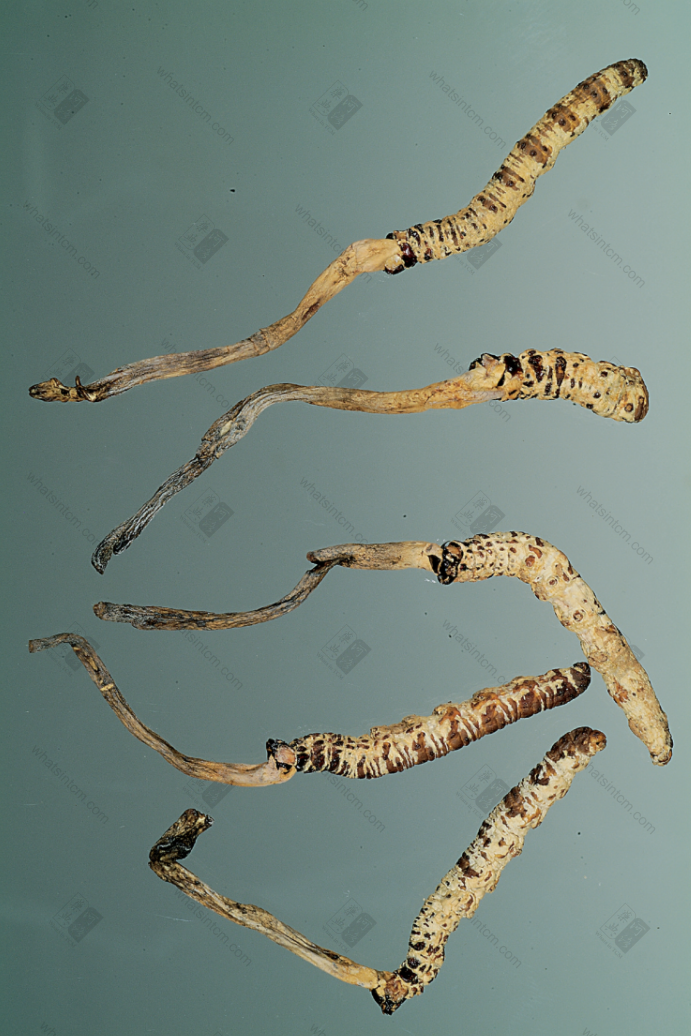 Changbai Mountain Cordyceps
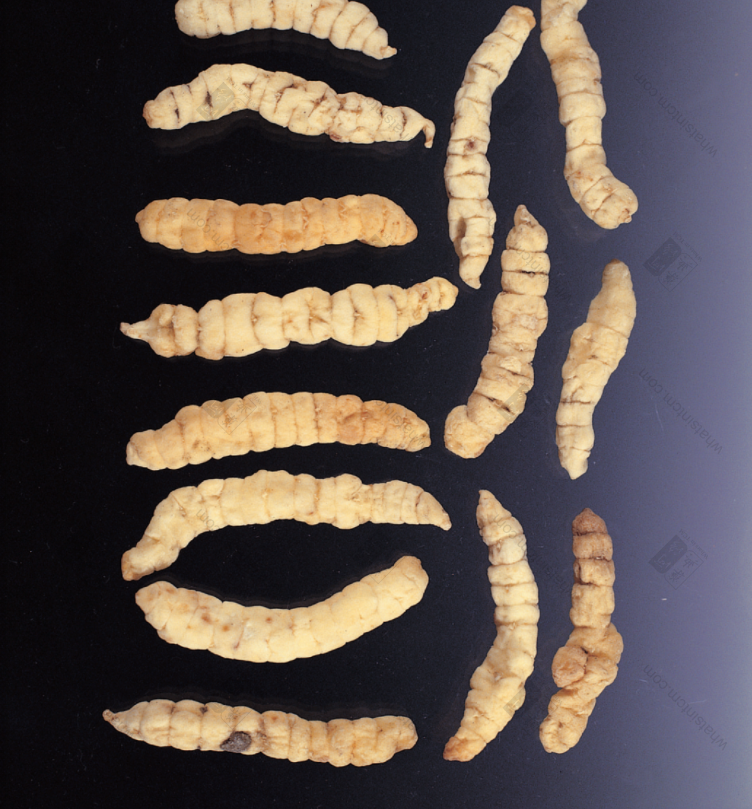 Fake Cordyceps (Plant Stachys Sieboldii Miq.)
【Naming】
【Source】
Compendium of Materia Medica Supplement
【Commonly Used Degree】
C
【Origin】
It is a composite of the stroma of the Cordyceps sinensis (Berk) Sacc. fungus in the Clavicipitaceae family and the larval carcass of the Hepialus armoricanus Oberthiir insect in the bat moth family.
【Characteristics】
Cordyceps is formed by the connection of the insect body and the fungal stroma, with a total length of 9~12㎝. The insect body is like an old silkworm, about 3~6㎝ long and 0.4~0.7㎝ thick. The appearance is deep yellow and rough, with many transverse wrinkles on the back, and 8 pairs of feet on the abdomen, the 4 pairs in the middle of the insect body are obvious and easy to see (red head and eight feet, four are obvious). The cross-section is solid inside, white, slightly yellowish, with deep yellow around it. The stroma grows from the head of the insect body, slender, club-shaped, curved, and slightly enlarged at the upper part. The surface is gray-brown or black-brown, can be 4~8㎝ long, and about 0.3㎝ in diameter. The insect and grass are of equal length, the grass is like a golden needle, the texture is soft and tough. When broken, the heart is empty, powdery white, slightly odorous, and the taste is light.
【Identification】
《Essentials of Materia Medica》: “The best Cordyceps is produced in Jiading Prefecture, Sichuan. It is in the soil in winter, shaped like an old silkworm, with hair that can move. In summer, the hair comes out of the soil.” 《Identification of Good and Bad》: “The best Cordyceps is that which remains large after drying and has a complete shape and fresh color. Those that are fragmented or have been eaten by insects are useless.”
The best are those with yellow and bright insect bodies, plump and stout, yellow-white cross-sections, not hollow, and small stroma. Among the commodities produced in various places, Tibetan and Qinghai Cordyceps are the best, followed by Sichuan Cordyceps. Cordyceps King is the best among Cordyceps, followed by Ba Cordyceps, and scattered Cordyceps is the worst.
【Identification Terminology】
(Modern Terminology)
1. Stroma: A mass of cushion-like fungal cells in or on which fruiting bodies are produced, or formed by a mixture of fungal cells and host tissue.
2. Hymenium: The spore-producing surface of ascomycetes and basidiomycetes, that is, the palisade layer in which asci or basidia are arranged, which may be interspersed with paraphyses, cystidia and other pregnant cells.
3. Sporangium: An organ that produces spores, usually composed of a sporangium or sporangiophore. A ring band is usually grown outside the sporangium. Many spores are produced inside the sporangium. When mature, the spores are often scattered through the opening of the ring band.
【Chapter】
Fungi and Algae