
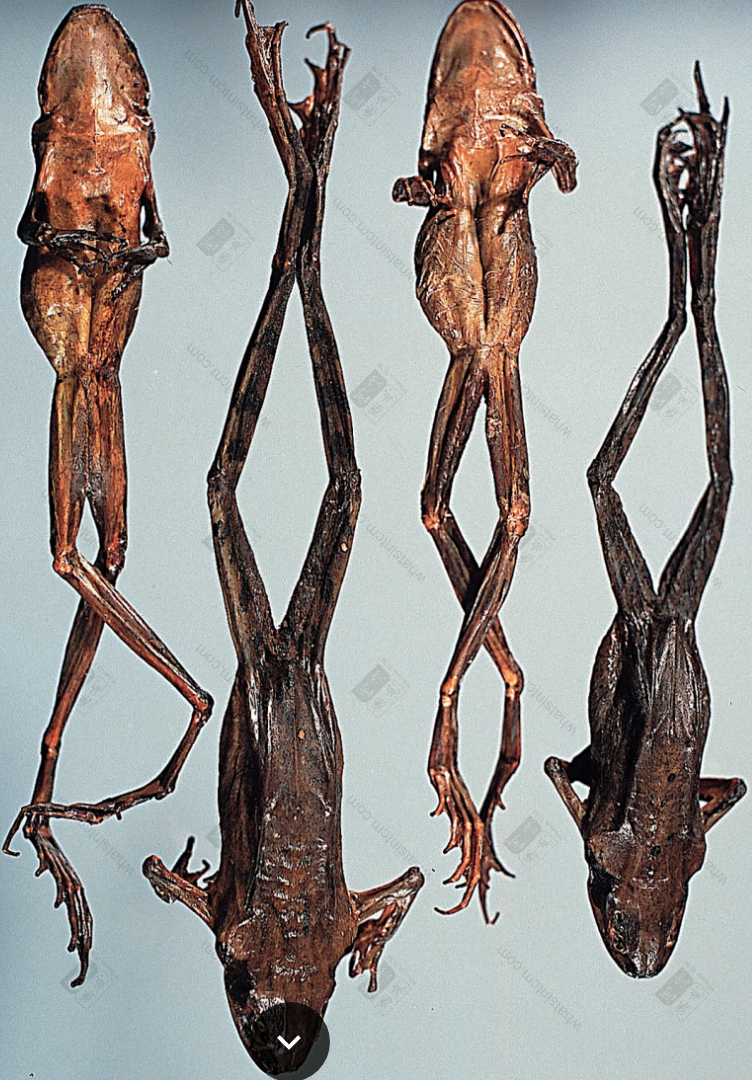
Hashima
【Naming】n
【Source】n
Yinpian Xincan (New Reference on Prepared Medicinals)
n 【Frequency of Use】n
C
n 【Botanical Source】n
The dried fallopian tubes of Rana temporaria chensinensis David or Rana amurensis Boulenger, amphibians of the class Vertebrata, order Anura, and family Ranidae.
n 【Characteristics】n
Hashima oil (also known as Hasma oil) is dried into irregular blocks, resembling oily substances, thick blocks overlapping each other, slightly oval, 1.5~2cm long, uneven, the surface is yellowish-white to light yellowish-brown, translucent, with a fatty luster, one side is flat with a white membrane, often with thin white tenacious skin attached, and occasionally with uncleaned black eggs. It feels slippery to the touch and can expand to 10-15 times its size when exposed to water. It has a unique slightly fishy odor and a slightly sweet taste, and is sticky when chewed.
n 【Identification】n
The best are those with large, thick, dry, white, and lustrous pieces, without fascia, and black eggs. Dark yellow to red and brown ones are inferior. The best Hashima are those captured in October, with a black back, yellow-red abdomen, and abundant oil; those that are small, thin, with a small abdomen, and little oil are second-rate.nMethods for identifying Hashima oil: (1) Hashima oil can increase in volume by 10~15 times when soaked in hot water, which cannot be faked or replaced by ordinary fats or oils. (2) There are white tube-like stripes on the cross-section of the Hashima oil block.
n 【Category】n
Vertebrates