
【Naming】
【Source】
Classic of Herbal Medicine, Supplementary Records
【Common Usage Level】
D
【Origin】
Fossilized teeth of ancient mammals such as elephants, rhinoceroses, three-toed horses, camels, and antelopes.
【Characteristics】
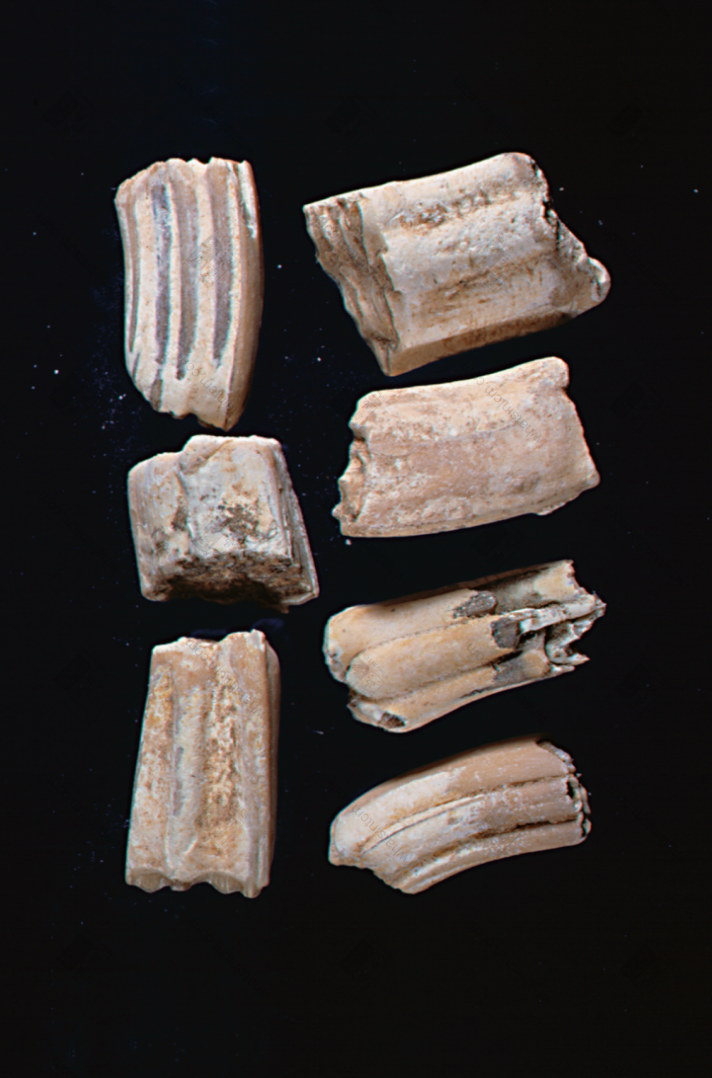
It appears as complete teeth or broken into irregular lumps. Complete teeth can be divided into canines and molars. Canines are conical, with a relatively thin or slightly curved tip, about 7 cm long and 3 cm in diameter. The area near the tip is often hollow. Molars are cylindrical or square cylindrical, with one end being thinner and slightly curved, about 5 cm long. They often have grooves and ridges of varying depths. They can also be larger, appearing in bluish-black, brownish-black, ivory-white, and reddish-white colors. Among them, those that are bluish-gray are commonly called “Qing Long Chi (Dragon Teeth)“, and those that are yellowish-white are commonly called “Bai Long Chi (Dragon Teeth)“. Some surfaces still have a glossy enamel. The texture is hard, the fracture surface is rough, uneven, or has irregular protruding ridges. It is highly hygroscopic and can stick to the tongue. It has no odor and no taste.
Calcined Long Chi (Dragon Teeth): shaped like broken pieces of raw Long Chi (Dragon Teeth), mostly powdery, white in color, soft and brittle.
【Preparation】
1. Raw Long Chi (Dragon Teeth) 2. Calcined Long Chi (Dragon Teeth):
【Identification】
The best quality is bluish-brown, without jawbone, and highly hygroscopic.
【Category】
Minerals