
【Name】
【Source】
Newly Revised Materia Medica (新修本草)
【Frequency of Use】
F
【Origin】
It is the calculus found in the gallbladder of the wild boar, *Sus scrofa L.*, an animal of the Suidae family.
【Characteristics】
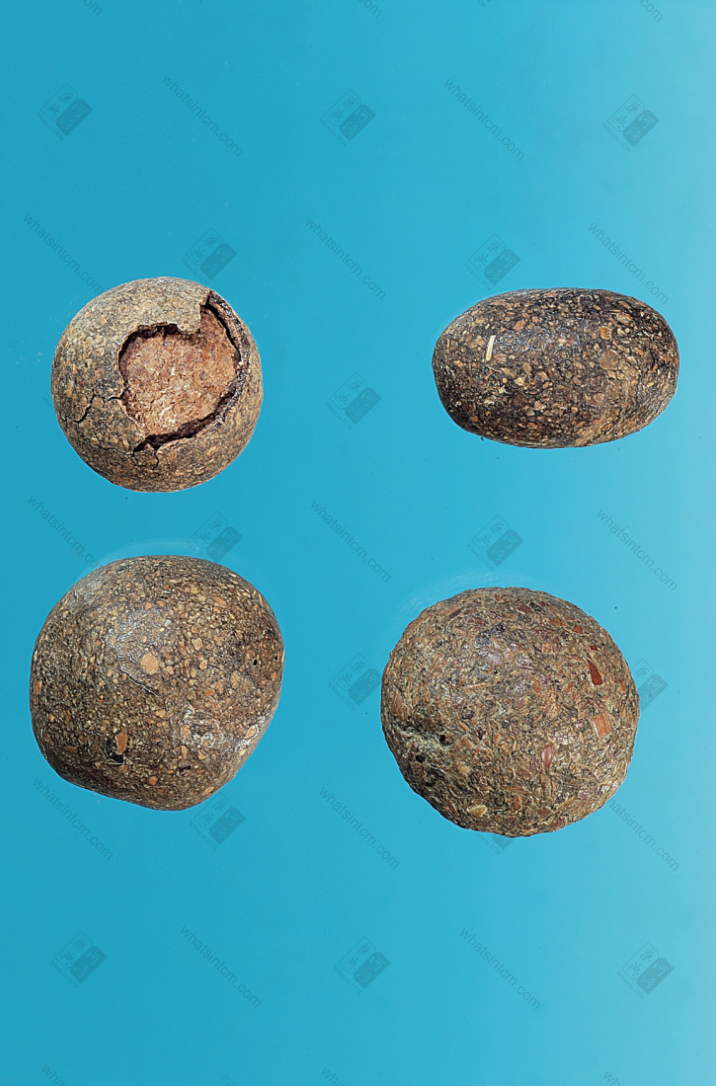
The calculus removed from the gallbladder is called “Wild Boar Yellow, Gall Yellow, Egg Yellow.” Gall Yellow: Mostly oval, irregularly spherical, square, or triangular in shape, with a diameter of 0.6~3.3cm. The surface is golden yellow or brownish yellow, delicate and slightly shiny, some with a layer of black, shiny film on the outside, commonly known as “Black Gold Coat,” and some are rough with cracks. It is light in weight, loose and brittle, with a yellow cut surface, and has closely arranged annular layers that overlap in alternating shades. It has a clear and fragrant odor, tastes bitter at first and then slightly sweet, leaving a cool sensation in the mouth that reaches the root of the tongue, and does not stick to the teeth when chewed. Its water has a significant cooling sensation that penetrates the fingers. Also known as Wild Boar Yellow.
【Identification】
The best quality is golden yellow or brownish yellow in color, with a layer of black, shiny film on the outside, a yellow cut surface, and alternating overlapping annular layers. It has a clear and fragrant odor and a cooling sensation.
【Category】
Vertebrates