
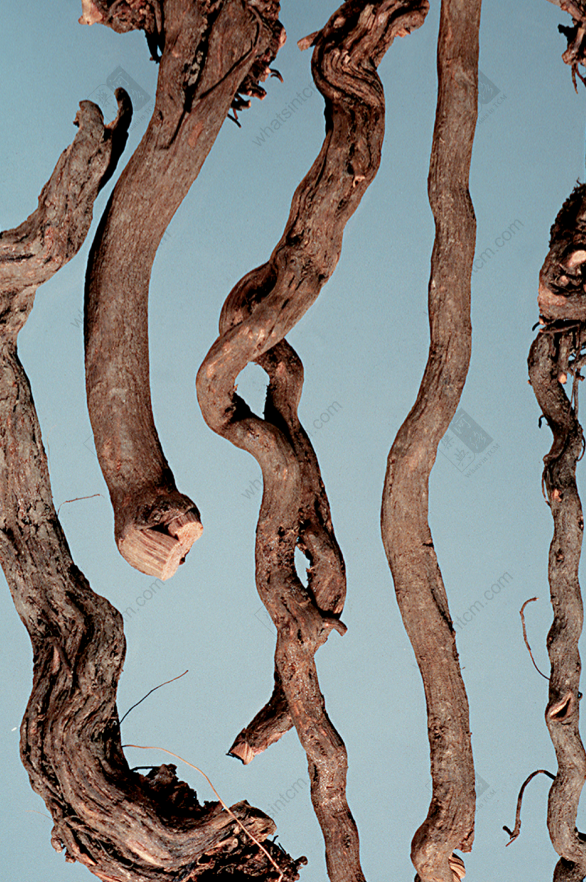
Rubia Root (Knotty roots are curved, reddish-brown, with longitudinal wrinkles and fine rootlet scars, brittle and easily broken)
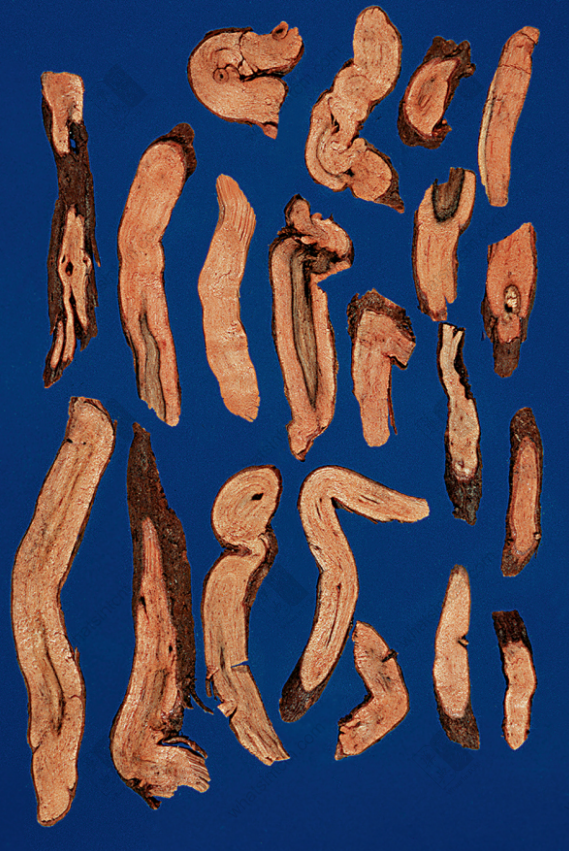
Rubia Root Slice (Wide wood part, yellowish-red and clear)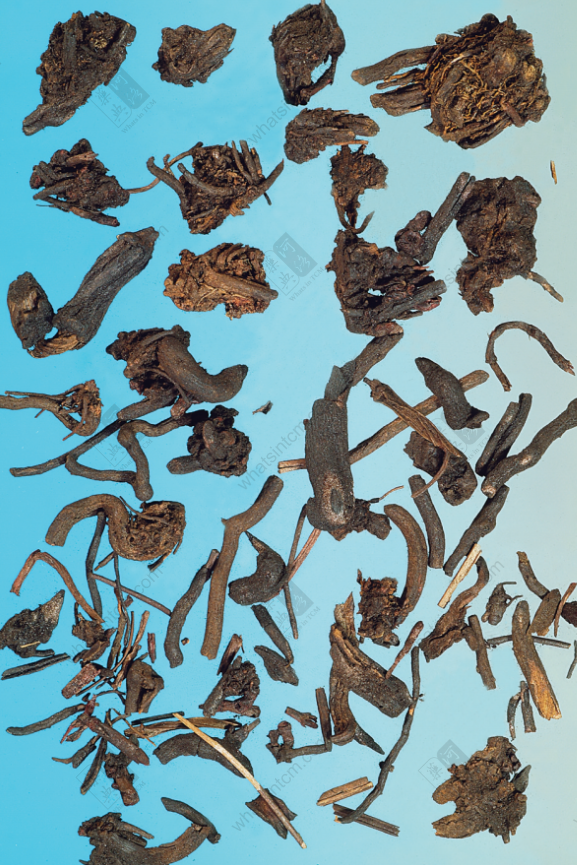
【Naming】n
n 【Source】n
Superior Class in the Classic of Herbal Medicine
n 【Common Usage Level】n
C
n 【Botanical Origin】n
The roots and rhizomes of Rubia cordifolia L. and closely related species in the Rubiaceae family.
n 【Characteristics】n
The rhizomes are horizontal, slightly curved, and present as nodular or irregular masses with residual bases of above-ground stems and fine roots at the top, and several or dozens of lateral roots below. The lateral roots are cylindrical and curved (forked roots are often twisted), about 10-20 cm long and about 0.1-1 cm in diameter. The surface is brown or reddish-brown, with fine wrinkles. The cork layer is easily peeled off, exposing the yellowish-red wood (the skin is easily separated). The texture is brittle and easily broken, with a flat fracture surface.nThe processed pieces are irregular thin slices, about 1 cm in diameter and about 1 mm thick, some with holes in the middle. The transverse section of the root is about 1 mm thick, the cortex is very narrow, dark purple, and the wood occupies most of the root, appearing brick red to purplish-red. The taste is slightly bitter with a cool sensation. Charred Rubia Root has a blackish-brown head and a scorched odor.
n 【Processing】n
n 【Identification】n
《Essential Compendium of Materia Medica》: “Roots with thick and strong stems are considered good.”nThe quality is better when the root is thick and long, the surface is reddish-brown, the interior is deep red, there is no mud, there are few branches, no stems or seedlings, and few fine fibrous roots. The cross-section is pink, the heart is light yellow, and the water immediately turns red when placed in boiling water. However, roots that are too thick and old, or *Bai Qian* (another herb) are not qualified.
n 【Category】n
Roots