



Amomi Fructus
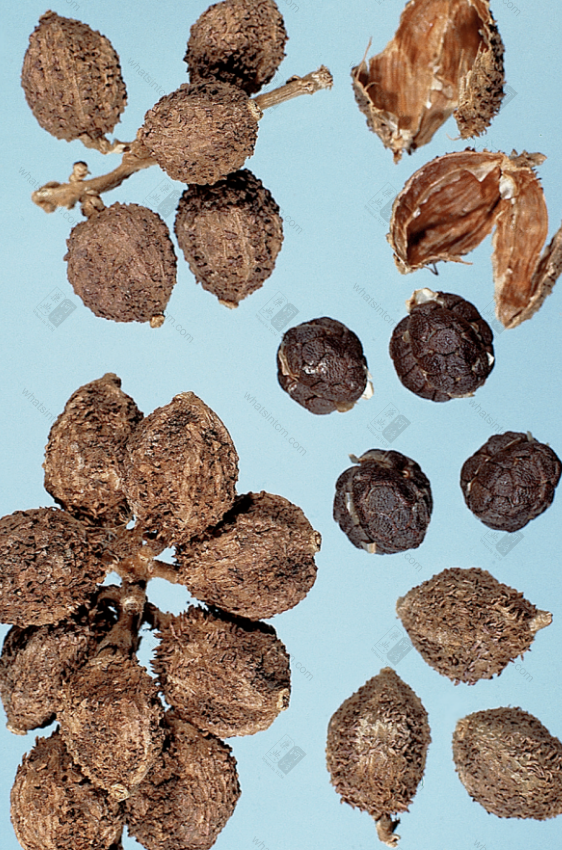 <a href='https://whatsintcm.com/dt_articles/Amomi Fructus/’>Amomi Fructus (Yangchun Amomum) (elliptical or ovoid shell with ridges, brownish-red, densely covered with soft, short spines, has a fruit stalk, several in number)
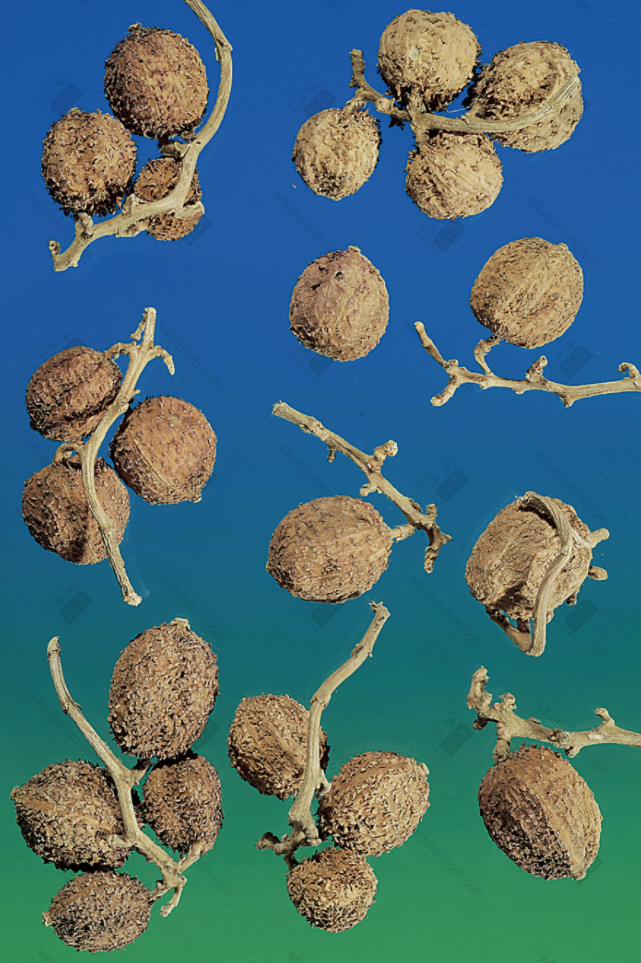 Yangchun Amomum (seeds are polyhedral, hard texture, endosperm is grayish-white, aroma is strong and pungent, taste is bitter and spicy)
 Guangxi Amomum
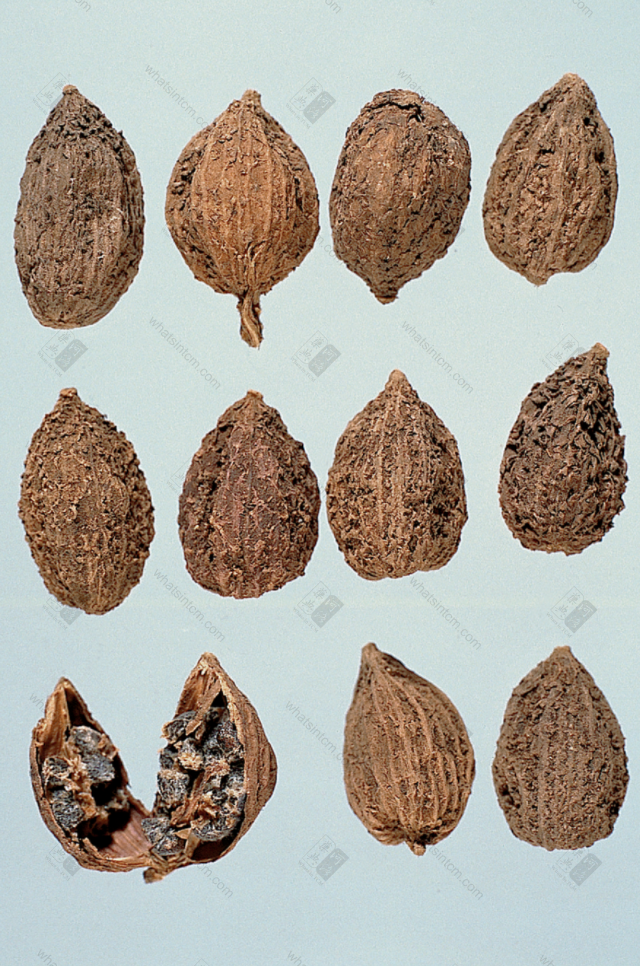 Thailand Amomum
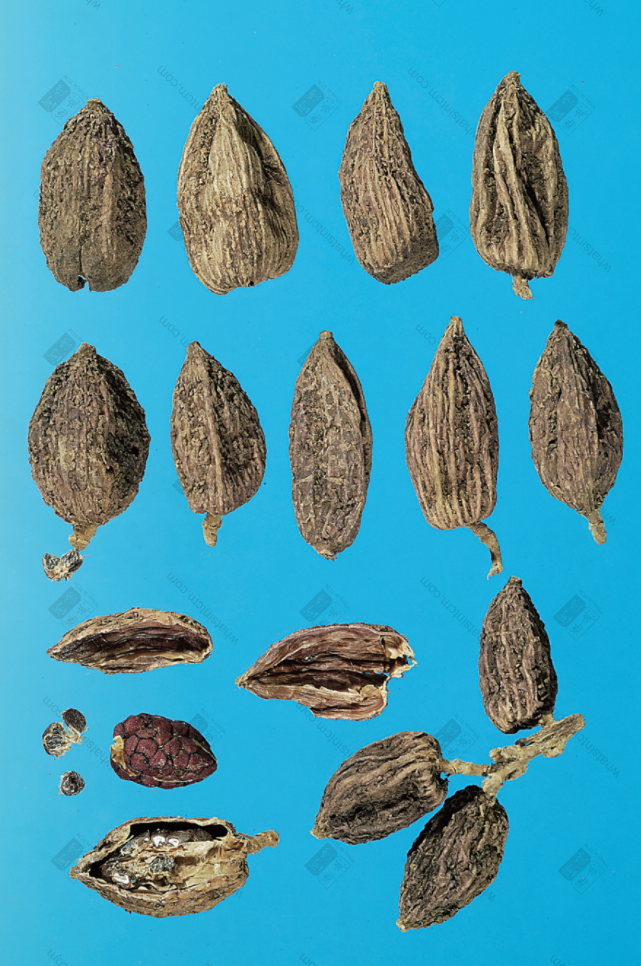 Pointed Amomum
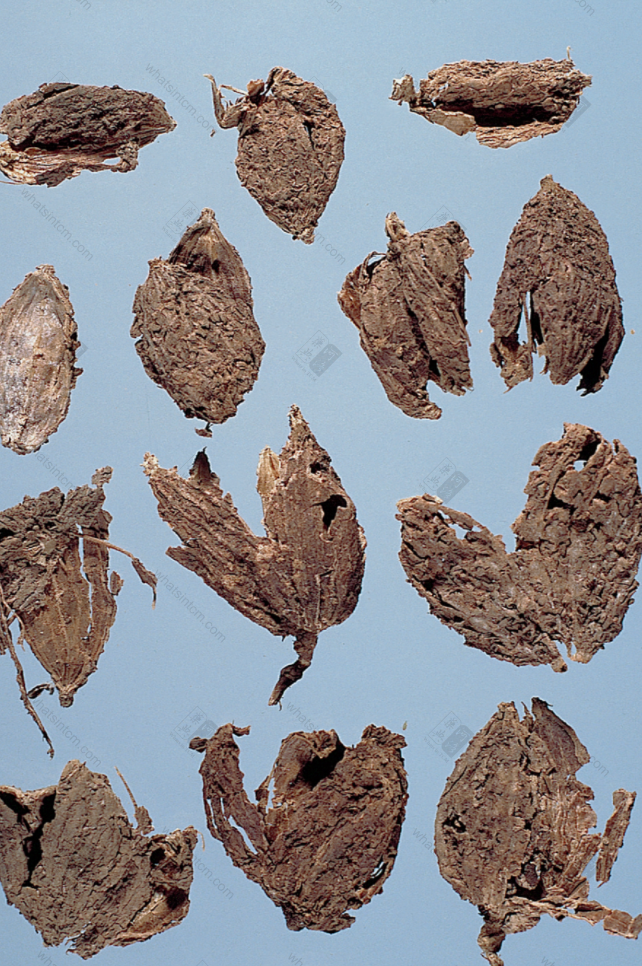 Amomum Shell
【Name】
<a href='https://whatsintcm.com/dt_articles/Amomi Fructus/’>Amomi Fructus
【Source】
Song Kaibao‧Shasumi (approximate transliteration)
【Commonly Used Grade】
B
【Botanical Origin】
The dried, ripe fruit (shell amomum) or seeds (amomum seed) of Amomum villosum Lour. (Yangchun Amomum) , A. villosum Lour. var. xanthioides (Wall. ex Bak.) T. L. Wu et Senjen (Shasumi Amomum), or A. longiligulare T. L. Wu (Hainan Shell Amomum), all belonging to the Zingiberaceae family.
【Characteristics】
(1) Yangchun Amomum: This is the dried fruit of Yangchun Amomum. The fruit is usually in clusters of several to a dozen attached to a common fruit stalk, rarely found as single fruits. Each individual fruit is elliptical or ovoid, with indistinct blunt trihedral shapes, 1.5-2cm in length and 1-1.5cm in diameter. The outer surface is brownish-red or purplish-red, densely covered with soft, fleshy, short spines. The apex has protruding remnants of the perianth, and the base has a short fruit stalk. The pericarp is thin and closely adheres to the seed mass. The pericarp is easily torn longitudinally, and the inner surface is light brown, slightly smooth, with distinct longitudinal ridges. The seed mass is trihedral oblong or round, divided into three chambers (three lobes). Each chamber contains 6-15 seeds, arranged closely in 2-4 rows, adhering to each other, and often clustered together. Each individual seed is somewhat square with edges and corners, with a membranous aril on the surface. The seed surface has irregular dense wrinkles and is brownish-red or dark brown in color. When broken open, the inside is grayish-white, oily, with a fragrant and strong aroma, and a spicy, cool, and slightly bitter taste. Chewing it provides a spicy, cool, and rich sensation.
(2) Shasumi Amomum: This is the dried fruit of Shasumi Amomum. It is elliptical or ovoid-spherical, slightly smaller and rounder than Yangchun Amomum, and slightly trihedral, 1.5-2cm in length and 0.8-1.5cm in diameter. The surface is yellowish-brown or grayish-brown, densely covered with spine-like protrusions. It is internally divided into three chambers, each containing 12-18 seeds, often clustered together. The shape of the seed mass is relatively round. The surface is grayish-brown. After removing the shell, the amomum seed often has a white powdery frost on its outer layer due to special processing. The aroma is slightly weaker than that of Yangchun Amomum.
【Preparation】
Salt-processed Amomum
【Identification】
《Jiang Xue Yuan Gu Fang Xuan Zhu》: “One tael and five mace of Amomum, boiled in eight taels of aged wine for a long time is of good quality.” 《Liang Lie Jian Bie》: “Remove the fruit shell, the one that is dark brown, oval and large is the best. The one that is dark black and easily broken is second-grade. There is also Shasumi with attached skin, the one with a large shape and a cluster of fruit inside is good.”
1. Imported Amomum is considered superior when it is large, the grains are full, and the aroma is strong. The quality is poor when the grains are small, hollow, blackened, and have a bitter taste. 2. Yangchun Amomum is considered good when it is dry, large, the fruit is ripe, firm and hard, full, the inner kernel is reddish-brown, oily, has a sweet aroma, and the pericarp does not easily fall off when rubbed. It is considered second-rate if it is thin, small, dry, shriveled, and has a weak aroma.
【Identification Terminology】
1. Seed coat: A botanical term, also known as “coat, membrane, pod membrane, pod.” It generally refers to a thin false seed coat on the outside of the seeds of certain fruits and seeds, which develops from the funiculus or placenta. Such as Amomum, nutmeg, etc. In the Taiwan market, Yangchun Amomum (Guangdong) and Shasumi (Thailand, Vietnam) are common.
1. Yangchun Amomum (Chunsha Amomum)
Mainly produced in Yangchun, Yangjiang, Luoding, Panlong Mountain in Guangdong, Dongjin and Longxing in Guangxi, etc. Hence the name Yangchun Amomum. Guangdong Amomum is also divided into Luoding Chunsha and Panlong Zhengchun depending on the origin.
(1) Luoding Chunsha: It is Huangmiao, which produces more fruits, the grains are round and small, the skin is light red, the seeds are reddish-brown, the fruits are not firm, and are mostly shriveled and thin.
(2) Panlong Zhengchun: It is Daqingmiao, which produces fewer fruits, the grains are long and round and large, the skin is dark red, the seeds are purplish-brown, oily and sufficient, firm and full, and is a good product. The products of Yangchun, Yangjiang, Gaozhou, and Xinyi are mostly fruits connected in strings (that is, the fruits grow on the common fruit stalk), the color of the surface is darker, showing purplish-red, the short spines on the surface are denser and longer, the pericarp and the seed mass are closely attached, and the aroma is stronger. Amomum produced in other regions are mostly loose fruits, mostly oval in shape, the surface color is lighter, mostly brownish-red or brownish-yellow, the short spines are sparse and short, the pericarp and the seed kernel are not closely attached, and the gap can be felt when pinched by hand.
In the Taiwan market, there is no such distinction as mentioned above. They are generally called Yangchun Amomum and Guangdong Amomum. 2. Green Shell Amomum (Shasumi, Shasumi Amomum)
Among the green shell amomum, the characteristics of products from Guangdong and Guangxi are different from those from Thailand (including Laos and Vietnam).
(1) The fruits of products from Guangdong and Guangxi are nearly round, 1.5-2cm in length and 1-1.2cm in diameter. The fruits are loose and not in strings, the short spines on the surface are flake-like protrusions, the outer surface is yellowish-brown or brown, with more obvious longitudinal ridges. The pericarp and seed mass are mostly not closely attached. The seed mass is smaller, and the aroma is lighter than Yangchun Amomum.
(2) The fruits of Thai products are oblong-elliptical, 1.5-2cm in length and 1-1.5cm in diameter. The fruits are loose and not in strings, with blunt trihedral shapes, one end is sharper, the color of the surface is darker, showing grayish-brown to brown, sparsely growing flake-like protrusions.
(3) Original Amomum is the seed mass of imported Amomum, which is oblong-elliptical with obvious blunt trihedral shapes, the surface is dark brown or grayish-brown, and it is divided into three lobes, with concave depressions at the junctions to form three longitudinal grooves. Each lobe has about several to a dozen seeds, and the size of the seed mass is uneven. Shell Amomum (Shell Sha); transported from Vietnam and Thailand to Hong Kong, the original had shells. After removing the shells, the Amomum often has a white powdery frost on its outer layer due to special processing. The aroma is slightly weaker than that of Yangchun Amomum.
(4) Shatouwang (Original Amomum) selects the best quality from the original Amomum, selects the best shells, removes the shells in Hong Kong, and makes various grades of Amomum, removes lean meat, too small particles, and a few with shells, leaving complete and large whole Amomum, which are nearly round or oval, the particles are large, uniform and full. Covered with white powder and covered with a layer of white powder frost.
(5) Shami is the loose seeds of Amomum, which are irregularly horseshoe-shaped or polygonal, with a diameter of about 0.3cm. The surface is dark brown or brownish-red, with numerous fine wrinkles. The texture is hard, and the cross-section is white and oily.
(6) Shashell is the pericarp of Amomum, which is the fruit shell peeled off as described above. Mostly split into three lobes. The outer surface is brown or brownish-brown, densely covered with spine-like protrusions, and the inner surface is light brown and smooth. The texture is light and tough, easy to tear longitudinally, and the aroma is lighter than that of Amomum.
3. Hainan Shell Amomum
The botanical origin is Hainan Amomum, produced in Hainan Province. The fruit is oval or oblong-elliptical, with obvious blunt trihedral shapes, 1.5-2.5cm in length and 1.2-1.5cm in diameter. The pericarp is thicker, brownish-brown or light brown, covered with flake-like branched short soft spine-like protrusions, and the spine-like protrusions are sparse. The pericarp is thicker than Yangchun Amomum and is not closely attached to the seed mass. The trihedral shape of the seed mass is more obvious, thinner and shriveled than Yangchun Amomum, and divided into three lobes, each lobe has 5-17 seeds, the seeds are blackish-brown or purplish-brown. The aroma is slightly fragrant, the taste is spicy, cool and slightly bitter.
Taiwan market products Mainly Shasumi imported from Thailand and Vietnam, and Yangchun Amomum imported from Guangdong.
【Category】
Fruits