



Bai Zhu (Atractylodes Macrocephala)
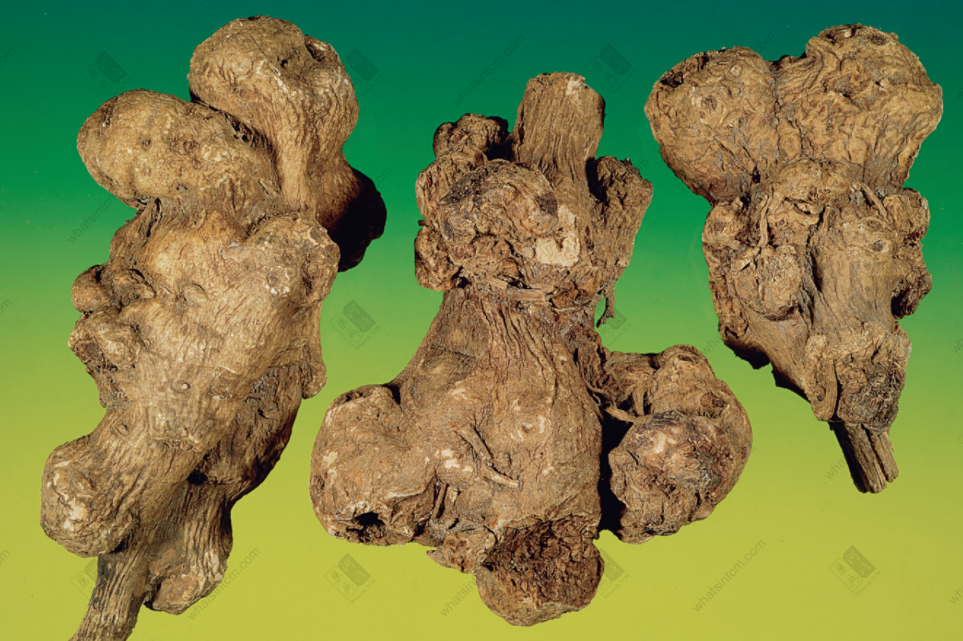
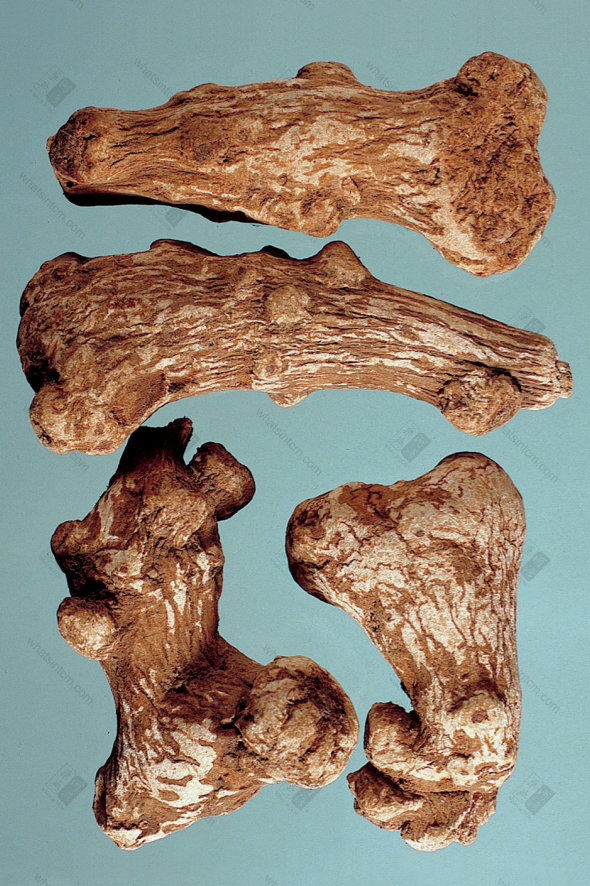 Bai Zhu (Zhe Bai Zhu) (Thick mass, grayish-yellow, lumpy, with grooves)
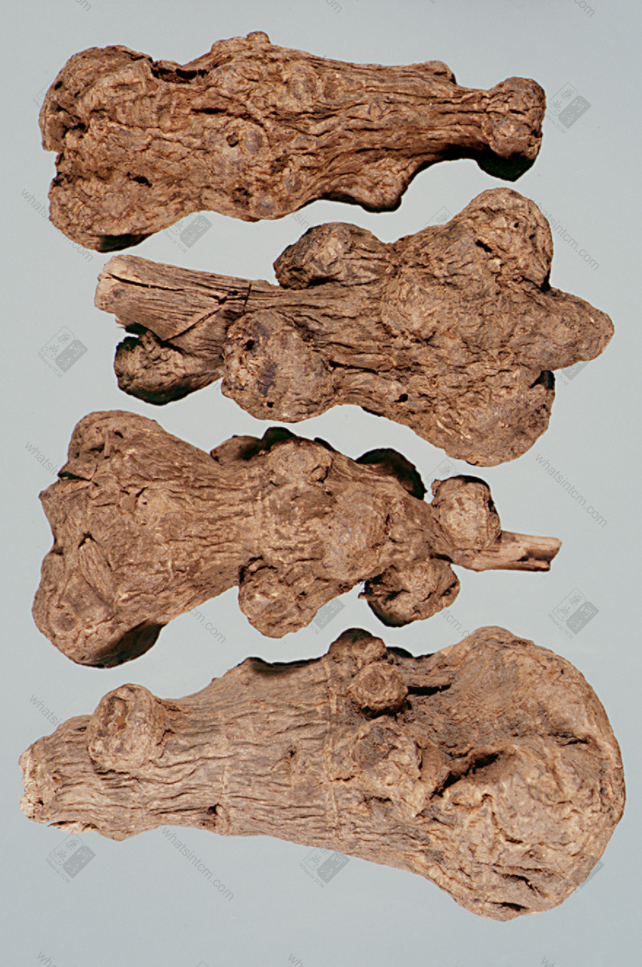 Zhe Bai Zhu (Zhu Tui – Atractylodes “leg”, Yun Tou – Cloud Head)
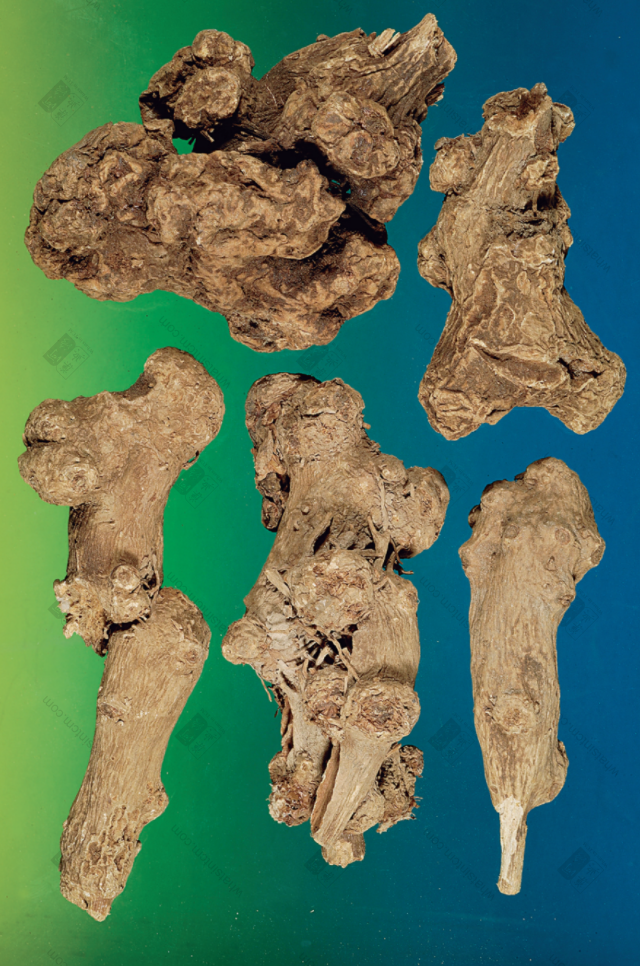 Cultivated Zhe Bai Zhu (Upper 2: Hua Zi – “Flower” nodules)
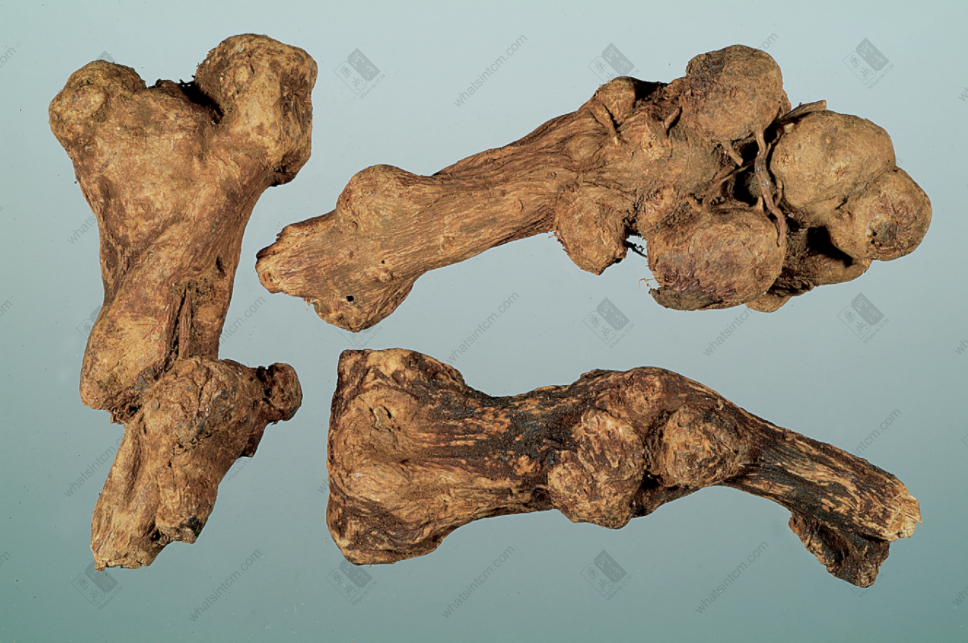 Bai Zhu (Yun Tou He Jing – Cloud Head Crane Stalk)
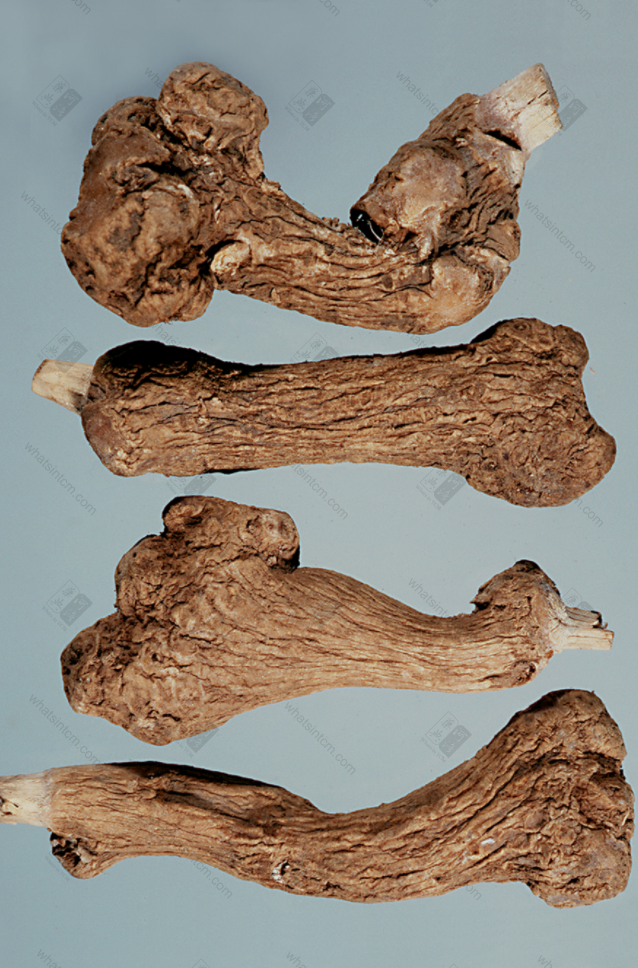 Tian Sheng Zhu (Yu Zhu – from Yuqian)
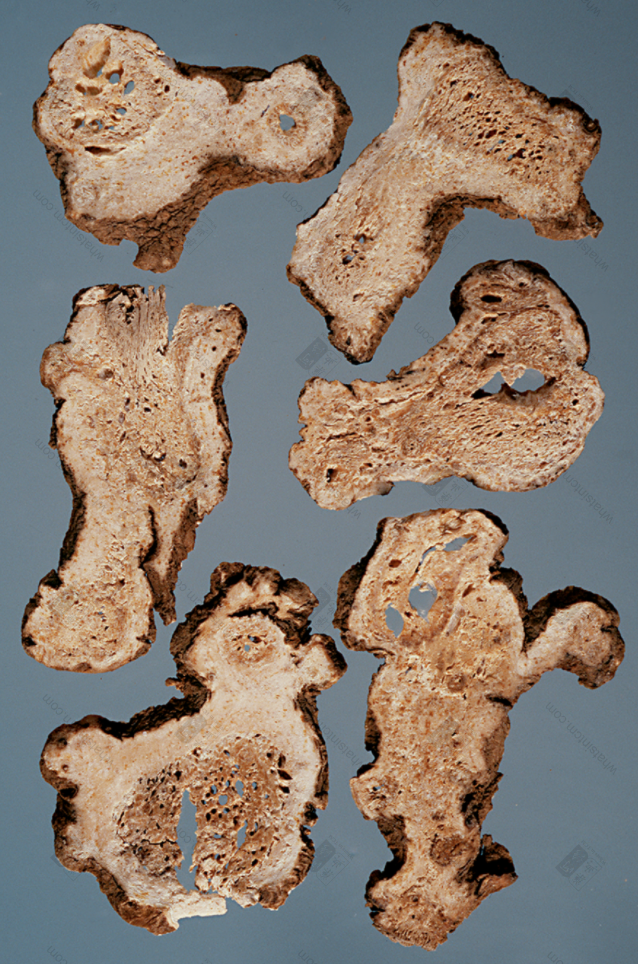 Bai Zhu Slices (<a href='https://whatsintcm.com/dt_articles/硃砂/’>Zhu Sha Dots) (Punctate oil chambers, aromatic and sweet)
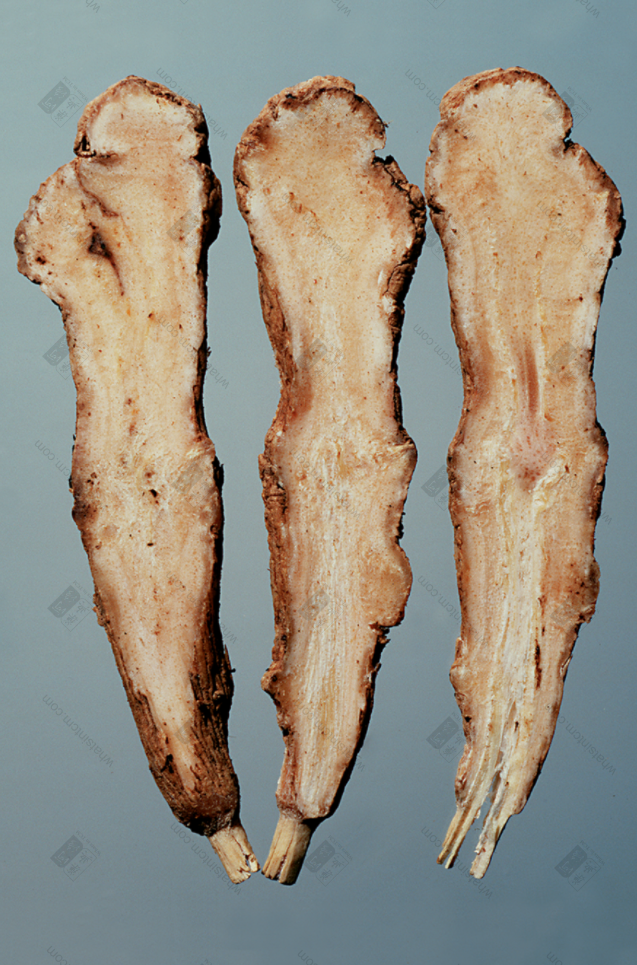 Tian Sheng Zhu Slices
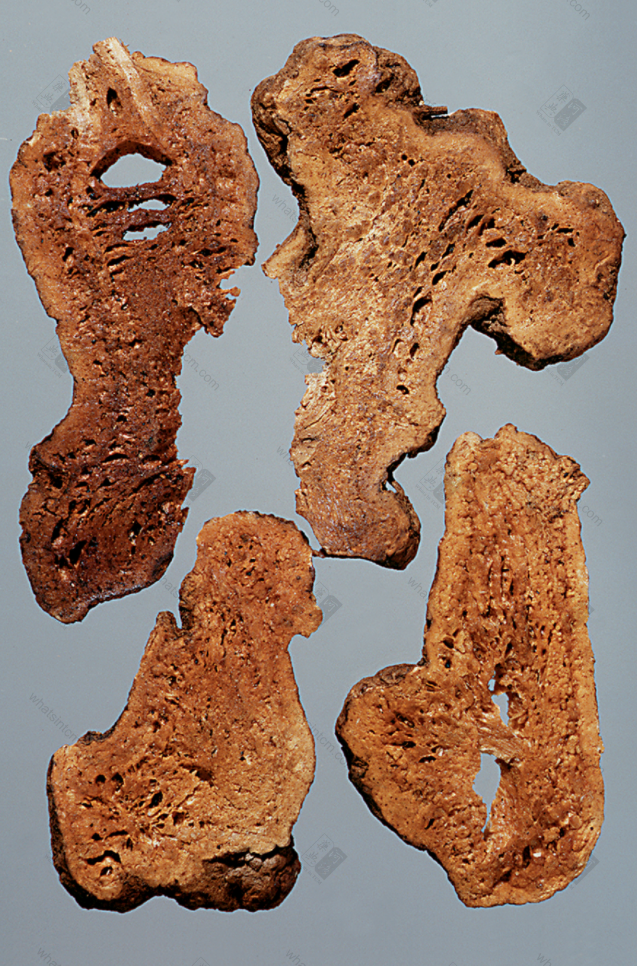 Bran-fried Bai Zhu Slices
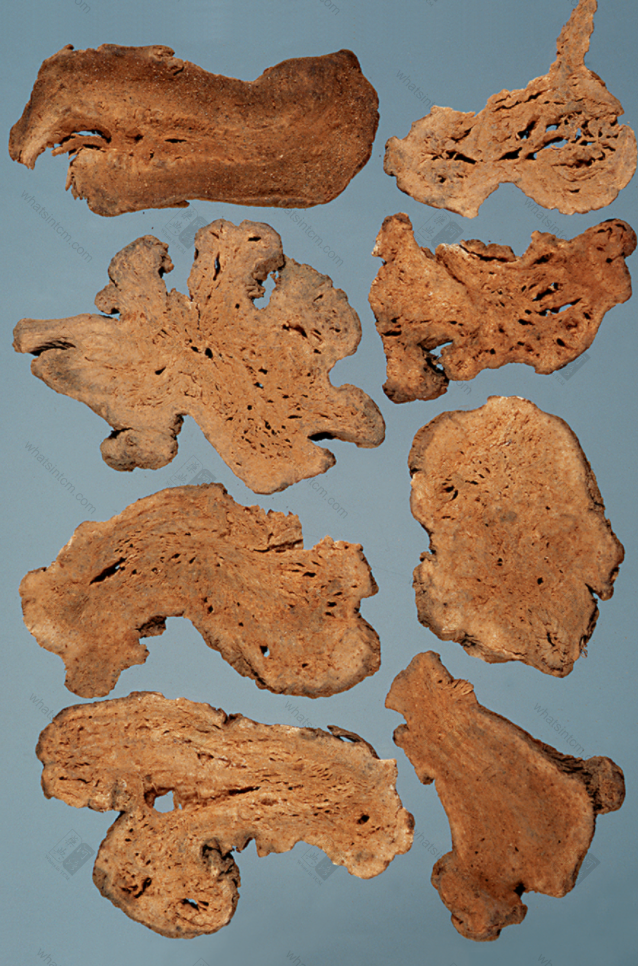 Earth-fried Bai Zhu Slices
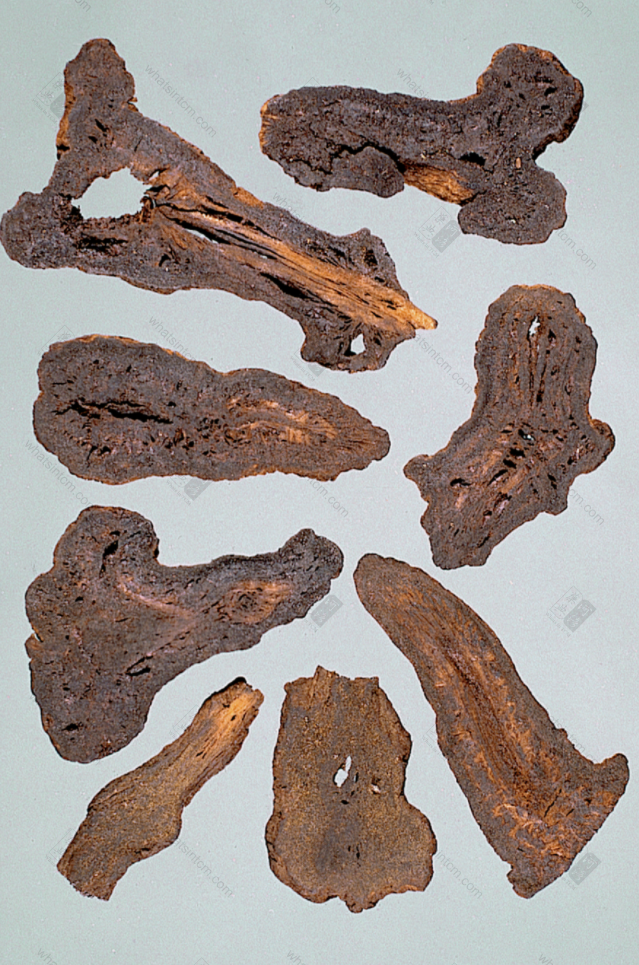 Bai Zhu Charred
【Naming】
【Source】
Shen Nong’s Classic of Materia Medica, Upper Class
【Common Usage Level】
A
【Botanical Origin】
The rhizome of Atractylodes macrocephala Koide., family Compositae.
【Characteristics】
The dried rhizome is a fist-shaped mass with irregular lumpy protrusions and obvious grooves. It is 5-8 cm long and 2-5 cm in diameter. The surface is grayish-yellow to brownish-yellow, with shallow and fine longitudinal wrinkles. The main axis of the rhizome extends upwards (commonly known as “crane’s neck”), so the whole is hoof-shaped. The lower part has irregular lumpy protrusions, which significantly enlarge towards the bottom and widen to both sides, and the enlargement is like a Ruyi head, commonly known as “cloud head”. It gradually thins upward, or retains a short section of woody hollow aerial stem like a small bamboo branch, commonly known as “Bai Zhu leg, Zhu leg”. At the top of the lumpy protrusions, there are often stem base remnants or bud scars, and the fibrous root scars are also more obvious. The texture is hard and not easy to break.
Prepared slices:
1. Raw Bai Zhu slices: These are transverse and oblique slices with irregular shapes, about 2-4 mm thick. The edges are grayish-yellow, and the inside is yellowish-white or light yellowish-brown. The cambium ring is brown, and there are yellow oil chamber dots everywhere. The inner side near the cambium layer has many pores. It has a clear, fragrant, sweet, and slightly pungent taste, and is slightly viscous.
2. Stir-fried Bai Zhu slices: These are irregular in shape, with brown edges and yellowish-white to yellowish-brown interiors. Most of the slices have cracks and oil chamber dots. The texture is hard and has a burnt aroma.
3. Charred Bai Zhu slices: These are the same size and shape as stir-fried Bai Zhu, but the color is darker, reddish-brown to blackish-brown.
4. Bai Zhu charcoal: The exterior is charred black.
【Processing】
1. Raw Bai Zhu 2. Earth-fried Bai Zhu 3. Bran-fried Bai Zhu 4. Bai Zhu Charcoal
【Identification】
《Prescriptions for Universal Relief》: “Bai Zhu with a white color is the best”. 《Compendium of Materia Medica》: “Those harvested in November and December are good”, “and those harvested in autumn are the best”, “with large pieces and purple flowers being superior”. 《Essentials of Materia Medica》: “Fat and white ones come from Zhejiang, named Yuntou Zhu (Cloud Head Atractylodes), dry and white ones come from Xuan and She, named Goutou Zhu (Dog Head Atractylodes), which is slightly better than Zhejiang”. 《Zeng Yao Bian》: “Small in shape with a very long crane’s neck, with <a href='https://whatsintcm.com/dt_articles/硃砂/’>cinnabar dots inside, and those with whiskers on the Atractylodes are especially good”.
It is best to have a dry body (after splitting, the inner core is hard and not damp, and there is a crisp sound when broken), large size, heavy weight, shaped like a “Ruyi head”, fine outer skin, yellow color with white inside (commonly known as fine-skinned white flesh), flat cross-section, no hard tendons, focus yellowish-white, with a cloud head, solid texture, and no hollow center.
【Identification Terminology】
1. Zhu Tui (Atractylodes “leg”): A section of woody aerial stem retained on the upper part of Bai Zhu is called “Zhu Tui”.
2. Cinnabar Dots: The surface of the medicinal material has nearly vermilion oil dots, such as Bai Zhu, etc.
3. Yu Zhu: Named because it is produced in Yuqian, Zhejiang. The medicinal material is spherical or oblate, as large as Pinellia.
4. Wu Zi: Refers to Bai Zhu with a body shape that is bifurcated more than twice.
5. Geda Ding: Refers to medicinal materials with numerous transverse protruding lenticels or conical pricks on the outer skin. The former is like Bai Zhu and Angelica dahurica, sometimes arranged neatly in four longitudinal rows; the latter is like Erythrinae Cortex.
6. Hua Zi (“Flower” nodules): Refers to lumpy nodules accumulated on the main body of Bai Zhu, accounting for more than 30% of the surface area.
7. Quan Bai Zhu (Fist Atractylodes): One of the commodity specifications of Bai Zhu medicinal materials. It refers to rhizomes that are thick like a fist, with good quality.
8. Yun Tou (Ruyi Head/Cloud Head): Refers to the entire Bai Zhu often having lumpy protrusions, with the lower part of the rhizome enlarged on both sides, shaped like a Ruyi head.
9. Yun Tou He Jing (Cloud Head Crane Stalk): The lower part of the Bai Zhu rhizome is enlarged on both sides and wart-like, like a Ruyi, called Yun Tou or Yi Tou; the lower part of the rhizome is thicker, gradually thinning downwards, and sometimes a section of aerial woody stem mark is left, which is called He Jing (Crane Stalk) or Bai Zhu Tui (Bai Zhu Leg) because it has a certain length.
10. Feng Tou He Jing (Phoenix Head Crane Neck): This is a description of the characteristics of wild Bai Zhu specially produced in Yuqian and Changhua, Zhejiang. This kind of Bai Zhu is thin and small in shape, with residual stems on the ground, shaped like a crane’s neck, and the rhizome part is slightly spherical, shaped like a phoenix head.
11. Dots: Generally refers to the oil dot marks on the cross-section of roots and rhizomes, that is, oil chambers or vascular bundles, etc. Such as the oil dots of Bai Zhu and Aucklandia; the “cinnabar dots” of Notopterygium and Atractylodes lancea; the “star dots” of Rhubarb are atypical vascular bundles, also known as “cinnabar dots”.
12. He Jing E Tun (Crane Neck Goose Butt): The rhizome of Bai Zhu is slightly longer, gradually thinning upwards, shaped like a crane’s neck; the lower part is full like a goose butt, commonly known as Crane Neck Goose Butt.
【Section】
Rhizomes
Related Products
