



Centipede
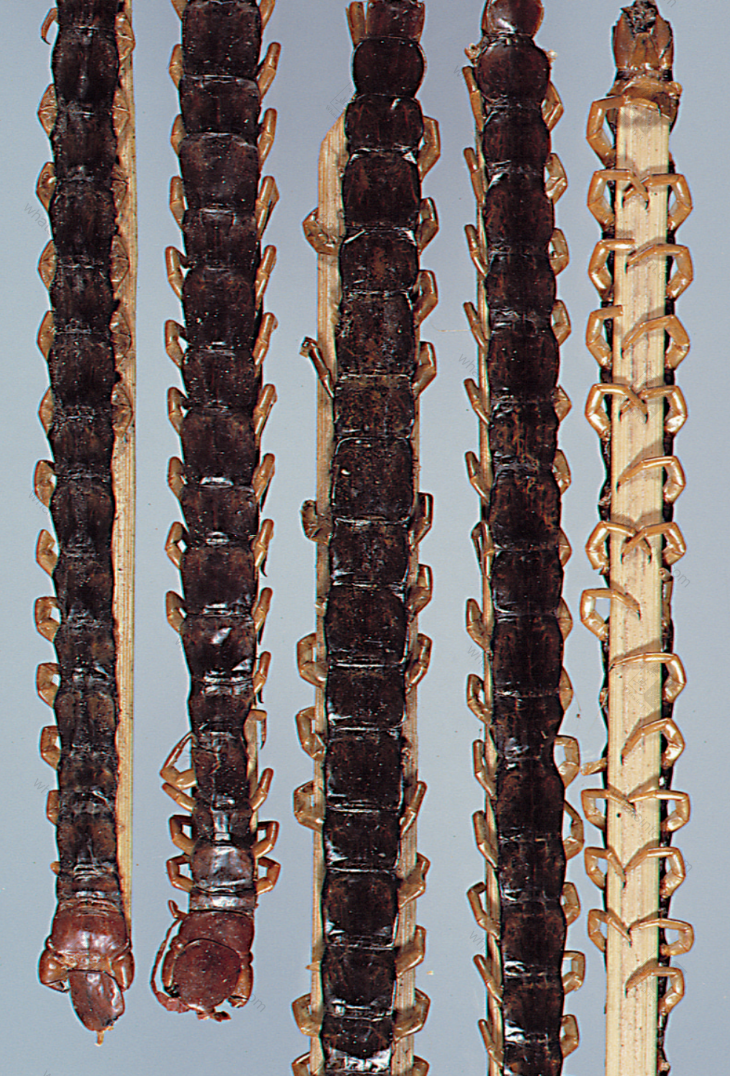 Centipede (Bamboo-propped, flat, long strip, head reddish-brown, back black-green, shiny, with uniform segments, 2 prominent ridges, fractured surface with gaps and emptiness, fishy odor)
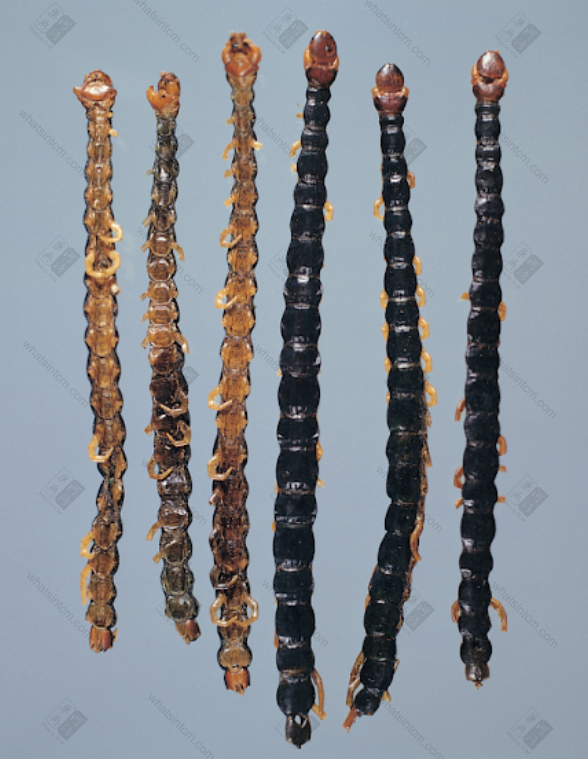 Wine-prepared golden-headed Centipede (Venomous jaws, venomous claws)
【Naming】
【Source】
Lower Grade in the Classic
【Common Usage Level】
C
【Botanical Origin】
The dried whole body of the Scolopendridae species Scolopendra subspinipes- mutilans (L.) Koch.
【Characteristics】
It is a flat, long strip, 14-16 cm long and about 6-10 cm wide. The head is reddish-brown, and the back is black-green, with a shiny appearance and 2 prominent ridges. The abdomen is brownish-yellow and shrunken. The legs are yellow or reddish-brown, curved backwards, and the last segment is like a thorn. There are holes in the head and tail made during processing. The cross-section has cracks or is hollow. It has a slightly fishy odor and a special pungent smell; the taste is pungent and slightly salty.
【Processing】
1. Remove the bamboo splints and crush before use. 2. Wine-fried Centipede
【Identification】
《Famous Doctors’ Records》: “Centipedes are poisonous. They grow mainly in Jiangnan. The ones with red heads and feet are good.” 《Illustrated Materia Medica》: “The ones that are flat, long, black, with red heads and feet are good.” 《Collection of Medical Formulas》: “Red-footed Centipedes are used to treat scorpion stings; the entire one is used for best results.” 《Collection of Medical Formulas》: “A pair of Centipedes, whole, are good.” 《Compendium of Materia Medica》: “The ones with red heads and feet are good.” 《Handbook of Benevolent Techniques》: “Centipedes with golden heads and red feet are the best.” 《Identification of Good and Bad》: “The ones with fat feet and fewer feet are high quality.”
The best are the ones that are dry, long, complete, with a black back and a yellow, shrunken abdomen. Generally, the best ones are those caught from the Winter Solstice to the Beginning of Spring, which are long, with a black back, yellow abdomen, shrunken belly, and are flexible and not easily broken when dry; those caught from the Beginning of Spring to Qingming are thin in flesh, have a black abdomen when dry, are easily broken, and are of poorer quality.
【Identification Terminology】
(Modern Terminology) 1. Venomous Jaws (Venomous Claws): The maxillipeds of the centipede, which are the first pair of appendages of the centipede. Located next to the mouth, they have strong claws at the end, with venom ducts inside, and have a stinging effect.
【Chapter】
Invertebrate Class