



Dung Beetle
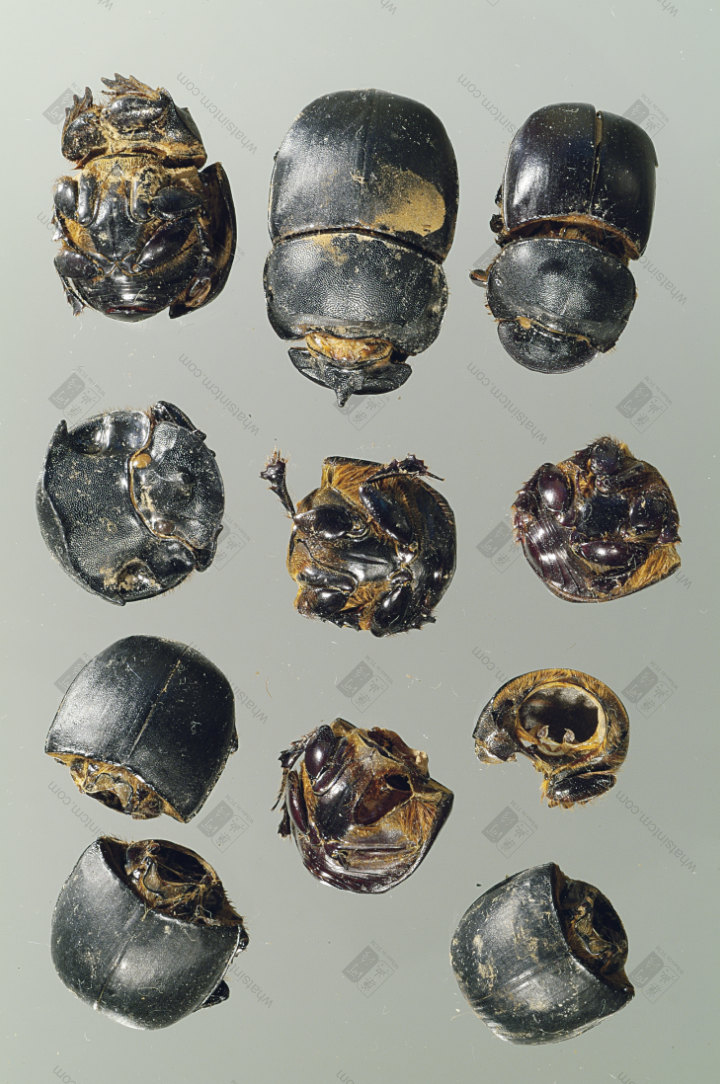 Dung Beetle (dung beetle) (dark brown, head anteriorly curved in a fan shape, female head without horn protrusions, hind wings yellowish-brown membranous)
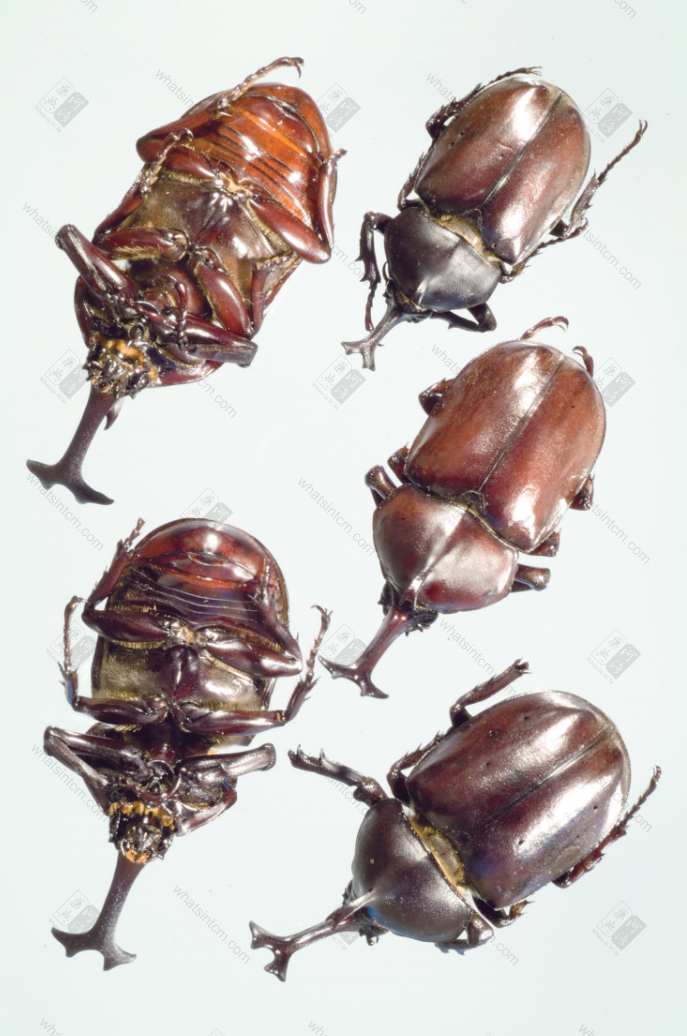 Dung Beetle (Japanese rhinoceros beetle)
【Naming】
【Source】
Shen Nong’s Herbal Classic, Lower Grade
【Common Usage Level】
E
【Origin】
It is the dried whole body of the dung beetle Catharsius molossus L. of the Scarabaeidae family. The Japanese rhinoceros beetle Allomyrina dichotoma (L.) is also used as this product, with similar efficacy.
【Characteristics】
1. Dung Beetle: The dried insect body is dark brown, 3-4cm long, 1.8-3cm wide. The male is slightly larger than the female. The male’s head is fan-shaped at the front and easily detached, with a single horn protrusion in the center, about 6mm long. The pronotum is a wide half-moon shape with a transverse ridge at the top and a horn protrusion on each side. The metathorax occupies about 1/2 of the body length and is covered by wings. The female has no horn-like protrusions in the center of the head and on both sides of the transverse ridge of the pronotum. The elytra are leathery, dark brown, with 7 longitudinal parallel lines; the hind wings are membranous, yellow or yellowish-brown. There are 3 pairs of legs. The body is hard and has a foul odor.
2. Japanese Rhinoceros Beetle: The body is very large, 36-60mm long, 20-23mm wide. The male has a strong bifurcated horn protrusion on the head. The whole body is reddish-brown, dark brown to dark black-brown, and shiny, especially the elytra. The head is small, the pronotum is broad and large, and there is a strong, forward-curving single-pronged horn protrusion in the center. The scutellum is obvious, the elytra are long and large, and the pygidium is short and wide. The ventral surface is shiny and covered with yellowish-brown fine hairs. The legs are well-developed, and there is a protrusion behind the coxa of the foreleg, with a smooth, arc-shaped line at the top.
【Identification】
The best are those that are black, dry, and intact.
【Chapter】
Invertebrates