



Mutong (Akebia Stem)
 Sichuan Mutong (Long cylindrical, curved, reddish-brown, hard, enlarged nodes with lateral branch scars, concave grooves and longitudinal striations)
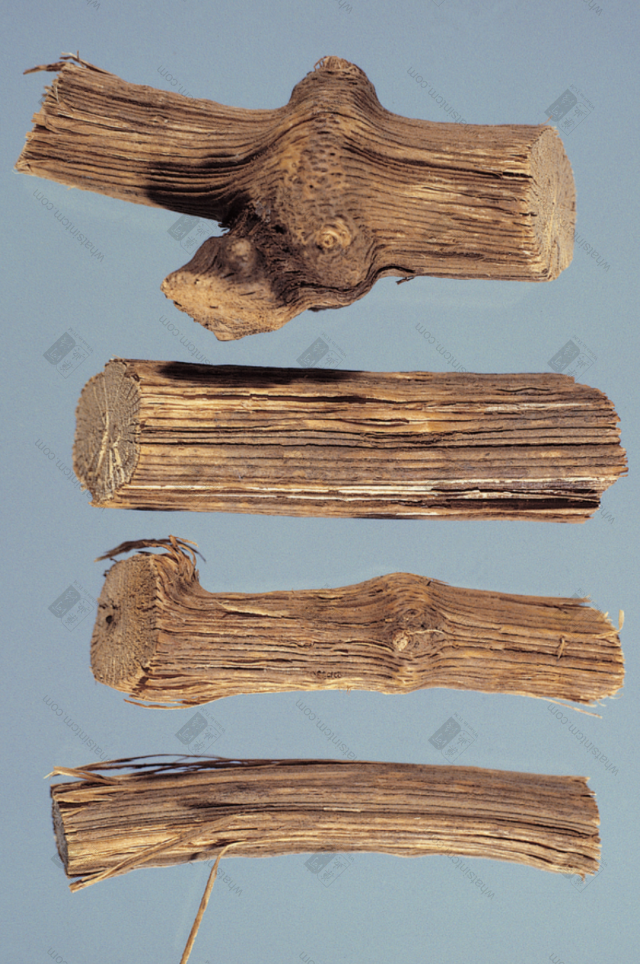 Sichuan Mutong
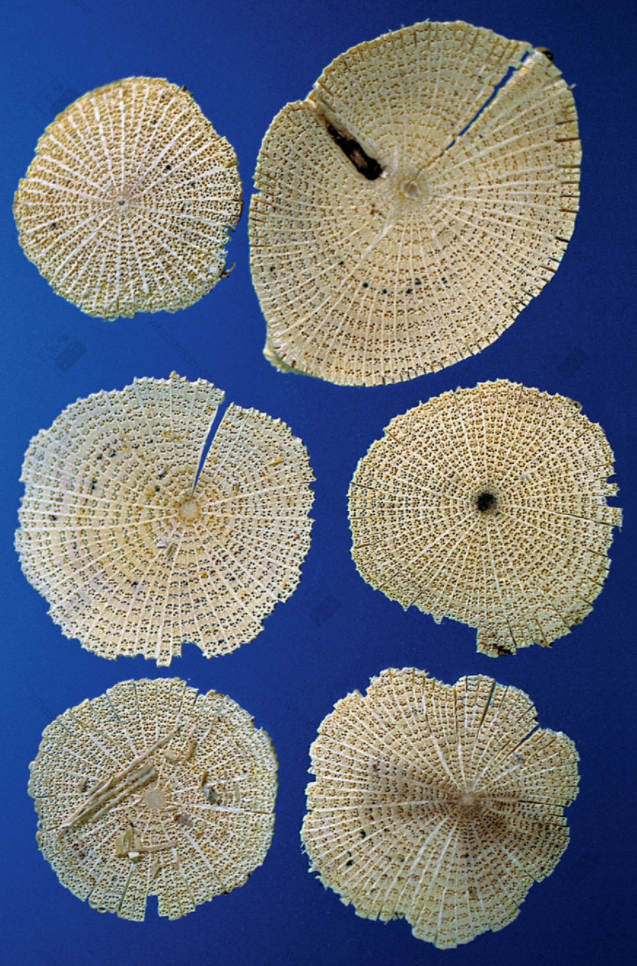 Sichuan Mutong Slices (Radially split appearance)
 Sichuan Mutong Slices
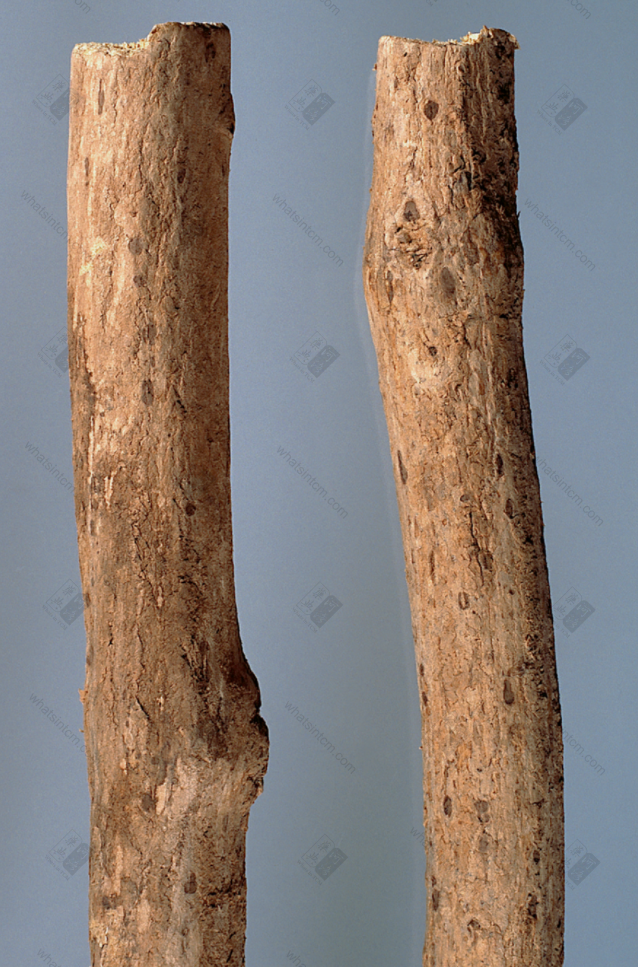 Guan Mutong (Cylindrical, grayish-yellowish-brown, rough, irregular cracks, enlarged nodes with branch scars, lightweight, thin and fibrous bark)
 Guan Mutong Slices (Round slices, small pores, xylem shows radiating yellow spoke-like patterns)
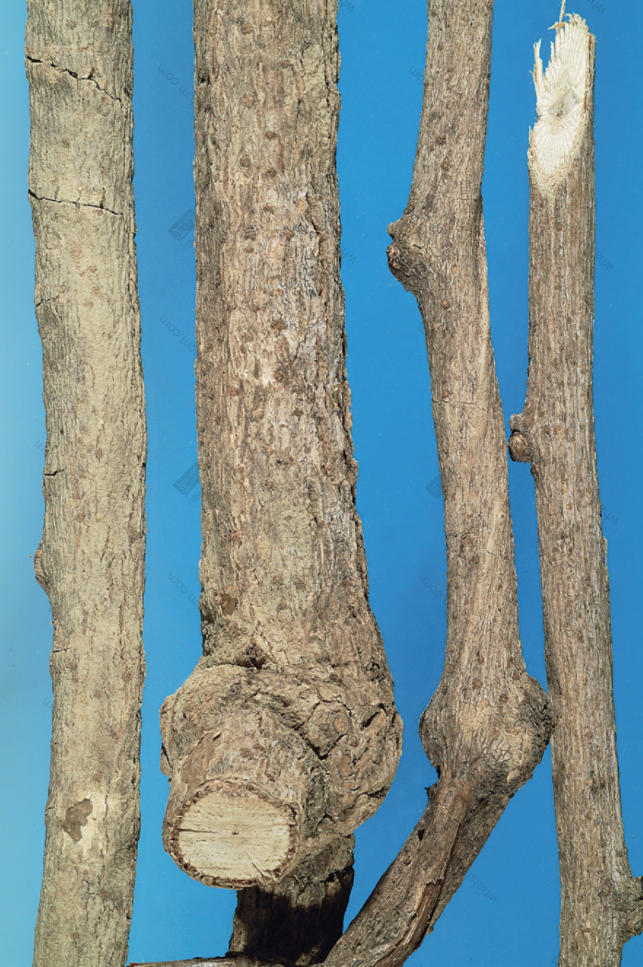 Bai (White) Mutong
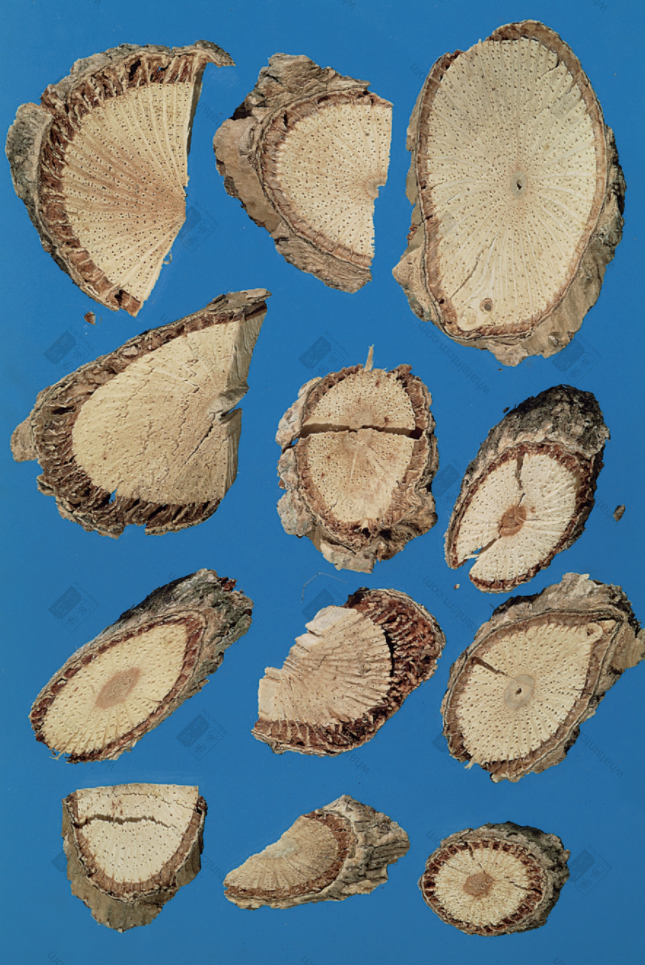 Bai (White) Mutong Slices
【Name】
【Source】
Classified as medium grade in the Shen Nong Ben Cao Jing (Divine Husbandman’s Classic of Materia Medica) under Tong Cao (Tetrapanax papyriferus)
【Common Usage Level】
B
【Botanical Origin】
Guan Mutong is the dried woody stem of Aristolochia manshuriensis (Kom.) Nakai, belonging to the Aristolochiaceae family. Chuan Mutong is the dried stem of Clematis armandi Franch., belonging to the Ranunculaceae family. Bai Mutong is the dried stem of Akebia quinata (Thunb.) Decne., belonging to the Lardizabalaceae family.
【Characteristics】
(1) The dried woody stem of Guan Mutong is cylindrical and curved. It is 30~60cm long and 1.2~2cm in diameter. The surface is grayish-brown, the outer bark is very rough with many irregular cracks, the nodes are not obvious, and only the scars of lateral branches can be seen. It is hard, difficult to break, and the fracture surface is fibrous. It has a faint odor and a bitter and astringent taste.
The sliced form is a thin, round slice about 0.2~0.4cm thick. The xylem accounts for the vast majority, the surface is grayish-yellow or grayish-brown, and there is occasionally coarse bark that has not been completely removed. The cross-section in the middle is filled with small pores of vascular bundles, which are interspersed with yellow lines to form a spoke-like pattern, and the vascular bundle groups are densely arranged in a spider web shape. The taste is extremely bitter.
(2) The dried stem of Sichuan Mutong is thin and cylindrical, 30~60cm long and 0.8~2cm in diameter. The outer skin is reddish-brown or grayish-yellow, mostly torn, easily separated from the xylem, with longitudinal striations. The vine stem nodes are enlarged, with traces of petiole and lateral branch abscission. The xylem is light yellowish-brown or yellowish-white. It is light and hard in texture and not easy to break. The sliced form is cut into small segments of 2~3cm, the cut surface is yellowish-white, showing a radial split shape, the arrangement of vascular pores is relatively sparse, the pith is obvious, the odor is weak, and the taste is bland.
(3) The dried stem of Bai Mutong is cylindrical and curved, 30~60cm long and 1.2~1.8cm in diameter. The surface is grayish-brown, rough, with many irregular cracks, the nodes are not obvious, and lateral branch scars can be seen. It is firm in texture, the fracture surface is uneven, the bark is yellowish-brown, the xylem is yellowish-white, and the vascular bundles are arranged radially. It has a faint odor and a bitter and astringent taste.
【Identification】
“Those that release air from the other end when blowing air into one end are good,” according to the Zheng Lei Ben Cao (Classified Materia Medica). “Mutong that are large and yellowish-white in color are best,” according to the Ren Shu Bian Lan (Handbook of Benevolent Arts). “Superior quality: yellow-white on a transverse fracture surface, spoke-like pattern, with small pores between the spokes, air comes out the other end when blown from one end, and tastes bitter,” according to the Liang Lie Jian Bie (Identification of Good and Inferior Qualities).
Superior quality: even stems without old skin, yellow inner bark, and a bright yellow fracture surface. Inferior quality: stems of uneven thickness, excessive curvature, with knots, and dark in color.
【Category】
Vine and Wood Category