

Palm Fiber
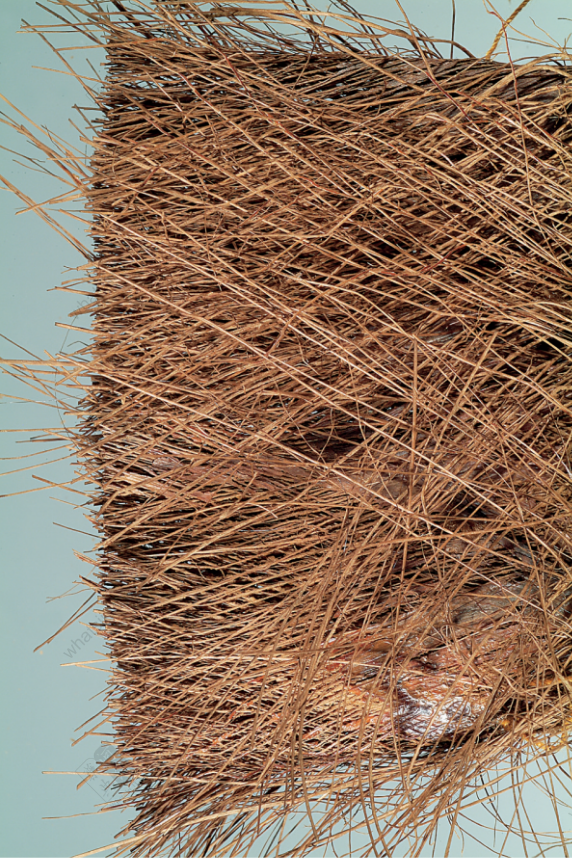
Palm Fiber (Red-brown, rough, with longitudinal sheath fragments, plate-like veins with brown hairs on both sides, and tough, hard fibers)
【Naming】
【Source】
Song Jiayou era
【Frequency of Use】
E
【Botanical Origin】
The dried petioles or aged petioles and sheath fibers of the Palm family Palm Trachycarpus fortunei H. Wendl.
【Characteristics】
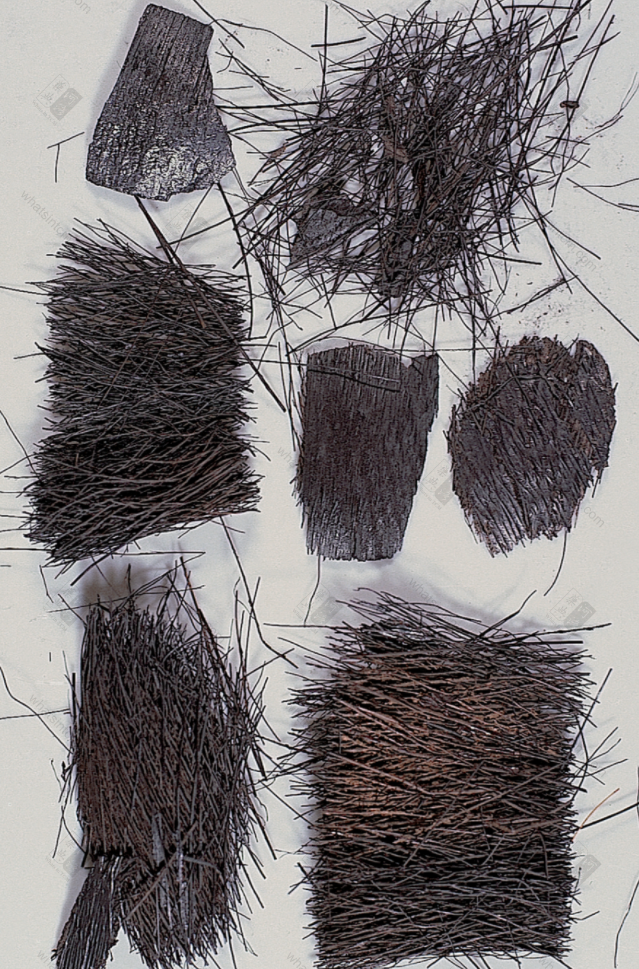
Aged Palm bark is called “Chen Zong Pi.” Some merchants use the petiole portion, shaving off the outer fibers and drying it, calling it “Zong Gu.”
(1) Chen Zong Pi: These are coarse, long fibers, in bundles or flakes, of varying lengths from 20 to 40 cm. They are brownish-red, tough, not easily torn, odorless, and have a bland taste.
(2) Zong Gu: These are long strips of varying lengths, reddish-brown, wider and flatter at the base, gradually narrowing and thickening upwards. The back is raised in the center, forming a triangle. The sides of the back are flat, with thick, dense reddish-brown fuzz. The ventral surface is flat. After removing the epidermis, tough fibers can be seen. The texture is tough and cannot be broken. It is odorless and has a bland taste.
(3) Chen Zong: This appears as broken, net-like pieces, deep brown in color, rough, tough, not easily broken, with a slight odor and a bland taste.
【Preparation】
Carbonized Chen Zong
【Identification】
Ben Cao Bei Yao: “Old, decayed palm fiber is especially good.”
Hui Sheng Ji: “Palm Fiber (the best is from trees several decades old).”
1. Chen Zong Pi: The best is one with no coarse bark, no impurities, and aged.
2. Zong Gu: The best is reddish-brown, with large pieces and a thick texture, and aged.
3. Chen Zong: The best is one that is dark black and free of impurities.
【Category】
Leaves