


Have you seen Cinnabar’s original form? It’s not what you’d expect.
Introduction to Medicinal Materials
- Cinnabar Ore
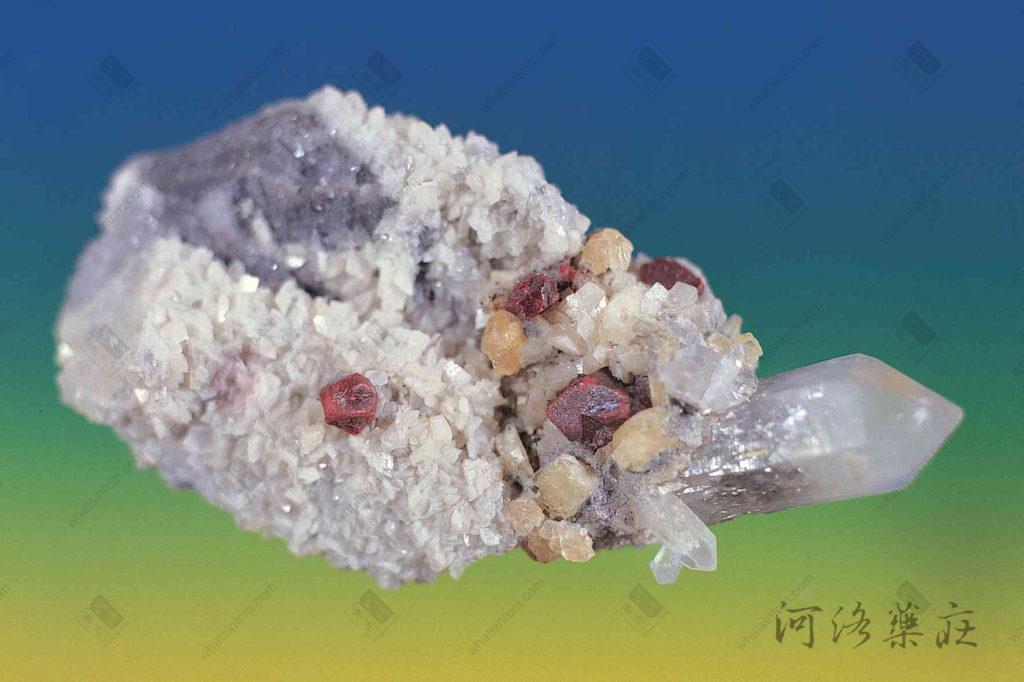
Cinnabar, also known as Chensha or Dan Sha, was an important raw material for ancient alchemy. Its main component is mercury sulfide. In Chinese history, the most famous female tycoon during the Warring States period amassed her wealth through the trade of cinnabar. Qin Shi Huang even specially built the Huaiqing Pavilion for her in present-day Chongqing to honor her virtue. This woman was Ba Widow Qing, later known as Ba Qing. Sima Qian of the Han Dynasty also recorded her in the ‘Records of the Grand Historian.’ This illustrates the greatness of this woman and further shows that cinnabar was a very important mineral during the Warring States period.
In ancient times, cinnabar was used for many purposes. In addition to being used as a dye, purified cinnabar, with sulfur removed, could also be used to extract mercury. It could also be used for preservation. It is said that besides thousands of terracotta warriors, Qin Shi Huang’s mausoleum also featured a moat. The shimmering, flowing metallic substance used as the ‘river water’ in this moat was mercury, and such a large quantity of mercury was extracted from cinnabar. Furthermore, cinnabar was often used in many ancient tombs for its preservative and anti-theft properties.
In Traditional Chinese Medicine (TCM), cinnabar is used as a sedative. Its main component is mercury sulfide (HgS). It is primarily produced in southwestern regions such as Sichuan, Guizhou, Guangxi, and Yunnan. It can be mined year-round. After mining the raw ore, it is split open to extract the small amount of cinnabar embedded in the rock. The ore is then crushed. Because cinnabar is denser than water, water is added to the crushed ore to remove impurities floating on the surface. The cinnabar settled at the bottom is then collected and dried. Its quality is best when it is bright red, slightly translucent, and lustrous.
However, dried cinnabar must undergo processing (Paozhi) before it can be used. A common processing method involves first using a magnet to remove iron-containing impurities. Then, it is placed in a mortar with an appropriate amount of water and finely ground. Afterward, a large amount of clear water is added and stirred. After resting for a period, once the coarser particles settle and the fine powder remains suspended in the water, the upper suspension is collected. The coarser powder at the bottom is then reground with clear water. This grinding and collection of the upper suspension is repeated until no more can be extracted. Finally, the collected suspensions are combined and allowed to settle, then dried and ground into powder for storage and future use. This processing method is called ‘water levigation’ (Shui Fei Fa), primarily used to remove impurities from the medicinal material and ensure a singular therapeutic effect. Depending on its quality, there are also different ways to identify it; please refer to the website (https://whatsintcm.com/硃砂). During the processing of cinnabar, it must not be calcined by fire, otherwise, mercury poisoning may occur upon use.
Regarding the debate on whether cinnabar is toxic or non-toxic, there has been ongoing controversy throughout various historical herbals (Bencao). Among them, ‘Ming Yi Bie Lu’ from the Wei-Jin period, and ‘Kai Bao Bencao’ and ‘Tu Jing Bencao’ from the Song Dynasty, all recorded it as non-toxic. However, another record states it is non-toxic when used raw but toxic when calcined by fire. This viewpoint originated from Li Shizhen’s ‘Compendium of Materia Medica’ (Bencao Gangmu) in the Ming Dynasty. It states: ‘Dan Sha, Ming Yi Bie Lu says it is non-toxic, while Qibo and Zhen Quan say it is toxic, which seems contradictory. According to He Mengchun’s Yudong Lu, Dan Sha is cold in nature and non-toxic, yet it can kill, as its properties change when subjected to fire. This statement is correct.’ In the Qing Dynasty, Chen Shiduo’s ‘Bencao Xinbian’ (New Compendium of Materia Medica) also held a similar view, stating: ‘Dan Sha… is non-toxic when consumed raw, but deadly when refined and consumed.’ Thus, the debate over cinnabar’s toxicity has raged for over a millennium. Currently, the 2015 ‘Pharmacopoeia of the People’s Republic of China’ lists this substance as toxic, advising against large doses or prolonged small doses, and prohibiting its use by pregnant women and those with impaired liver or kidney function.
In Taiwan, based on official document No. Shu Shou Yao Zi 0940002424, the manufacturing, dispensing, import, export, sale, or display of cinnabar for use in Traditional Chinese Medicine has been prohibited since May 1, 2016. This demonstrates that the prohibition of cinnabar is the current trend. However, many famous and highly effective formulas, such as Angong Niuhuang Wan (https://whatsintcm.com/宮牛黃丸/), contain mineral medicinal materials like cinnabar and realgar. Their remarkable efficacy in clearing heat, detoxifying, calming convulsions, and resuscitating consciousness is evident. In modern times, they are used for conditions such as epidemic cerebrospinal meningitis, uremia, hepatic coma, cerebrovascular accidents, craniocerebral trauma, and high fever caused by infection or poisoning. Their effects are very significant, making them invaluable medicinal materials. Nevertheless, whether they should be banned or how they can be safely used still requires further research and discussion by all.
- Cinnabar (granular lumps, vivid red, extremely heavy, smooth and bright, diamond-like luster, brittle and easily fractured)

- Synthetic Cinnabar

- Left: Mirror Cinnabar

- Cinnabar Translucence

About the Author – Chen Ta-chen

Education
Ph.D. in Chinese Medicine, China Medical University
Current Positions
Compiling Committee Member for the Common Textbook of Chinese Medicine Colleges and Universities, Chinese Materia Medica Subject
Distinguished Lecturer, Industrial Technology Research Institute (ITRI)
Adjunct Lecturer, Post-Baccalaureate Program in Chinese Medicine, China Medical University
Adjunct Assistant Professor, Department of Pharmacy, Chia Nan University of Pharmacy and Science