


Honeysuckle, a common TCM herb in antiviral teas, should be used with caution by individuals with a certain genetic disorder
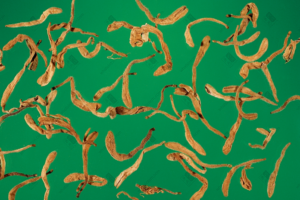
Honeysuckle: Also known as Jia Yin, it has slender, rod-shaped buds, with a pale yellow-white to pale green surface and hairy green calyx.
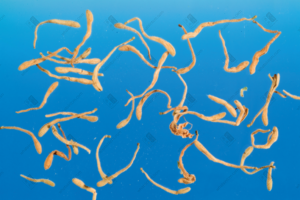
Honeysuckle: Lower quality.
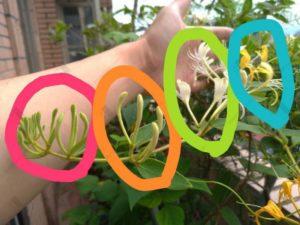
Honeysuckle plant: From left to right, the buds gradually mature, finally turning golden flowers. The bottom right shows its seeds.
“Its nature like autumn chrysanthemum, its color like silver, it does not covet luxury or worldly dust. It knows the warmth and cold of bitter rain and harsh winter, its loyal heart helps the common people in the summer heat. It smiles with joy in the spring breeze, and is close to the people with its cooling properties in the summer. Even if its value is millions, it emits no vulgar fragrance.”
– Anonymous This poem vividly describes the color of honeysuckle and its resilient nature, blooming even after the harsh winter. It also highlights its cooling properties and pleasant fragrance when in bloom.
Honeysuckle (https://whatsintcm.com/dt_articles/%e9%87%91%e9%8a%80%e8%8a%b1/) according to the third edition of the Taiwan Pharmacopoeia, is the dried flower buds or newly opened flowers of Lonicera japonica Thunb., a plant of the Caprifoliaceae family. The plant is called honeysuckle, or Shuang Hua (double flower) or Er Hua (two flower), because its flowers exhibit both golden and silver colors when blooming. Due to its vining nature, it is also known as Jin Yin Teng (golden silver vine) or Er Bao Teng (two treasures vine). As it remains evergreen through winter, it is also called Ren Dong (enduring winter), or Ren Dong Teng (enduring winter vine). Honeysuckle is mainly produced in Henan and Shandong provinces, with Mi Yin Hua from Xinmi, Henan being of higher quality. Dong Yin Hua from the Yimeng Mountains in Shandong is also highly regarded. In Taiwan, thanks to the climate and advancements in agricultural technology, honeysuckle is organically cultivated near Sun Moon Lake in the central region, Pingtung in the south, and even Taitung in the east. Therefore, honeysuckle is cultivated on nearly the entire island of Taiwan, and its quality is excellent.
In “Ben Jing Feng Yuan,” it is recorded: “Honeysuckle detoxifies and removes pus, it supplements while purging. It is a divine medicine for festering sores after they have ulcerated.” This indicates its excellent antibacterial properties and its effectiveness in treating festering sores. It also possesses properties for clearing heat and detoxifying, and is effective for fever caused by epidemic febrile diseases. During the SARS epidemic, this herb was found to have excellent antiviral effects, leading to its widespread popularity. With the severe COVID-19 pandemic, people began purchasing antiviral tea packs to boost their immunity. Honeysuckle is a common ingredient in these antiviral tea packs. Therefore, attention should be paid when selecting it. According to the pharmacopoeia, honeysuckle refers to dried flower buds. When selecting, prioritize unopened buds, hence the saying “pick needles, not flowers.” Top-grade honeysuckle has a higher proportion of flower buds, some pharmacies refer to it as “Da Bai Zhen” (big white needle). Additionally, be wary of excessive non-medicinal parts, such as small branches or leaves mixed into the medicinal material. Finally, check for fine sand mixed in during harvesting, as unscrupulous merchants use these methods to increase weight. These are initial steps in selecting the herb. Next, touch the herb; it should have a tactile sensation, known as “ding shou gan” (hand-gripping sensation). Good quality honeysuckle will have this sensation when held. However, remember that this is still a flower bud. If it breaks easily with a grip or lacks fuzz on the surface, it may have been soaked in alum solution. Besides touching, smell it; a clear fragrance indicates good quality, while a sour smell might suggest problems during storage or processing. Furthermore, a herb called Shan Yin Hua (mountain honeysuckle) can also be found in the market, mainly used for making herbal teas. It resembles honeysuckle, but differs in that Shan Yin Hua’s surface is greenish-brown to yellowish-white, about 3-4.5cm long, with an upper diameter of about 2mm and a lower diameter of about 1mm. It also has less fuzz. These three points serve as distinguishing features.
Depending on clinical needs, honeysuckle undergoes different processing methods. Commonly, it is stir-fried over low heat until the surface darkens, then quickly removed and cooled, known as fried honeysuckle. Another method involves washing the honeysuckle, placing it in a hot pan, stir-frying over medium heat until the surface turns dark brown, then spraying a small amount of water to extinguish any sparks, and quickly spreading it out to cool, which is then used as honeysuckle charcoal. Honeysuckle that has already bloomed can be used to extract its floral dew, which is beneficial for thirst caused by summer heat or sore throat.
Although this herb is common and has numerous benefits, its medicinal properties are cold. Therefore, individuals with spleen and stomach deficiency-cold should use it cautiously. Additionally, those with the genetic disorder G-6-PD deficiency, also known as “glucose-6-phosphate dehydrogenase deficiency” and commonly called “favism,” must not use it. This disorder is an X-linked chromosomal deficiency, making it more prevalent in males who have only one X chromosome. The main symptom is the destruction of red blood cells after contact with or ingestion of certain substances, leading to anemia. If symptoms such as paleness, rapid heartbeat, shortness of breath, reduced activity, fatigue, and tea-colored urine appear, seek medical attention immediately. Furthermore, imported medicinal materials in Taiwan undergo testing for sulfur dioxide and heavy metals such as arsenic (As), cadmium (Cd), and mercury (Hg) as required by the government, ensuring their safety for public use.
【Image Provider】Professor Chang Hsien-che, “Illustrated Guide to Authentic Chinese Materia Medica,” https://whatsintcm.com
【Author Introduction】
Education: Ph.D. in Chinese Medicine, China Medical University
Current Position: Assistant Researcher, Center for Medical Intelligence, Taichung Tzu Chi General Hospital
Editor, Committee for Compiling Common Textbooks for Chinese Medicine Schools Nationwide, Department of Chinese Materia Medica
Distinguished Lecturer, Industrial Technology Research Institute
Adjunct Lecturer, School of Post-Baccalaureate Chinese Medicine, China Medical University
Adjunct Assistant Professor, Department of Pharmacy, Chia Nan University of Pharmacy and Science
Co-founder, Heluo Pharmacopoeia, www.whatsinTCM.com