



Introduction to Easily Confused Chinese Medicines in the “Qing Guan Yi Hao” Antiviral Formula
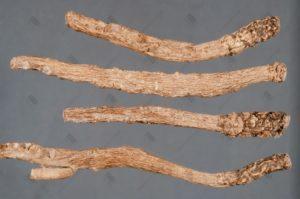
Raw Northern Ban Lan Gen: Nodules are visible
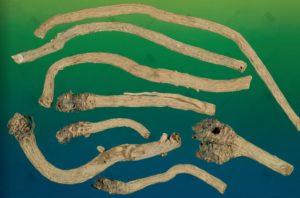
Raw Northern Ban Lan Gen: Cylindrical, twisted shape, grayish-yellow, with longitudinal striations and lenticels
The Traditional Chinese Medicine Division of the Ministry of Health and Welfare in Taiwan recently issued a temporary drug license for “Qing Guan Yi Hao (NRICM101)”, allowing domestic pharmaceutical companies to manufacture the drug during the epidemic. This allows the antiviral formula to be sold abroad and used in Taiwan. It is currently mainly distributed to hospitals for the treatment of COVID-19 patients. The formula primarily consists of ten medicinal herbs: Houttuynia cordata, Northern Ban Lan Gen, Scutellaria baicalensis, Trichosanthes kirilowii fruit, Schizonepeta tenuifolia, Morus alba leaf, Mentha haplocalyx, Magnolia officinalis, Saposhnikovia divaricata, and Prepared Licorice. It is mainly used for external pathogenic epidemics, with functions of releasing the exterior, promoting lung function, clearing heat and detoxifying, broadening the chest and resolving phlegm, harmonizing the stomach, and descending qi. This formula is mainly based on the “Jing Fang Bai Du San” from the “She Sheng Zhong Miao Fang” compiled by Zhang Shiche during the Ming Dynasty, with modifications and additions.
The medicinal herbs Magnolia officinalis and Prepared Licorice in the formula have been introduced previously and will not be elaborated upon here. This article will focus on Northern Ban Lan Gen.
According to the third edition of the Taiwan Pharmacopoeia, its source is the dried root of Isatis indigotica Fortune, a plant in the Brassicaceae family. It is mainly produced in Hebei, Anhui, Jiangsu, and Henan provinces, and some cultivation is also carried out in Taiwan, with breed improvements leading to several times higher active components than the original. This is a market worth developing. As it is a root herb, it is mainly dug up in autumn. After digging, it is cleaned of mud and sand, air-dried, impurities are removed, washed, sliced, and dried before use. Its quality can be identified in several ways. Firstly, by observing the color of the outer bark of the sliced root; typically, a yellowish-white outer layer and a brown pith and cambium layer are considered good. Secondly, by tasting it. The correct herb is slightly sweet when placed in the mouth, followed by a bitter taste after a few seconds, and then a slightly astringent sensation. As it is a plant in the Brassicaceae family, the entire tasting process will have a radish-like aroma. If this aroma is absent, it may be a counterfeit product. Another easily confused herb due to similar names is Southern Ban Lan Gen. According to the third edition of the Taiwan Pharmacopoeia, its source is the dried rhizome and root of Strobilanthes cusia (Nees) Kuntze, a plant in the Acanthaceae family. It is mainly produced in Guangdong, Fujian, Sichuan, and Guangxi provinces. Due to suitable climate and soil, there is sporadic cultivation in Taiwan. It is usually harvested in summer and autumn, cleaned of mud, sand, and aerial parts, washed, and sun-dried. Traditionally, long, stout pieces with short aerial stems are preferred.
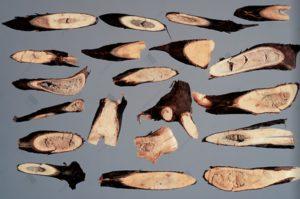
The main differences between Northern Ban Lan Gen and Southern Ban Lan Gen can be identified in several ways: Generally, Northern Ban Lan Gen has a grayish-yellow surface with longitudinal wrinkles and protruding lenticel-like structures. Southern Ban Lan Gen appears grayish-brown with swollen nodes, fine roots, or stem remnants. Furthermore, Northern Ban Lan Gen is typically solid, soft, with a yellowish-white bark and a brown pith. Southern Ban Lan Gen is usually hard and brittle, with a blue-gray bark, grayish-blue pith, and often a pith in the center. Finally, because Northern Ban Lan Gen is a Brassicaceae plant, it has a radish-like aroma when tasted, while Southern Ban Lan Gen does not have this taste. The above are a few simple identification methods for consumers to refer to when purchasing.
Additionally, “Qing Guan Yi Hao” is a prescription drug for treatment. Its main mechanism is to inhibit the entry of the novel coronavirus into cells. It can only be prescribed by a licensed Traditional Chinese Medicine practitioner and is not a health supplement tea that can be taken long-term for epidemic prevention. The formula is primarily used for confirmed cases, both mild and severe, and not for generally healthy individuals. There are also rumors in society that this formula can treat the common cold. Basically, this formula is based on “Jing Fang Bai Du San” with additions and subtractions. “Jing Fang Bai Du San” is mainly used for symptoms of external contraction of wind-cold and dampness, chills, fever, headache, and stiff neck. Therefore, some physicians may use it for patients with the common cold. Since “Qing Guan Yi Hao” is based on this, it will have a certain therapeutic effect. However, the fastest and best approach is to consult a qualified Traditional Chinese Medicine practitioner and avoid self-medicating in haste; accurate diagnosis and treatment are essential for the most comprehensive care.
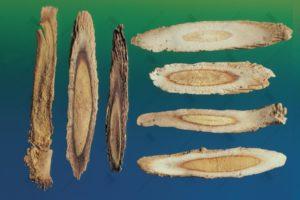
Northern Ban Lan Gen slices: The outer bark layer is yellowish-white, and the cambium layer is brown.
【Image Provided By】 Professor Zhang Xianzhe, “Illustrated Compendium of Authentic Medicinal Materials” https://whatsintcm.com
【Author Introduction】 Chen Da Zhen
Education: Ph.D. in Traditional Chinese Medicine, China Medical University
Current Position: Assistant Researcher, Medical Intelligence Center, Taichung Hospital, China Medical University Hospital
Editor, Traditional Chinese Medicine Subject, National Traditional Chinese Medicine Curriculum Development Committee
Distinguished Lecturer, Industrial Technology Research Institute
Part-time Lecturer, School of Post-Baccalaureate Chinese Medicine, China Medical University
Part-time Assistant Professor, Department of Pharmacy, Kaohsiung Medical University
Co-founder, Heluo Pharmacopoeia www.whatsinTCM.com
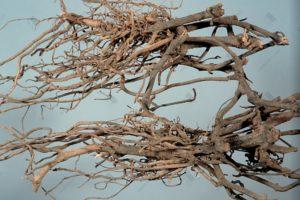
Raw Northern Ban Lan Gen: Cylindrical, twisted shape, grayish-yellow, with longitudinal striations and lenticels
Southern Ban Lan slices: Blue-gray color visible in the bark and pith.