



Licorice: More Than Meets the Eye, Usage Requires Care
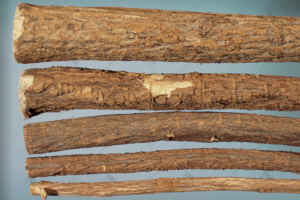
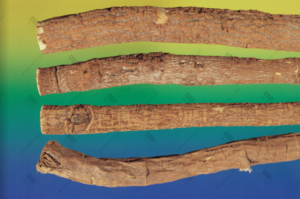
Licorice: From top to bottom, these are Special, A-grade, B-grade, C-grade, and D-grade licorice.
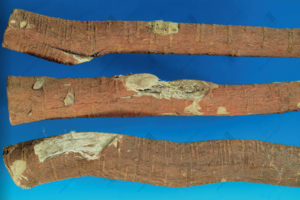
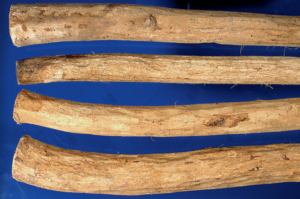
Liangwai Special Grade Licorice: Reddish-brown, long cylindrical shape.
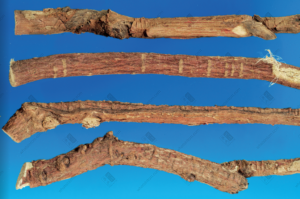
Liangwai D-grade Licorice: Ends are flat and even, skin is tight.
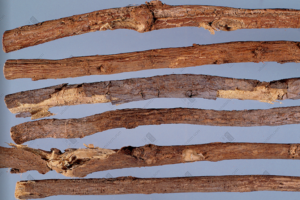
Xizhen Licorice: The bottom four (pieces) are Liangwai Licorice, long and cylindrical.
【Image Source】Professor Chang Hsien-che, “Authentic Materia Medica Illustrated Guide” 【Author】Chen Ta-chen
Licorice comes in many varieties; a sweet taste doesn’t necessarily mean it’s the correct kind. Pay attention when purchasing.
“This beautiful herb, destined to become a staff, grows precariously on Horse Mountain. From the south, it follows the old man with a bamboo basket, rather entering the Dragon Transformation Pond. It goes to be gathered by the people of Qin, and comes to aid the ailing guests of Chu. Among medicines, it is hailed as ‘Guolao’ (the Elder of the State), but how can it cure my laziness?” —<Mei Yaochen, Song Dynasty>
Licorice is a medicinal herb with a long history of use. It was recorded in China’s oldest dictionary, “Erya,” and has a history spanning over four millennia. During the Wei, Jin, Northern and Southern Dynasties, “Shennong Ben Cao Jing” (The Divine Farmer’s Materia Medica) recorded: “Licorice, sweet in taste, neutral in nature. It primarily treats pathogenic cold and heat in the five zang organs and six fu organs, strengthens sinews and bones, promotes muscle growth, doubles strength, treats carbuncles and swellings from wounds, and detoxifies.” This illustrates its remarkably diverse and significant efficacy, earning it the title “Guolao” (Elder of the State). This title is primarily due to its ability to harmonize various medicinal ingredients. Consequently, in “Shanghan Lun” (Treatise on Cold Damage), written by Zhang Zhongjing during the Eastern Han Dynasty, over 60% of the prescriptions contain licorice, used to enhance their efficacy. Beyond its use in Eastern countries, licorice was also documented in Europe and West Asia, appearing in the “Code of Hammurabi,” one of the world’s oldest legal codes, dating back over two millennia BCE. After 1820 CE, licorice was included in the United States Pharmacopoeia. Today, many countries, including Taiwan, mainland China, the United Kingdom, Germany, and France, list it in their pharmacopoeias and impose specific regulations on its use, underscoring its importance.
According to the third edition of the Taiwan Herbal Pharmacopoeia, licorice (https://whatsintcm.com/en/dt_articles/licorice-root/) refers to the dried roots and rhizomes of the leguminous plants Glycyrrhiza uralensis Fisch., Glycyrrhiza inflata Batalin, or Glycyrrhiza glabra L. It is mainly produced in Inner Mongolia, Gansu, and other regions of China. It is also cultivated in western parts of northeastern areas like Shaanxi, Shanxi, and Heilongjiang. “Liangwai grass” from Hangjin Banner, Inner Mongolia, is generally considered to be of the best quality. Currently, several products are available on the market. Among them, “Liangwai Licorice” is primarily wild, with yellowish flesh and a sweet taste. Another type, “Cultivated Licorice,” is mainly grown, has whiter flesh, and is less sweet. Finally, there’s “Inner Mongolian Licorice,” which has yellowish flesh, a taste that starts sweet and turns bitter, and an appearance similar to Liangwai Licorice, leading to potential confusion. Caution is advised when purchasing. The three types of licorice regulated by the Taiwan Pharmacopoeia can be primarily distinguished by differences in surface color, texture, and cross-section. Glycyrrhiza uralensis has distinct lenticels, a reddish-brown cross-section, and a firm, coarse, slightly fibrous texture. Glycyrrhiza inflata has a grayish-brown or grayish-reddish-brown cross-section, a harder texture, more wood fibers, and is less powdery. Glycyrrhiza glabra has fine and indistinct lenticels, a grayish-brown cross-section, and a relatively firm texture, which are the main distinguishing features. There are also other Chinese medicinal materials commonly mistaken for licorice in the market, so extra caution is needed during purchase. Among these adulterants are the roots and rhizomes of Glycyrrhiza echinata (spiny licorice), which tastes bitter and is also known as “dog licorice,” or the roots and rhizomes of Yunnan licorice, which is extremely bitter. Therefore, it is advisable to taste them first when buying. Furthermore, both licorice and Radix Hedysari (Hong Qi) taste sweet, leading to cases where Radix Hedysari is mistakenly sold as licorice. The biggest difference between the two lies in the “chrysanthemum heart” structure visible in the cross-section of licorice, which is absent in Radix Hedysari. This serves as the primary way to differentiate them.
Licorice undergoes different processing methods (Pao Zhi) depending on its clinical application. A common method involves stir-frying it with honey, known as “Zhi Gan Cao” (honey-fried licorice). This primary method was first documented in “Qian Jin Yi Fang” (Supplement to the Essential Prescriptions Worth a Thousand Gold), written by Sun Simiao during the Tang Dynasty. Traditional Chinese Medicine (TCM) theory suggests that after being honey-fried, licorice’s effect shifts from “clearing” to “tonifying,” thereby enhancing its tonifying properties. For daily health maintenance, a blend of licorice, wheat, and red dates can be steeped or decocted in a 1:2:1 ratio. This mixture helps with sleep, nourishes the heart, and calms the spirit, making it an excellent wellness formula for spring.
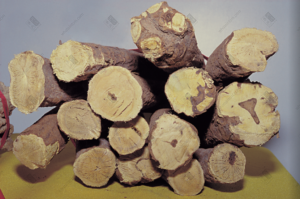
Licorice cross-section: Skin peeling, flesh exposed, with a ‘pepper-eye’ pattern.
Powdered Licorice.
Licorice: Cultivated in Inner Mongolia.
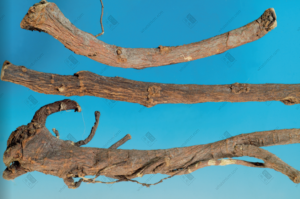
Cultivated Licorice.
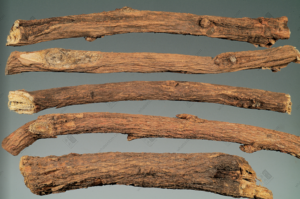
Xinjiang Licorice: Glycyrrhiza uralensis (Ural Licorice), Uyghur Region.
【About the Author】 Chen Ta-chen
Education: Ph.D. in Traditional Chinese Medicine, China Medical University.
Current Position: Assistant Research Fellow, Medical Intelligence Center, China Medical University Hospital.
Editorial Board Member for Chinese Materia Medica, National Common Textbook Compilation Committee for TCM Colleges and Universities.
Distinguished Lecturer, Industrial Technology Research Institute (ITRI). Adjunct Lecturer, Post-Baccalaureate Program in Traditional Chinese Medicine, China Medical University.
Adjunct Assistant Professor, Department of Pharmacy, Chia Nan University of Pharmacy and Science.
Co-founder of Heluo Pharmacopoeia www.whatsinTCM.com.
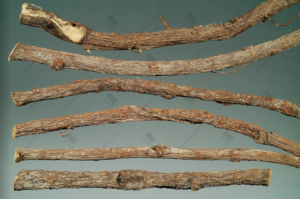
Xinjiang Licorice (Secondary Grade): Glycyrrhiza glabra, with alkali bark.
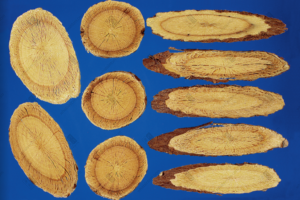
Licorice Slices: Special grade, A-grade, B-grade. Sweet to taste, powdery and fibrous cross-section.
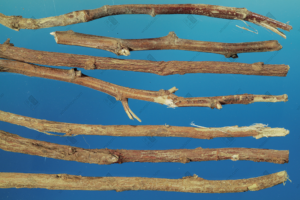
Licorice Tips: The upper four are aerial stems, the lower three are D-grade licorice pieces.
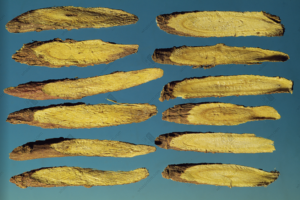
Licorice Slices: Left, with reddish skin, is wild; right is cultivated.
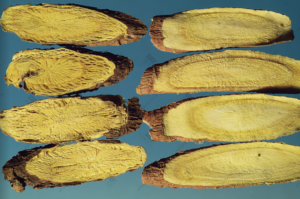
Licorice Slices: Left is wild, right is cultivated, with radial fissures.
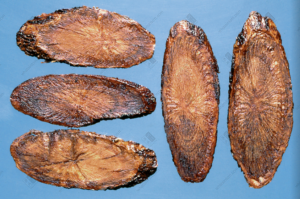
Honey-fried Licorice Slices.
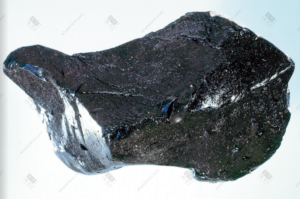
Licorice Paste.