



Longan (Gui Yuan): The Essential Vegetarian Ingredient for the Jade Emperor’s Birthday
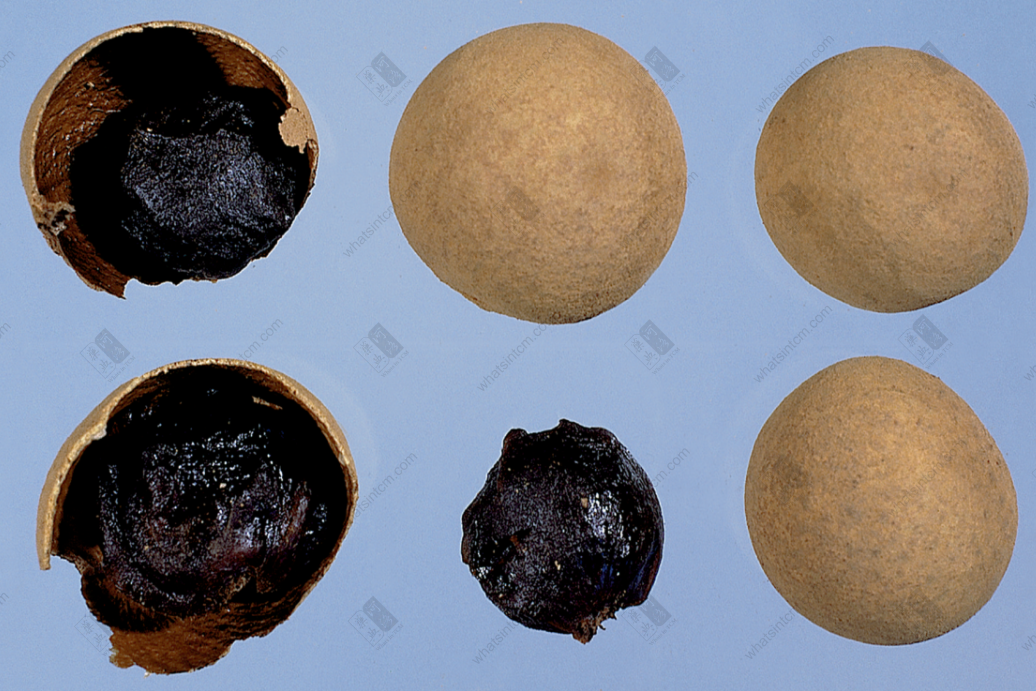 Dried Longan Meat: Partially peeled on the left, with husk on the right.
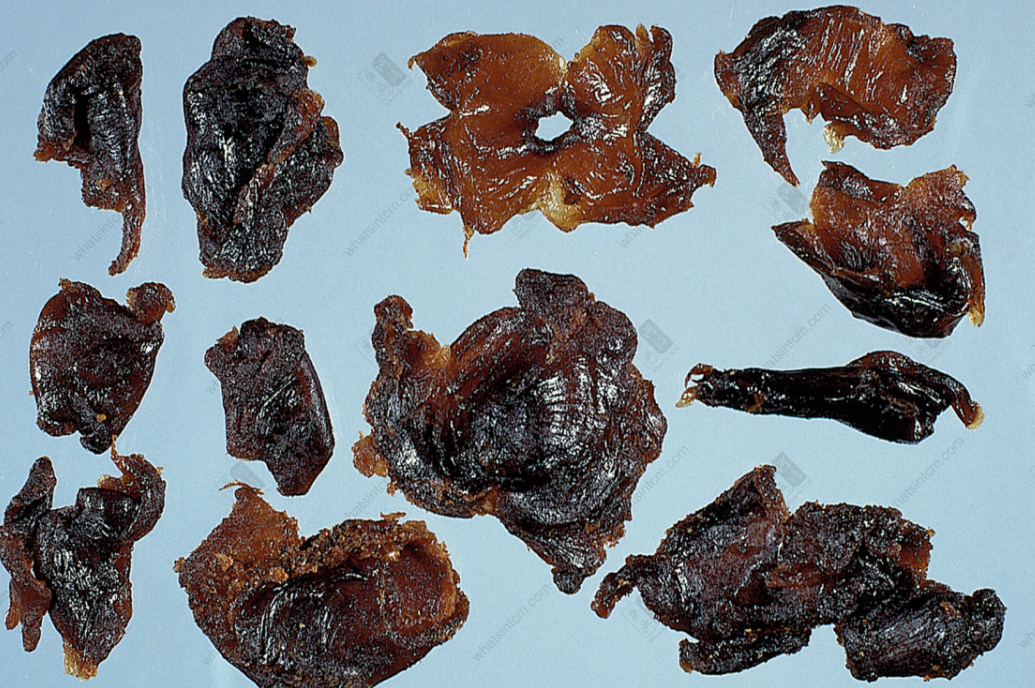 Dried Longan Meat: Flat, brownish-red, translucent, thick, oily, and sweet.
“Why is it called the slave of the lychee,
When its sweetness surpasses all fruits.
Its rich nectar shames the dew of heaven,
And its golden orbs rival precious pearls.
Fit for the immortals of Gu She Mountain,
To be offered at the Queen Mother’s feast in the Jade Pool.
It should be hailed as a brother to the lychee,
And its power to benefit the mind is even more distinct.”
By Wang Xiangjin of the Ming Dynasty, “Longan”
The author of this poem, Wang Xiangjin, was a Jinshi scholar during the Ming Dynasty. In his later years, he settled at home and focused on agriculture, compiling the book “Qun Fang Pu” (A Compendium of Flowers). This poem primarily defends longan against being called the “slave of the lychee.” Its taste is sweet and delicious. The golden peel and translucent flesh are more beautiful than white pearls. It is like a fruit grown by the enlightened immortals of Gu She Mountain and should be offered at the grand banquet in the Jade Pool. It deserves to be called a brother to the lychee, and moreover, longan has the benefits of nourishing the mind and calming the spirit, so it should not be merely called the “slave of the lychee.”
According to folk custom, the ninth day of the first lunar month is the birthday of the Jade Emperor, hence it is called “Tian Gong Sheng” (Birthday of the Heavenly Grandfather) in Southern Fujian. The offering table is divided into an “upper table” and a “lower table.” The upper table is for the Jade Emperor and should be set with three cups of clear tea, five fruits, and six kinds of vegetarian offerings. Dried longan is one of these six vegetarian items.
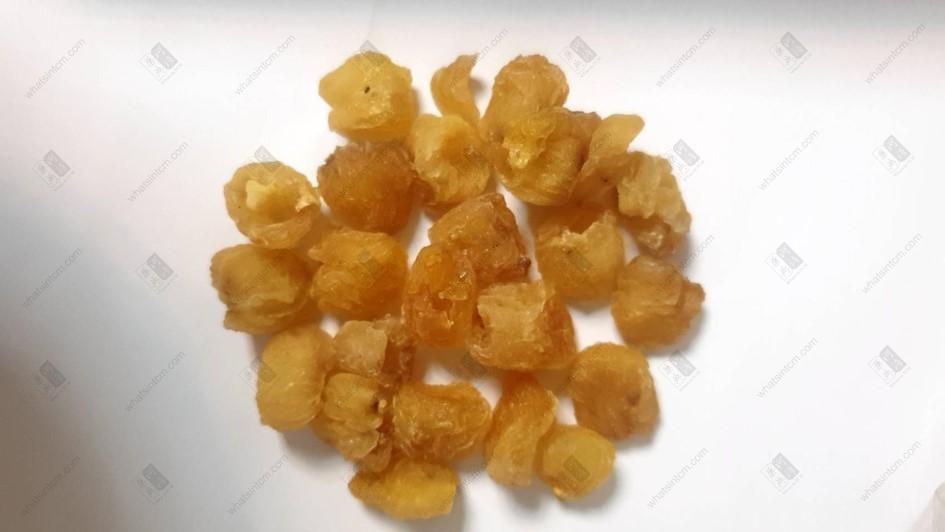
Dried longan meat (https://whatsintcm.com/en/dt_articles/longan-aril/) is the dried aril of the longan tree (*Dimocarpus longan* Lour.) from the soapberry family. It is mainly produced in tropical Asia, including Fujian, Guangxi, Guangdong, and Yunnan. Vietnam also cultivates it extensively due to its suitable climate. In Taiwan, it is primarily grown in Nantou and areas south of Miaoli. Harvesting occurs in autumn when the fruits mature. After drying, the husk and seed are removed, and it is sun-dried until it is dry and not sticky. It is also known by other names such as Gui Yuan, Long Mu, Gui Yuan, Long Yan Gan, and Li Zhi Nu. The medicinal aril is irregularly shaped, flaky, and in pieces of varying sizes. The surface is reddish-brown or brownish-red, semi-translucent. The side attached to the husk is shriveled and uneven with a slight network pattern. The side attached to the seed is usually glossy with fine longitudinal wrinkles. They often stick together in clumps, are soft, moist, and sticky, with a unique aroma and a strong, sweet taste. Generally, thicker, softer, moist, brownish-red, and strongly sweet pieces are considered superior. Dried longan meat was first recorded in the Shen Nong Ben Cao Jing and classified as a medium-grade substance. It nourishes the heart and spleen, can nourish blood and calm the spirit, and is clinically used for symptoms such as palpitations, forgetfulness, and insomnia. There are two common types of dried longan meat found in markets: one is peeled from dried fruits, often in flakes, and is darker in color; the other is dried after fresh pulp is directly peeled, usually spherical and lighter in color. Additionally, some products are found to be fumigated with sulfur, then soaked in sugar water and dried. These are thicker, heavier, whiter, sticky to the touch, and have a sulfurous odor, with a very pronounced sweetness but lacking the unique fresh aroma of longan. Some products are also soaked in high-concentration brown sugar water before drying. These are usually thicker, darker, close to purplish-brown, often clumped together, and upon separation, brown sugar crystals may be visible within. They are sticky to the touch and have a prominent brown sugar taste, lacking the characteristic scent of longan. Some products are also found to be mixed with jam, which results in thick pulp, often several pieces stuck together. Sometimes, jam can be found upon separation, and the luster is poor. The inner surface lacks fine longitudinal wrinkles, is sticky to the touch, and has a jam-like taste. Additionally, dyed raisins or dried cherries are sometimes used as substitutes. Their size and color are similar to dried longan, and they usually have a slightly sweet taste but lack the characteristic scent of dried longan. They will decolorize when soaked in water. Dried lychee pulp is also found to be mixed in. The pulp from dried lychees is thicker, brownish-red, and less translucent. Another confused variety is Long Li, used as dried longan. The dried fruit has many circular, nodular protrusions on its surface, and the seed coat of the mature seed cracks longitudinally. The aril is not easily separated from the seed, and the seed is irregularly ovoid. It has a faint aroma and a slightly sweet taste, with a sticky chewing sensation. Currently, Vietnamese longans are similar to the early local Taiwanese varieties, smaller in size, but have a more intense longan aroma and flavor.
Dried longan in Taiwan is often machine-dried or dried using longan wood fire. The longan dried with wood fire, due to the slow evaporation of moisture, requires continuous work for several days and nights. Furthermore, constant control of the heat and the smoking effect is necessary, making it very labor-intensive and time-consuming. However, in addition to the aroma of longan, it has a special smoky scent, making it highly popular among consumers. The dried longan available in Taiwanese markets adheres to food safety and hygiene management standards, so consumers can enjoy it with peace of mind.
【Image Provided By】Professor Chang Hsien-cheh, “Authentic Medicinal Materials Illustrated Guide” https://whatsintcm.com