

Spring’s Revival: Sing Your Heart Out with Essential Traditional Chinese Medicine (But Be Careful Not to Buy the Wrong Kind!)
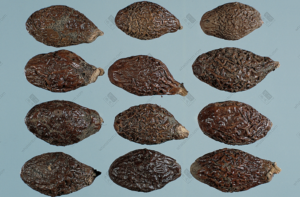
The appearance of Sterculia lychnophora: Olive-shaped, wrinkled, dark brown, lustrous, expands eight times when steeped in water.
Zilu, Zeng Xi, Ran You, and Gongxi Hua were seated. The Master said: “Although I am older than you, do not regard me as such. When at home, I say: ‘I am not understood!’ If anyone understood me, what would they do?” … “Dian! What about you?” He played the zither, then put it aside and stood up. He replied: “My aspirations are different from those of the three gentlemen.” The Master said: “What harm is there in that? Each expresses his own will.” He said: “It is the end of spring, when the spring attire is ready. Five or six young men, and six or seven boys, will wash in the Yi River, enjoy the breeze at Wuyu, and sing their way back.” The Master sighed deeply and said: “I agree with Dian!” — From the Analects
In the passage above, Confucius asked his disciples about their aspirations. Zeng Dian said that in the third month of late spring, he would wear his spring clothes, gather five or six companions and six or seven youths, bathe in the Yi River, enjoy the breeze on a high terrace, and sing their way back. Confucius greatly approved. This illustrates that bathing and singing by the river in spring is a very free and healthy way to live, symbolizing the renewal of life and the flourishing of all things in nature. However, singing can sometimes strain the throat. Therefore, traditional Chinese medicine offers many herbs for soothing the throat or resolving phlegm, among which Sterculia lychnophora is the most common.
According to the Third Edition of the Taiwanese Pharmacopoeia, Sterculia lychnophora (https://whatsintcm.com/en/dt_articles/malva-nut-pang-da-hai/) is the dried mature seed of the Malvaceae family plant Sterculia lychnophora Hance. It is also known by other names such as Da Fa, Da Hai, and Tong Da Hai. It is mainly produced in the Great Cave Mountain of Annan, hence its name An Nan Zi. Annan is located in present-day Vietnam. It is also produced in other places such as Thailand, Indonesia, Malaysia, Guangxi, and Hainan Island. Zhao Xuemin’s “Compendium of Materia Medica Supplement,” written during the Qing Dynasty, states: “Sterculia lychnophora treats carbuncles caused by fire stagnation; it immediately relieves them upon ingestion and also treats all heat-related illnesses, labor injuries, spitting and vomiting blood, clears toxins and dispels summer heat, epidemic red eyes, wind-fire toothaches, dry cough without phlegm, bone steaming with internal heat, and fire syndromes of the San Jiao.” This indicates its significant efficacy in clearing heat and moistening the lungs, as well as its good effect on dry cough. When purchasing Sterculia lychnophora in the market, choose those that are large, firm, dark brown, have a lustrous surface with fine wrinkles, and swell significantly in water. Additionally, some Sterculia lychnophora seeds may appear normal on the outside but show signs of mold inside when cut open, which should be noted. Therefore, the Taiwanese Pharmacopoeia not only sets limits for heavy metals such as arsenic, cadmium, mercury, and lead in Sterculia lychnophora but also specifies limits for aflatoxins to ensure safe usage. In the market, Pterygota alata seeds may be used as a counterfeit product. There are two ways to distinguish them: First, through visual observation. Sterculia lychnophora has an oval or spindle shape, a dark brown color, wrinkled surface, and usually a slight luster. Pterygota alata seeds are spherical or nearly oval, yellowish-brown on the surface, and have a fine reticular texture. Second, by observing their reaction in boiling water. Sterculia lychnophora usually expands at least eight times its original size, expands quickly, and is larger in volume. However, Pterygota alata seeds typically only expand two to three times, expand slowly, and are smaller in volume. The two identification methods above should quickly differentiate between these commonly confused traditional Chinese medicinal materials. In the Taiwanese market, Pterygota alata is also sold as a food, with a unique taste and a smooth appearance, different from Pterygota alata seeds, making it easy to identify.
Modern pharmacological research indicates that Sterculia lychnophora, due to its bassorin content, can promote intestinal peristalsis. It has also been found to lower blood pressure, so individuals with low blood pressure should consume it with caution. Furthermore, Sterculia lychnophora is considered cool in nature and is not suitable for long-term excessive consumption. Typically, one to two seeds are used at a time, steeped in boiling water for consumption. However, it is important to stop when discomfort is relieved and to limit consumption to no more than 5 days. May everyone be able to sing to their heart’s content this spring and praise the great beauty of heaven and earth.
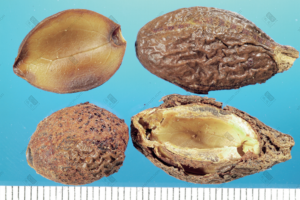
Pterygota alata seed and its cross-section. Right: Sterculia lychnophora seed and its cross-section.
【Author’s Introduction】
Education: Ph.D. in Traditional Chinese Medicine, China Medical University
Current Position: Assistant Researcher, Medical Intelligence Center, Taichung Hospital, China Medical University
Editor, Department of Traditional Chinese Medicine, National Council for Common Curriculum Compilation of TCM Schools
Distinguished Lecturer, Industrial Technology Research Institute
Adjunct Lecturer, School of Post-Baccalaureate Chinese Medicine, China Medical University
Adjunct Assistant Professor, Department of Pharmacy, Kaohsiung Medical University
Co-founder of He Luo Pharmacopoeia www.whatsinTCM.com
【Image Credits】Professor Chang Hsien-Cheh, “Illustrated Handbook of Authentic Chinese Medicinal Materials” (whatsintcm.com)