


Talc
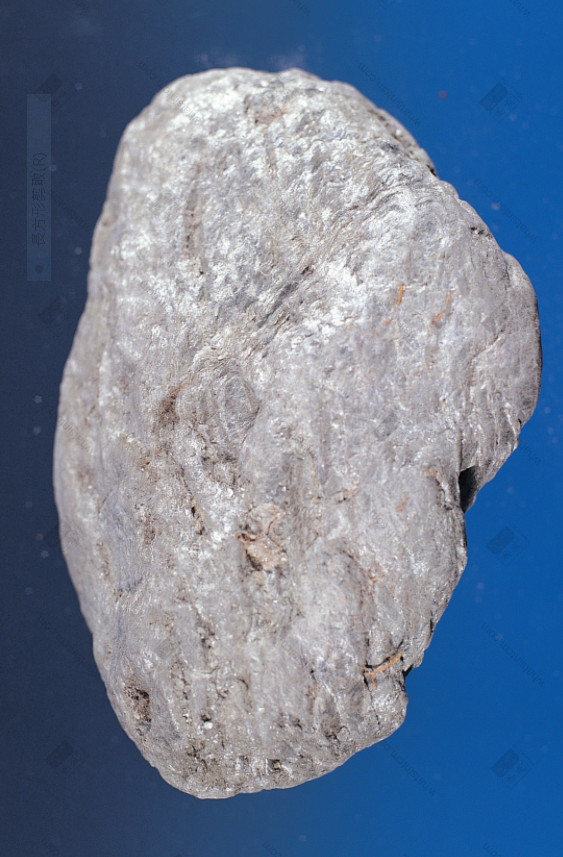 Talc (Bluish-yellow or white, with pearl-like luster, translucent or opaque, feels slippery to the touch, soft but firm, heavy and easily broken)
[Naming]
[Source]
Shen Nong’s Classic of Materia Medica, Upper Class
[Frequency of Use]
B
[Origin]
The silicate mineral talc.
[Characteristics]
It appears as flat, oblique square, or irregular lumps, varying in size. The overall color is white, eggshell blue, or yellowish-white, with a pearl-like luster on the surface, translucent or opaque. It is soft and fine, feels slippery to the touch, and white powder can be scraped off with a fingernail. Odorless, tasteless, with a slightly cool sensation.
[Identification]
《Zheng Lei Ben Cao》: “Generally, talc resembles ice, is bluish-white, and the one that leaves a white, greasy streak when drawn on stone is genuine.” 《Ben Cao Yan Yi Bu Yi》: “White talc resembles calcite, is white in color, and the one that leaves a white, greasy streak when drawn on stone is good.” 《Ben Cao Gang Mu》: “This substance is the most slippery and greasy, and the one without hardness is of good quality.” 《Ben Cao Bei Yao》: “The one produced in Fujian is the best.” 《Ben Cao Qiu Zhen》: “The white and moist one is good.” 《Ben Cao Yi Du》: “The ones from Guangdong and Penglai in Shandong are considered the best.” 《Liang Lie Jian Bie》: “The one with a white color and the luster of a pearl, slightly sweet and slippery, soft and smooth is the best.”
The bluish-white flaky masses that are slippery and soft are the best; the yellow ones with broken pieces are inferior.
Note: There are two types of talc: hard talc and soft talc.
(1) Talc (Talc) is a monoclinic system, and the crystals are hexagonal and rhombic plates, which are generally rare. It is commonly found as granular and scaly dense masses. The color is generally light green, white, or gray. The hardness is 1, the specific gravity is 2.7~2.8, and it has an oily feel. Its composition is 3MgO·4SiO2·H2O, which consists of MgO 31.7 %, SiO2 63.5 %, H2O 4.8 %. Usually, a part of MgO is replaced by FeO, and it often contains Al2O3 and other impurities. The appearance and properties of the medicinal material are as described above.
(2) Soft talc (Kaolinite) is a monoclinic system, and the common ones are curved columnar fragments. The aggregates are loose scaly, earthy, or dense fine-grained. The hardness is 1, the specific gravity is 2.53~2.6, it feels rough to the touch, and it is sticky when licked with the tongue. Its main component is aluminum silicate minerals, namely Al2O3·2SiO2·2H2O, and sometimes contains a small amount of iron. Medicinal material properties: It is in irregular ten-piece shape, varying in size. The whole is white, or mixed with light red, light brown, and gray. The surface is matte or slightly shiny, and it feels slippery to the touch. The body is light, the texture is soft, and it can be crushed into white powder by hand. It has a slight earthy smell, and it is tasteless but has a sticky feeling on the tongue.
The main differences between the above two types are as follows:
(1) Hard talc–translucent, stone-like, relatively firm; it feels slightly cool but not sticky on the tongue when licked.
(2) Soft talc–opaque, earthy, relatively soft; it feels sticky on the tongue when licked.
[Identification Terminology]
(Modern) 1. Flexibility: refers to the property of a mineral tending to bend under the action of external force without breaking, and cannot return to its original shape after removing the external force, such as talc, etc.
[Chapter]
Minerals