



Gu Sui Bu (Drynaria)
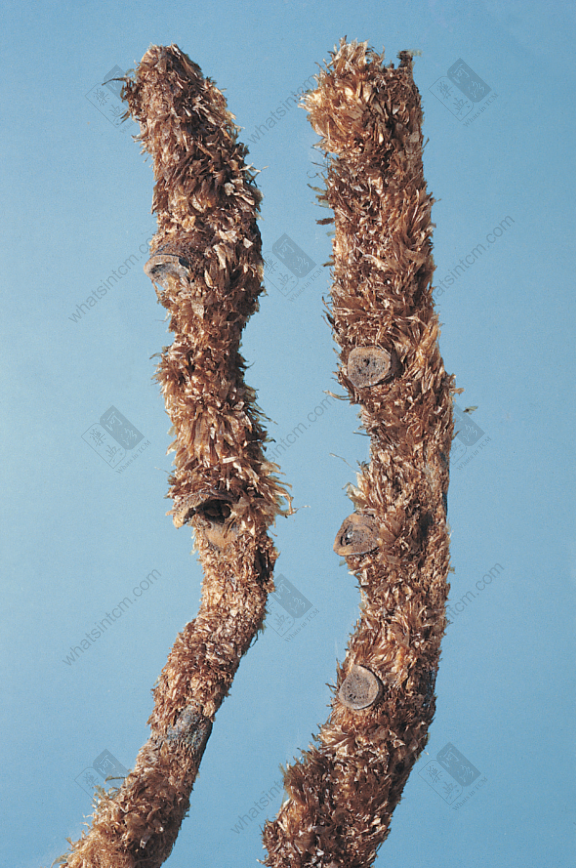 Gu Sui Bu (Drynaria) (Flat and curved, with small, dark brown scales)
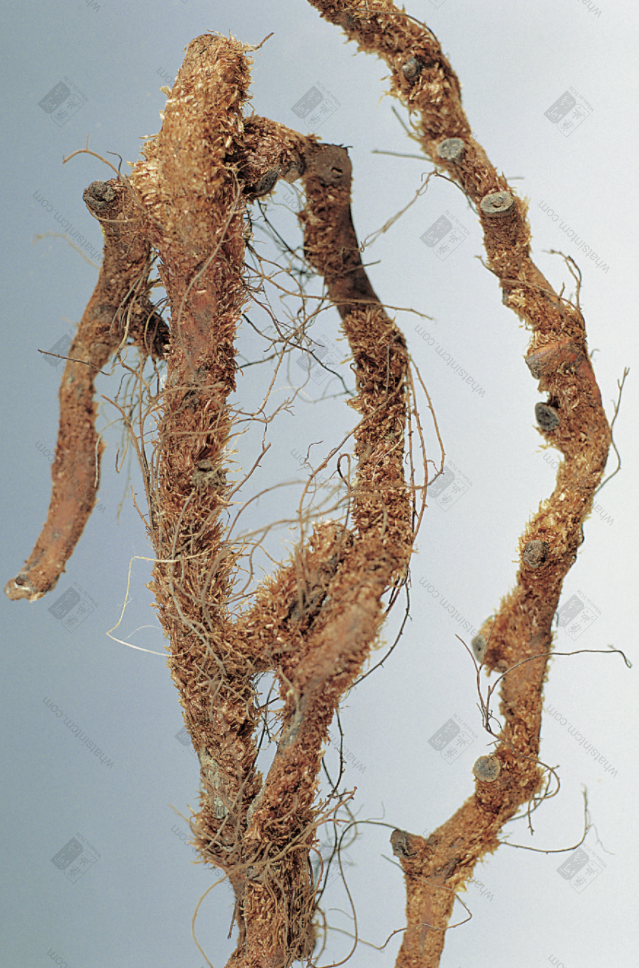 Small Gu Sui Bu (Drynaria) (Large-leaf Gu Sui Bu (Drynaria), with circular protruding leaf base scars)
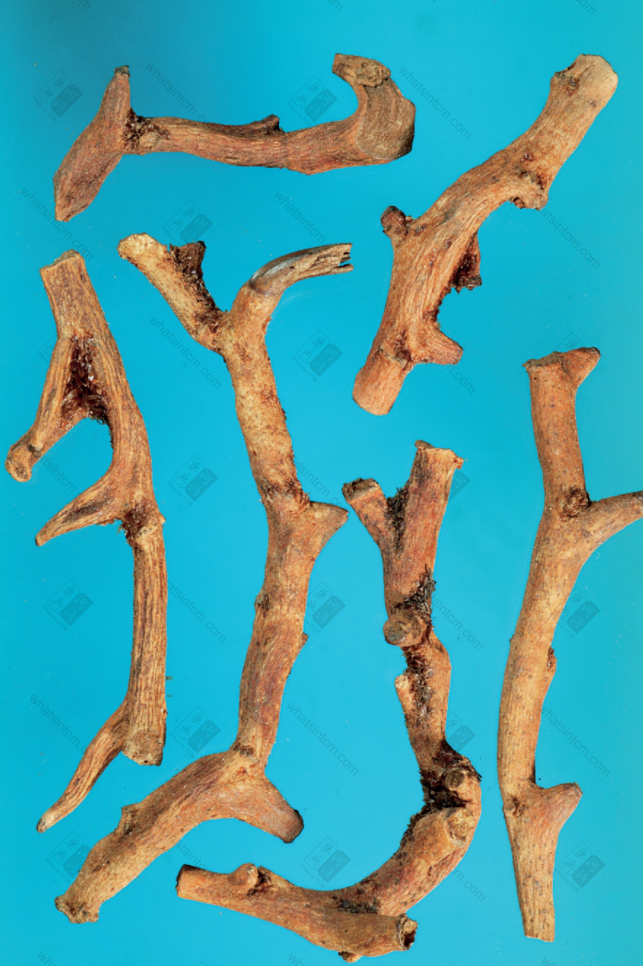 Small Gu Sui Bu (Drynaria)
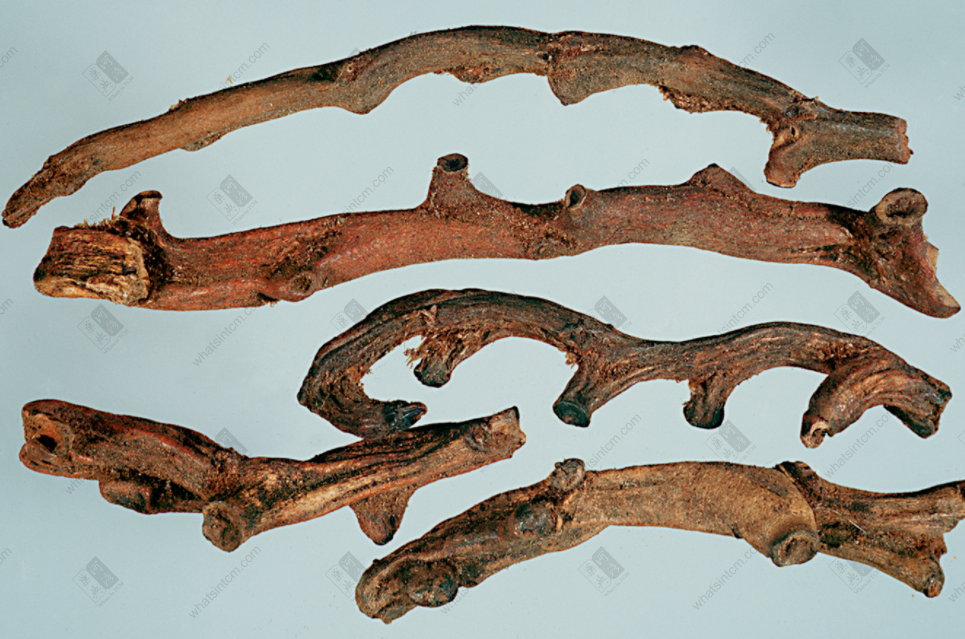 Gu Sui Bu (Drynaria) (Dark brown from burning)
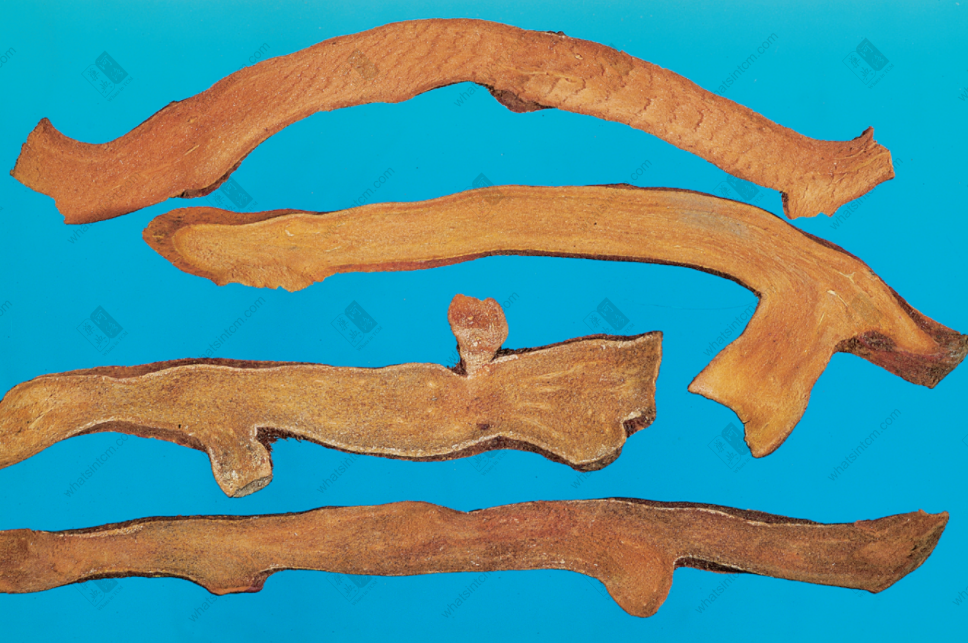 Large Gu Sui Bu (Drynaria) slices (Large-leaf Gu Sui Bu (Drynaria))
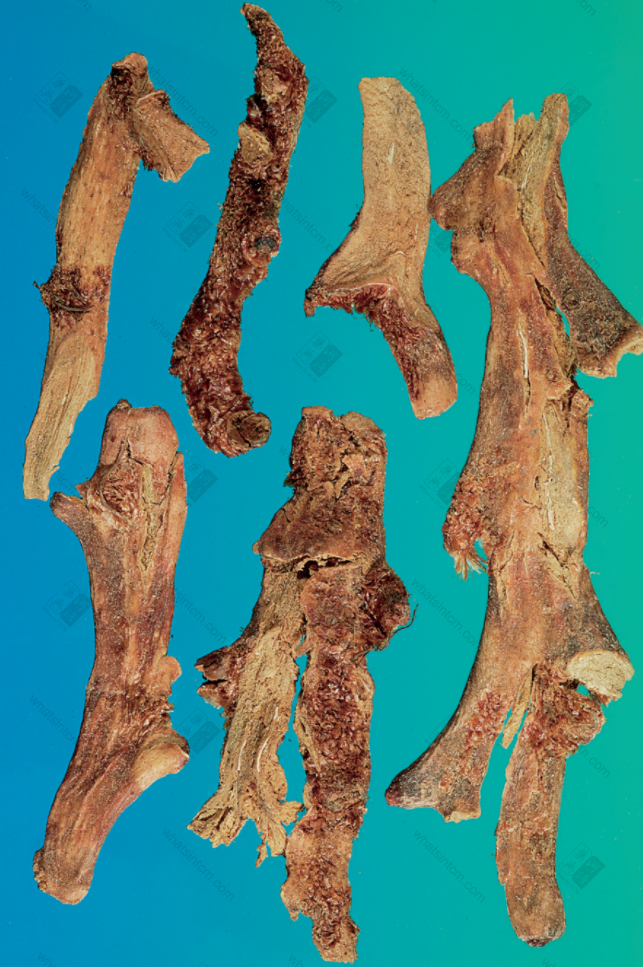 Gu Sui Bu (Drynaria) slices (Yellow dotted ring arrangement) (Flattened and sliced)
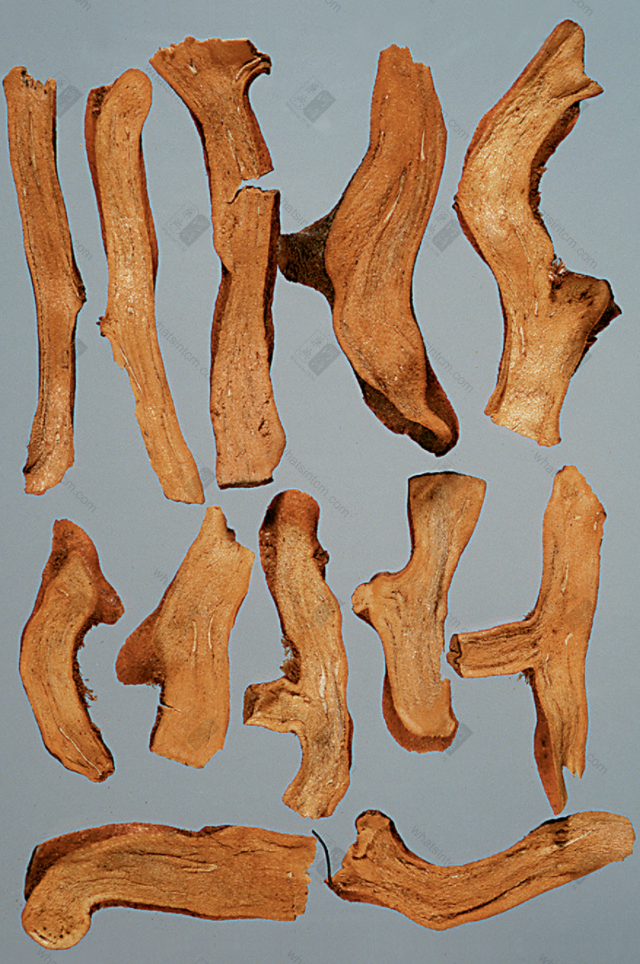 Gu Sui Bu (Drynaria) slices (White central column)
【Name】
【Source】
Ben Cao Shi Yi (Supplement to Materia Medica)
【Commonly Used Degree】
C
【Botanical Origin】
The rhizomes of Drynaria fortunei J. Sm., Drynaria baronii (Christ) Diels, Pseudodrynaria coronans (Wall.) Ching, and Davallia formosana Hay. of the Polypodiaceae family.
【Characteristics】
(1) Drynaria fortunei (Soft Gu Sui Bu (Drynaria)): Presents as a twisted, flattened, long strip, often branched, 6~20㎝ long and 0.5~1~2㎝ in diameter. The surface is light brown, densely covered with small, yellow-brown scales that are soft like hair. Both sides and the upper surface have protruding or concave circular leaf scars. The texture is hard and easily broken.
Chong Lou (Rhizoma Paridis), Quan Shen (Rhizoma Bistortae) distinction
Name
Item Chong Lou (Rhizoma Paridis) Quan Shen (Rhizoma Bistortae)
Source Dried rhizome of Paris Polyphylla Smith var. yunnanensis (Franch.) Hand-Mazz or P. polyphylla Smith var. chinensis (Franch.) Hara of the Liliaceae family. Rhizome of Polygonum bistorta L. etc. of the Polygonaceae family.
Shape Nodular, flattened, round, slightly curved Flattened cylindrical, often curved, resembling a shrimp
Surface One side has dense circular or semi-circular concave scars formed after the stem falls off, with rings that are relatively sparse, and the nodes are not obvious One side is raised, and the other side is slightly flat or has grooves.
Color Yellow-brown or gray-brown or yellow Purple-brown or purple-black
Texture Hard Hard
Cross section Flat, white, powdery, horny, with fine vascular bundles scattered in a ring, white to yellowish-white Light brownish-red to brownish-red, with annularly arranged yellow-white small dots. The vascular bundles are white small dots, arranged in a ring of 30~50.
Taste Slightly bitter, bitter Bitter, astringent
Distinction between Jing San Leng (Rhizoma Scirpi) and Hei San Leng (Rhizoma Sparganii)
Name
Identification point Jing San Leng (Hei San Leng) Jing San Leng (Rhizoma Scirpi)
Source Peeled tuber of Sparganium stoloniferum Buch. Ham. of the Sparganiaceae family Dried tuber of Scirpus yagara Ohwi, a plant of the Cyperaceae family.
Shape Both have the outer skin removed and are conical or obovate, slightly flattened, round at the top and pointed at the bottom. With or without skin, both are round, pointed-round, or short-obconical.
Size 2-6 cm long, 2-3.5 cm in diameter 2-4 cm long, 1.5-3 cm in diameter
Surface Yellow-white or gray-yellow, with knife marks and small dot-like rootlet scars, slightly annularly arranged. The surface has small protrusions with numerous rootlet scars, dark brown or reddish-brown, with wrinkles. The top has a round scar-like stem mark and protruding rootlet scars. When the outer skin is removed, it is yellow-white or yellow with knife marks.
Texture Firm and heavy, sinks in water Firm and hard, light, does not sink in water
Cross section Flat, yellow-white or gray-white, with numerous scattered, not-so-obvious vascular bundle dots and strip-shaped transverse vascular bundles. Flat, yellow, vascular bundle dots obvious, with scattered vascular bundles of yellow small dots
Odor Slightly scented, slightly sweet, and tingling when chewed Odorless, tasteless
Starch granules Very small, single grain diameter 1~12μm Extremely small, single grain diameter less than 1μm
Calcium oxalate cluster crystals Occasionally seen in the cortex Absent
Remarks Authentic product Easily confused product
Drynaria fortunei is a flat, long strip, slightly curved and twisted, densely covered with yellow-brown soft scales, and circular scar-like leaf marks can be seen. The texture is relatively brittle, and the cross-section has numerous yellow dotted vascular bundles arranged in a ring. Drynaria baronii has a straight and slender rhizome, with many scales falling off, appearing light brown, with a firmer texture, and a yellow cross-section.
(2) Pseudodrynaria coronans (Large Gu Sui Bu (Drynaria)): Presents as cylindrical or flattened strips, thick and large, slightly curved, unbranched, 7~15㎝ long and 1~2㎝ in diameter. The surface is dark brown with irregular longitudinal grooves. Fine and dense yellow-brown scales can be seen in the grooves, wrinkles, and leaf bases. There are protruding circular leaf scars on the surface, about 1㎝ in diameter. The texture is firm and hard, not easily broken.
The processed slices are longitudinal slices. After being parched with sand, the slice surface is brownish-yellow, and the texture is loose, porous, light and brittle. The taste is sweet and the aroma is fragrant.
(3) Davallia formosana (Small Gu Sui Bu (Drynaria)): The rhizome is a twisted cylinder, 4~15㎝ long and about 1㎝ in diameter. The surface is reddish-brown to brownish-brown, with longitudinal grooves and wrinkles, with protruding cylindrical leaf bases, 5~7㎜ in diameter, with a small amount of residual yellow-brown scales around them. The texture is firm and hard, not easily broken. The cross-section is reddish-brown, and several yellow dotted vascular bundles can be seen, arranged in a ring, with two large crescent-shaped vascular bundles in the center. The aroma is faint, and the taste is slightly astringent.
【Identification】
“Yi Fang Lei Ju (Classified Collection of Medical Formulas)”: “Gu Sui Bu (Drynaria), the ones growing on rocks are the best.”
Usually divided into fresh and dry goods. Fresh goods with fresh white cut surfaces are preferred. It is generally believed that fresh goods have stronger medicinal properties. For dry goods, the ones that are dry, wide, long, brown, and have fewer hairs are preferred. Dry goods are now mostly used. For Gu Sui Bu (Drynaria) strips, the ones that are hairless, large and thick, reddish-brown, and thoroughly dry are preferred. For Gu Sui Bu (Drynaria) slices, the thin slices that are reddish-yellow, without broken pieces, and thoroughly dry are preferred.
【Category】
Rhizomes