



Job’s Tears: The Pearl of Dampness Relief and Spleen Strengthening, Yet the Idiom “Job’s Tears as Pearls” Carries a Negative Connotation
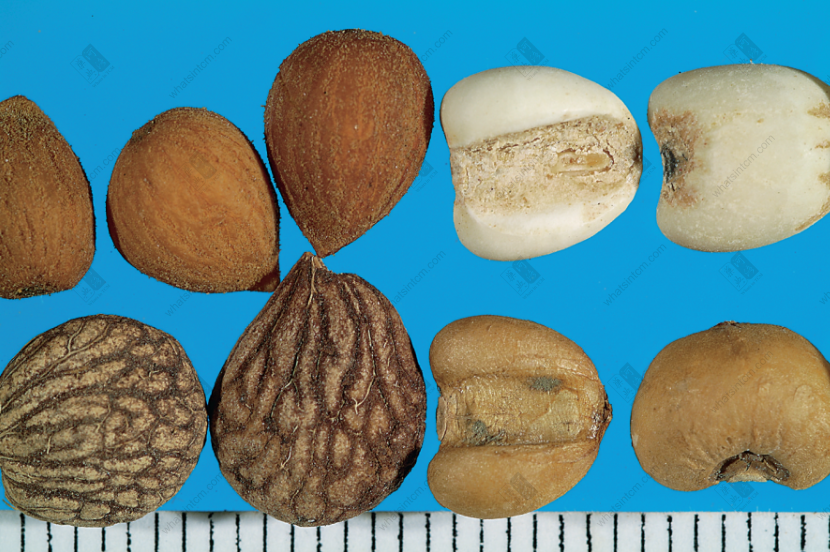 Top right: White Job’s Tears; Bottom right: Fried Job’s Tears; Top left: Prunus persica seed; Bottom left: Sterculia seed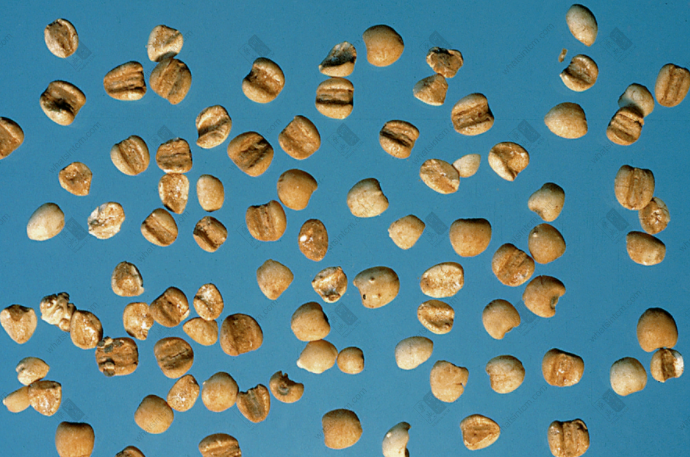
Fried Job’s Tears
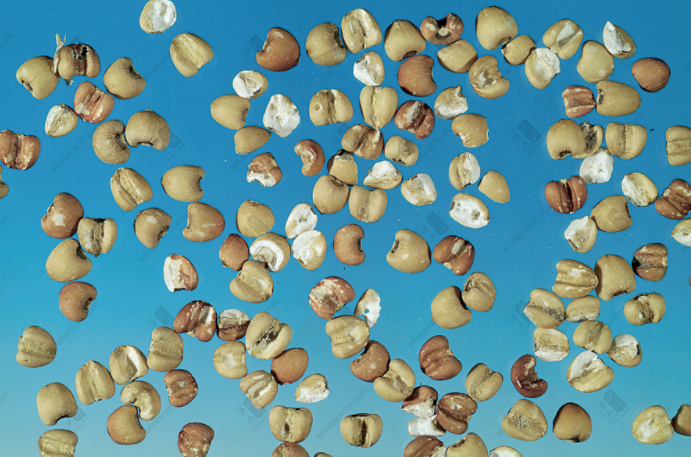
Red Job’s Tears
 Job’s Tears: Oval and spherical in appearance, milky white and smooth, with a blunt apex, a deep longitudinal groove on the ventral side, and a large scutellum-shaped endosperm.
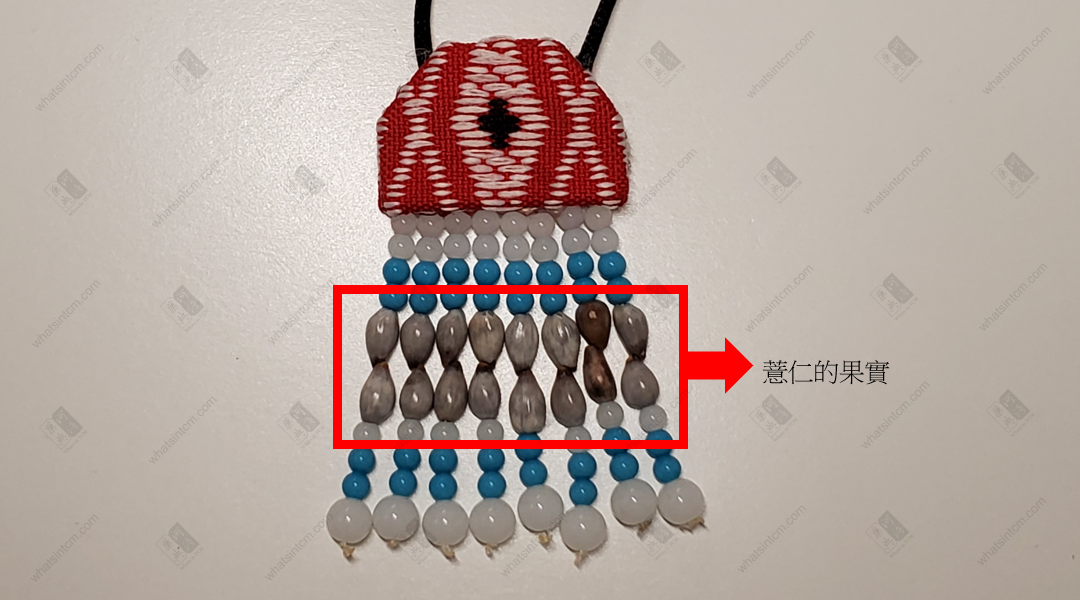 Rattle made from the fruit of Job’s Tears. Provided by Dr. Ta-chen Chen.
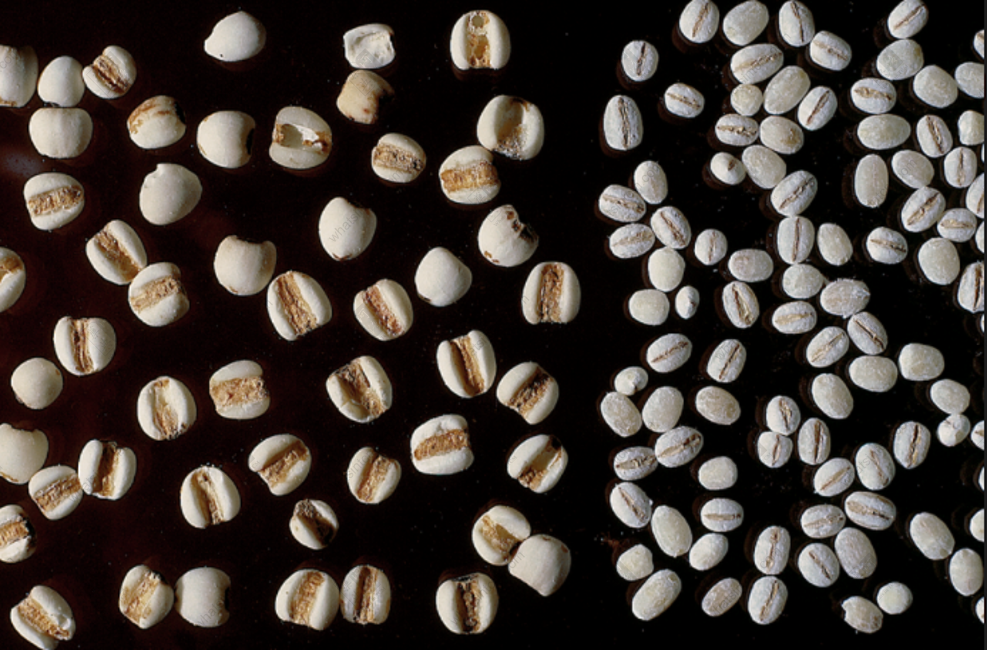
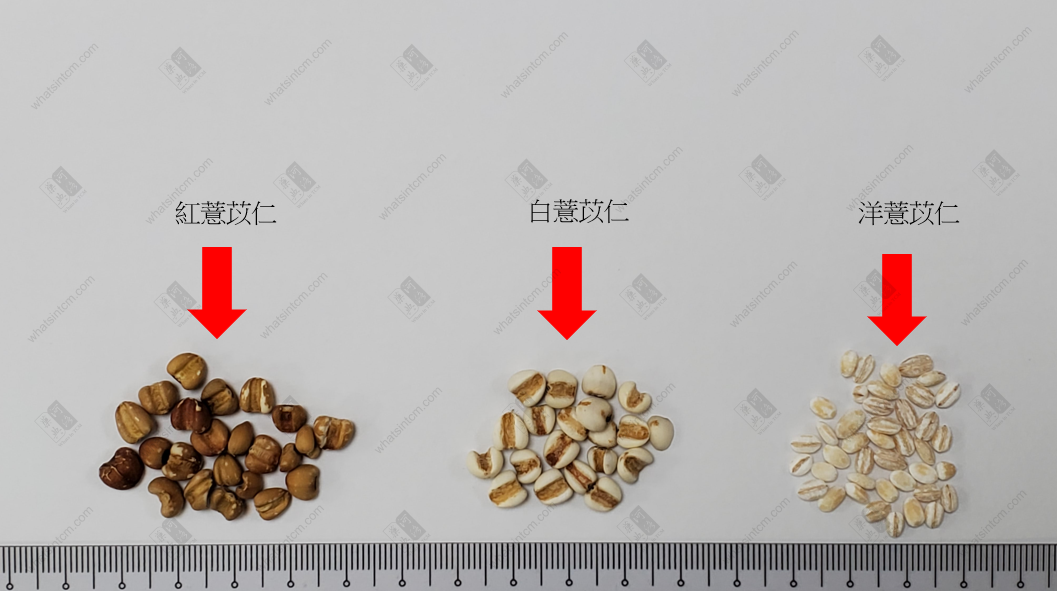 Left: Red Job’s Tears; Center: White Job’s Tears; Right: Foreign Job’s Tears. Provided by Dr. Ta-chen Chen.
“Boiling Job’s tears for sustenance, it heals the miasma and nourishes the spirit. It can dispel the poisons of the five streams, but cannot save from slander. Slander passes like wind and rain, miasma and pestilence eventually vanish. Neither can be truly cured, yet we cherish the growth of plants. Plants have their own uses, precious products lining the southern wilderness. Red sacs hang lychees, snow-white powder reveals palm hearts. Who knew this wild reed’s form, held both medicine and grain within. Ground into round芡珠, cooked into fragrant菰米. Zimei picked acorns, huangjing fooled an empty stomach. Why do I now possess only this, like jade grains illuminating the seat.” From “Job’s Tears” by Su Shi of the Northern Song Dynasty
Su Shi was exiled to Lingnan in his later years. However, being in a remote area, medical supplies were scarce. Therefore, he planted superior herbs like ginseng, rehmannia, goji berries, chrysanthemum, and Job’s tears in his own garden. He also wrote the poem “Five Poems of the Small Garden,” in which he “ground Job’s tears into round芡珠, cooked into fragrant菰米” to dispel miasma and nourish the spirit, incorporating it into his daily diet and thus beginning the practice of medicinal food for health and wellness.
According to the Fourth Edition of the Taiwan Chinese Materia Medica, Coix Seed (https://whatsintcm.com/en/dt_articles/jobs-tears-yi-yi-ren/) is the dried mature seed of the Gramineae plant Coix lacryma-jobi L. var. ma-yuen (Rom. Caill.) Stapf. It is mainly produced in Fujian, Hebei, Liaoning, Zhejiang, and other places. “Puchang Job’s Tears” from Pucheng, Fujian, “Qiyi Rice” from Anguo, Hebei (Qizhou), or “Guanyi Rice” from Liaoning are generally more famous. Taiwan also has sporadic cultivation, mainly in central Taiwan. The indigenous Saisiyat people of central Taiwan use the fruit of Job’s tears to make rattles (tapangaSan) or back rattles, used during festivals. Currently, the varieties cultivated in Taiwan are mainly introduced from Japan, and their seeds are smaller than imported Job’s tears, making them easy to distinguish. Imported Job’s tears to Taiwan mainly come from Laos and other Southeast Asian countries and are exported to Taiwan through Thailand. This Chinese medicinal material is usually harvested in autumn when the fruits mature. The plants are cut, dried, and the fruits are threshed and then dried again. The outer shell, seed coat, and impurities are removed, and then the seeds are collected for use. Due to its diverse origins and long history of use, this Chinese medicinal material has many aliases, including 薏苡, 薏仁, 苡米, 薏黍, 薏珠子, 解蠡, 白薏仁, 回回米, 草珠兒, 菩提子, and 珠子. Its English name is Job’s tears or Adlay. Thai people call it Duay. In Japan, when used as food, it is called Hatomugi (鳩麥), and when used as a Chinese medicinal material, it is called Yokuyinin (薏苡仁). When purchasing, it is best to choose dried, large, plump seeds that are white and unbroken.
Regarding the idiom “Job’s Tears as Pearls,” it mainly originates from the famous general Ma Yuan of the Eastern Han Dynasty. While fighting in Jiaozhi (present-day Vietnam, etc.), he frequently consumed Job’s tears rice due to the severe damp and miasmatic conditions there, to dispel dampness and ward off miasma. Because the Job’s tears species from the south were particularly excellent, he brought back a large cartload. However, after Ma Yuan’s death in battle, someone slandered him to the emperor, claiming that the cartload contained pearls obtained from the south. Consequently, Ma Yuan’s family was greatly alarmed and almost dared not hold a funeral. Therefore, this idiom is used to describe being falsely accused, suffering injustice, and is also used in the phrase “suspicion of Job’s tears.”
According to the “Shen Nong Ben Cao Jing”: “Job’s Tears Seed, sweet and slightly cold in taste. It primarily treats muscle spasms and contractures that prevent extension and flexion, wind-dampness obstruction, and promotes qi. Long-term consumption lightens the body and benefits qi. Its root dispels three types of worms. Also known as Jielih. Grows in marshes.” This indicates that besides dispelling dampness, long-term consumption can benefit qi, and its root has different functions. There are many product names on the market that can easily cause confusion. Generally, true Job’s tears are usually named red Job’s tears, brown Job’s tears, white Job’s tears, or large Job’s tears. Another type imported from abroad is called small Job’s tears, foreign Job’s tears, or pearl Job’s tears, which are actually refined barley grains. Their particles are smaller and oval-shaped, with very shallow ventral grooves that are almost linear, completely unrelated to true Job’s tears. Additionally, red Job’s tears and brown Job’s tears are the same thing, similar to the concept of brown rice. They are produced by removing the husk and seed coat of Job’s tears seeds. After removing the bran, they become refined white Job’s tears, which are the white Job’s tears we often see. In summary, Job’s tears currently on the market in Taiwan are mainly imported from Laos, Vietnam, and Thailand, while domestic Taiwanese production primarily yields brown Job’s tears.
Since Job’s tears are not only a Chinese medicinal material but also a common food for the general public, to ensure their safety for consumption and to help people purchase the correct Job’s tears, the Food and Drug Administration of the Ministry of Health and Welfare has stipulated that food businesses, from January 1, 2017, are not allowed to solely label barley products with product names such as “small Job’s tears,” “foreign Job’s tears,” or “pearl Job’s tears” on their outer packaging. They must also include the actual raw material label, such as “Barley (small Job’s tears),” “Barley (foreign Job’s tears),” or “Barley (pearl Job’s tears).” Furthermore, the Taiwan Chinese Materia Medica also stipulates limits for heavy metals such as arsenic, cadmium, mercury, and lead, as well as residual sulfur dioxide limits. Additionally, because Job’s tears are seed-type medicinal materials, regulations on aflatoxin content have also been established, allowing the public to use them with peace of mind.
【Images Provided By】Professor Chang Hsien-che, “Authentic Medicinal Materials Illustrated Guide” https://whatsintcm.com