



Common Summer Cooling Herb, Goji Root Bark: Be Careful Not to Buy the Wrong Kind
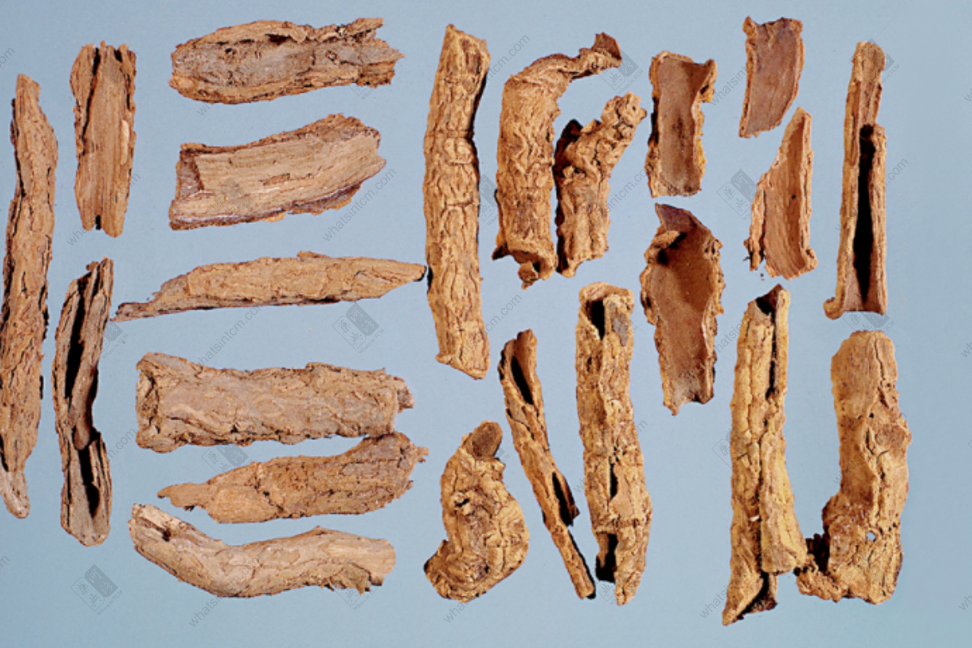 Goji Root Bark: Left: Tianjin, Right: Quanzhou
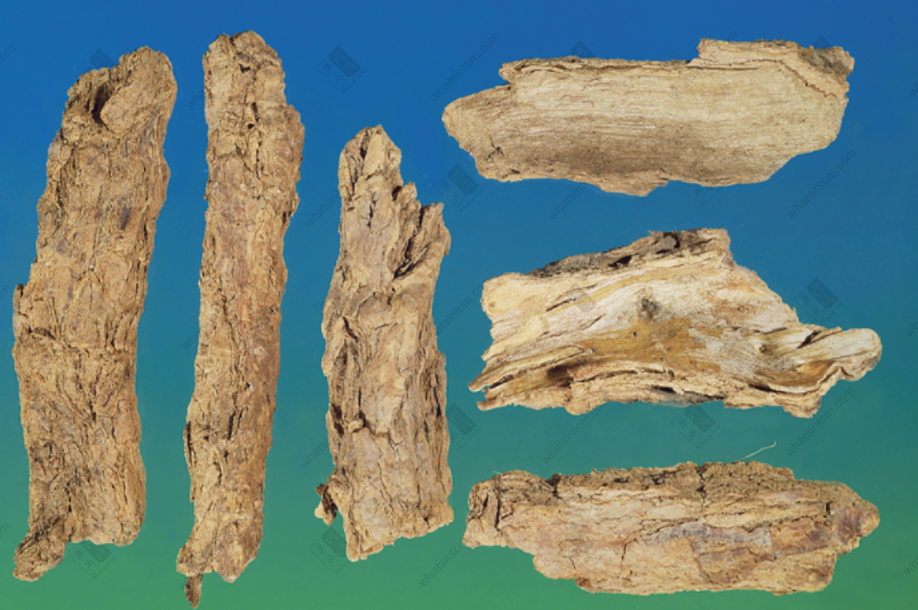 Goji Root Bark: Tubular or channeled, grayish-yellow to brown, rough texture, with longitudinal cracks, easily peels, light and brittle, coarse outer bark and white inner bark, no fragrance when smelled.
Dr. Da-Zhen Discusses Chinese Herbal Medicine Channel Introducing “Goji Root Bark”:
https://youtu.be/fVyHh0cH8KA
“Dewdrops, on the jujube and hawthorn. Truly, a noble person, their virtue is pure.”
From “Zhan Lu,” the Book of Songs
In the Book of Songs, jujube and sour jujube are used to symbolize noble individuals who are open-minded and sincere. “Jujube and hawthorn” are both thorny yet fruitful plants, echoing the noble person’s magnanimity and integrity, and their sincerity and loyalty. They are used to metaphorically describe people of good moral character, indicating the ancient reverence for goji berries.
According to the fourth edition of the Taiwan Chinese Materia Medica (https://reurl.cc/Gxya7v), Goji Root Bark is the dried root bark of the Solanaceae plant *Lycium chinense* Mill. or *Lycium barbarum* L. It is usually harvested in early spring or after autumn. The roots are dug up, washed, the root bark is peeled off, and then dried. The medicinal material is often tubular, with a grayish-yellow outer surface and irregular, scaly texture. It is light and easily broken. The cross-section is uneven. It has a faint odor and a slightly sweet taste that turns bitter. Generally, larger pieces with thick flesh and without pith or impurities are considered superior. The Han Dynasty text “Shen Nong Ben Cao Jing” records: “Goji berries… grow in Changshan’s plains and marshes, and on various hillsides.” Changshan is believed to be in the area of today’s Quyang, Hebei Province. Shen Kuo of the Northern Song Dynasty, in his “Meng Xi Bi Tan,” records: “Goji berries grown at the extreme border of Shaanxi are over a zhang tall and thick enough to be several inches in diameter, thornless. The root bark is like *Houpo*, sweet and delicious, unlike other places.” This indicates that the root bark of goji berries from Shaanxi is of superior quality. Li Shizhen of the Ming Dynasty, in his “Ben Cao Gang Mu,” also recorded: “In ancient times, the goji berries and goji root from Changshan were considered the best, while others from hillsides could also be used. In later generations, only those from Shaanxi were considered excellent, and those from Ganzhou were the absolute best~~” Therefore, Li Shizhen also believed that the goji root bark from Shaanxi was of better quality. Currently, it is cultivated in Shanxi, Shandong, Shaanxi, and Inner Mongolia, and also sporadically in Taiwan. It rarely bears fruit, and its leaves are mainly used as food. The name “Goji Root Bark” first appeared in the “Lei Gong Pao Zhi Lun” by Lei Xiao during the Wei, Jin, and Southern and Northern Dynasties. Due to its long history of use, it has many other names, commonly including枸杞根 (Gou Qi Gen), 地骨 (Di Gu), 地仙 (Di Xian), 紅耳墮根 (Hong Er Duo Gen), 狗奶子根皮 (Gou Nai Zi Gen Pi), 紅榴根皮 (Hong Liu Gen Pi), etc. Because its seedlings grow in spring, and its leaves are soft and thin like pomegranate leaves, it is popularly called sweet vegetables, hence also known as 甜齒牙根 (Tian Chi Ya Gen).
In Traditional Chinese Medicine, Goji Root Bark is primarily used to clear deficiency heat and cool the blood. It is commonly used to treat conditions such as chronic low-grade fever with night sweats, and cough and asthma due to lung heat. It is also used in common formulas like Xie Bai San and Qing Xin Lian Zi Yin. Depending on the clinical purpose, there are different preparation methods. Commonly used Goji Root Bark is prepared by removing impurities and residual pith, then washed and dried. There is also salt-processed Goji Root Bark, where the purified Goji Root Bark is first sprayed and mixed with brine, then allowed to sit until moist, placed in a pot, and stir-fried over a low heat until it turns deep brown or slightly charred, then removed and dried.
When purchasing Goji Root Bark in the market, be careful not to buy adulterated medicinal materials. Common adulterants include the dried root bark of *Vitex negundo* L. (family Verbenaceae), because in parts of Fujian, Zhejiang, and Guangxi, its root bark is called “Tu Di Gu Pi” or “Hong Di Gu Pi,” leading to confusion. The distinguishing features are a yellowish-brown or wrinkled outer surface and a yellowish-white inner surface with fine longitudinal striations. The fracture surface has a light yellowish-brown outer layer and a brownish-red inner layer, and the fracture is usually flat. It has a weak odor and a slightly bitter taste. Another common adulterant is the dried bark of *Jasminum floribundum* (family Oleaceae). The medicinal material is tubular in appearance, with a grayish-yellow outer surface and irregular longitudinal cracks. The inner surface is brownish-yellow with fine longitudinal lines. It is easily broken, and the fracture is uneven. The outer layer is yellow to brownish-yellow. It has a faint fragrance when smelled and a slightly bitter and astringent taste, and lacks the characteristic “coarse outer bark and white inner bark.” *Jasminum floribundum* is used to invigorate blood and dissipate stasis, with different functions from Goji Root Bark’s ability to clear deficiency heat and cool the blood, so it is important to distinguish between them. If it is in powder form, fluorescent observation can be used for identification. Another adulterant is the dried root bark of *Psychotria rubra* (family Rubiaceae), which is called “Bai Tu Di Gu Pi” in Zhejiang, causing confusion. In the market, one can also find the dried root bark of *Acanthopanax gracilistylus* (family Araliaceae). Its outer surface is grayish-brown with slightly twisted longitudinal wrinkles and elongated lenticel-like marks. The inner surface is pale yellow or grayish-yellow with fine longitudinal lines. It is light, brittle, and easily broken. It has a faint fragrance when smelled and a slightly spicy and bitter taste. One may also find the dried root bark of *Akebia trifoliata* (family Lardizabalaceae). The main distinguishing feature is its peculiar fragrance when smelled and its bitter taste. Lastly, there is the dried root bark of black goji berry (family Solanaceae). Its distinguishing characteristic is that the outer bark easily peels off in scales, and the cross-section has a yellowish-brown outer layer and a brownish-red inner layer. It tastes salty, which helps in identification.
In summary, the identification of Goji Root Bark primarily relies on the principle of “coarse outer bark, white inner bark, and no fragrance.” “Coarse outer bark” refers to the outer bark of Goji Root Bark being soft and thick; half of the thickness of Goji Root Bark can be pinched off with a fingernail with slight force. Another characteristic is “white inner bark,” meaning the inner surface of Goji Root Bark is grayish-white and clearly visible when broken. Tasting the inner white part of Goji Root Bark with the tip of the tongue will reveal a sweet taste, which then turns bitter after chewing for a few seconds; this indicates it is genuine. Finally, Goji Root Bark has no special fragrance; if a fragrance is detected, caution should be exercised. Common Goji Dew is made by steaming and boiling Goji Root Bark. Therefore, the Taiwan Chinese Materia Medica has detailed regulations for its limits of sulfur dioxide and heavy metals such as arsenic, cadmium, mercury, and lead, so the public can use it with peace of mind.
【Images provided by】Professor Chang Hsien-Cheh, “Illustrated Guide to Authentic Medicinal Herbs” https://whatsintcm.com