



Pearl
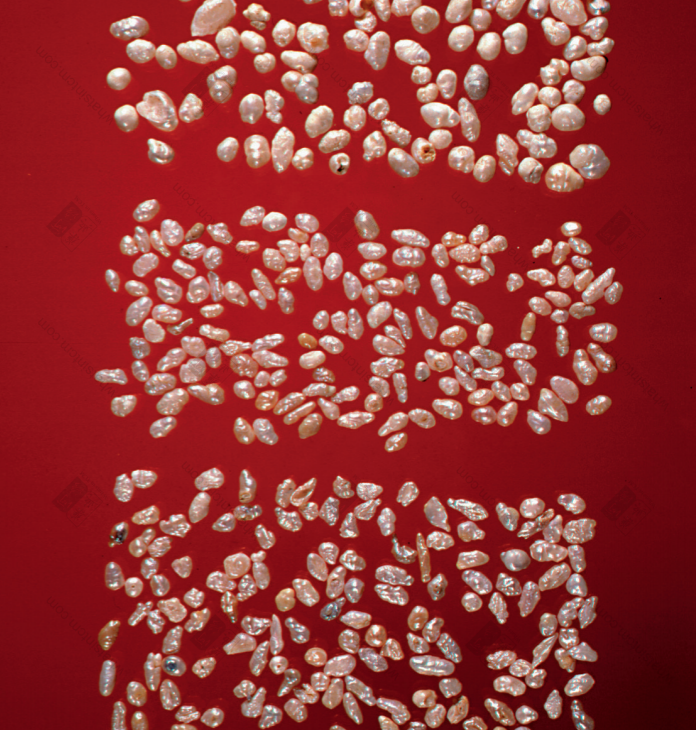 Pearl (Wan Lan Zhu, West Lake Freshwater Pearl, Japanese Cultured Pearl)
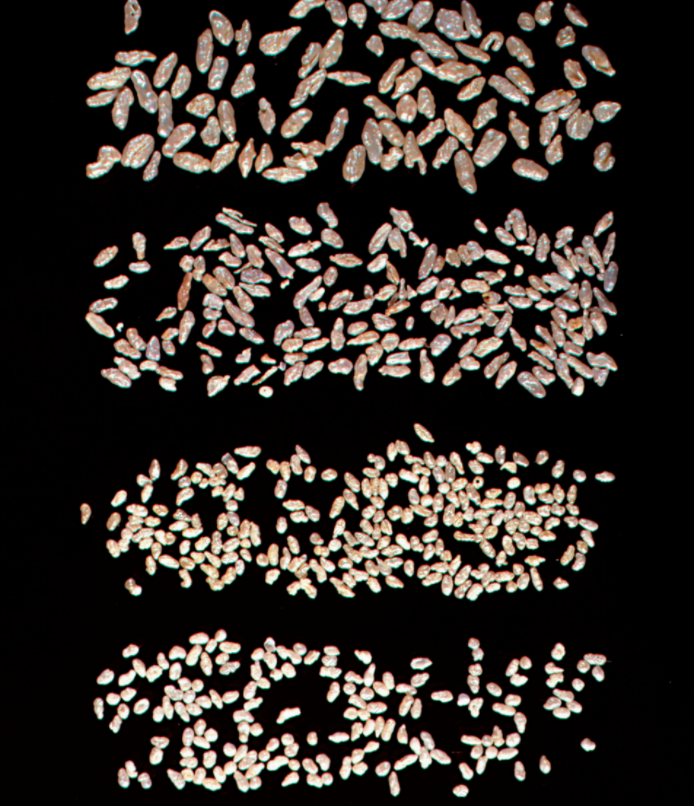 Wheat Ear Pearl (Four Types) (Pearlescence)
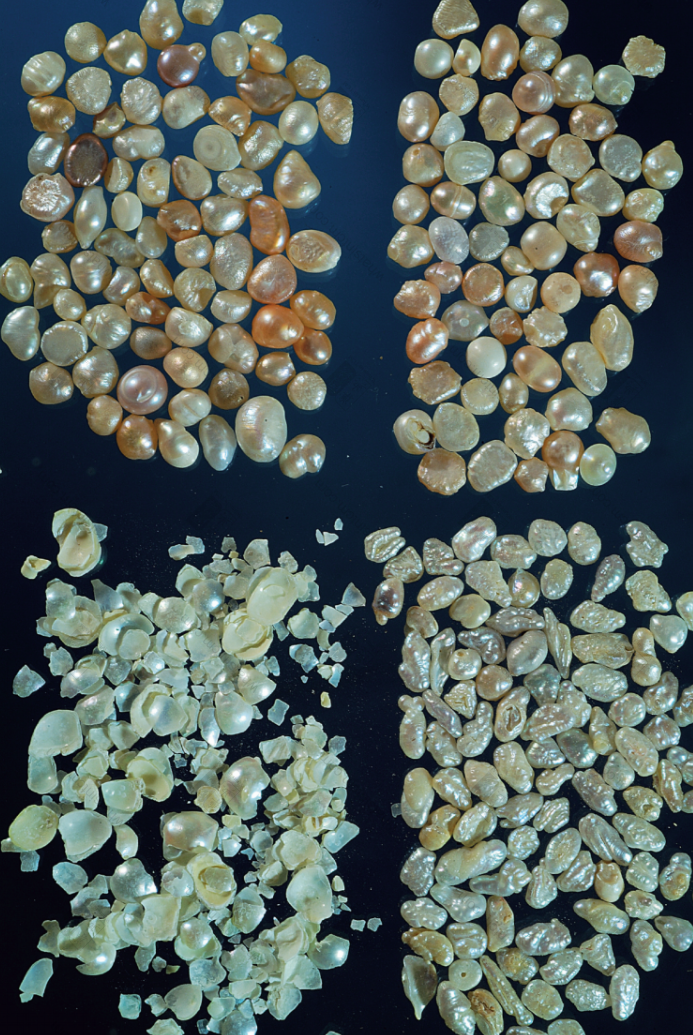 Top 2 Japanese Cultured Pearls Bottom Left Pearl Fragments Bottom Right Mainland Cultured Pearls (Spherical, oblong, oval, rod-shaped, smooth and round, slightly concave-convex, distinctive colorful luster, hard texture) (Fluorescence under ultraviolet light)
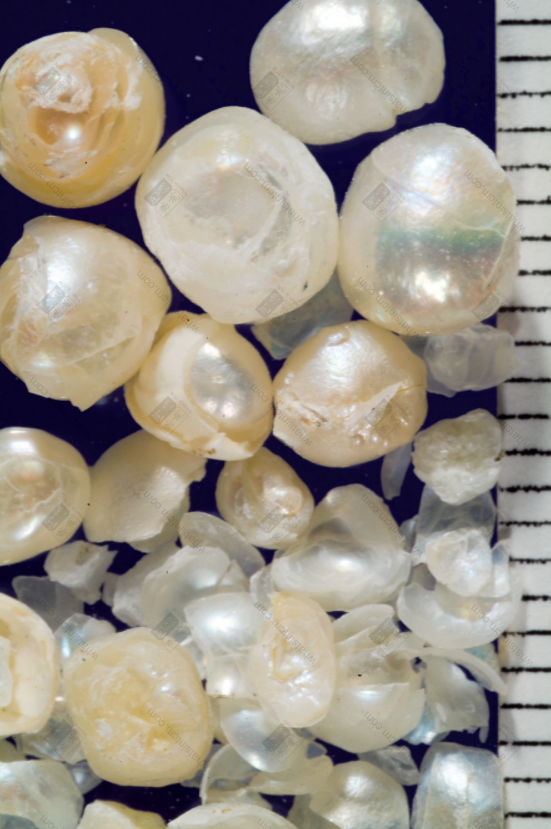 Pearl Broken Open (Fracture reveals concentric layers)
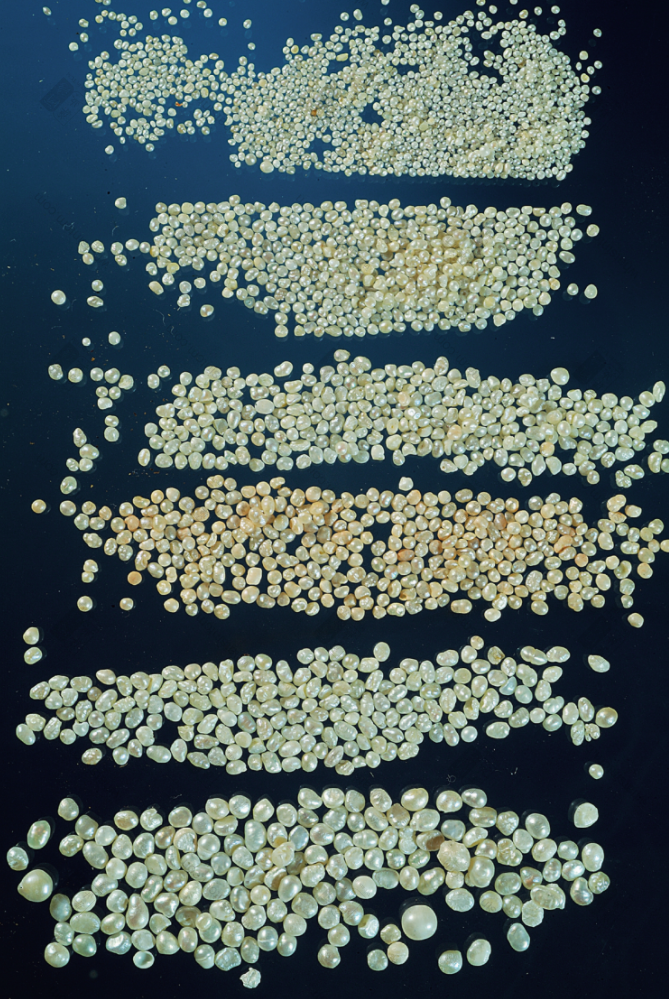 Pearl One, Two, Four, Four, Five, Six Mao
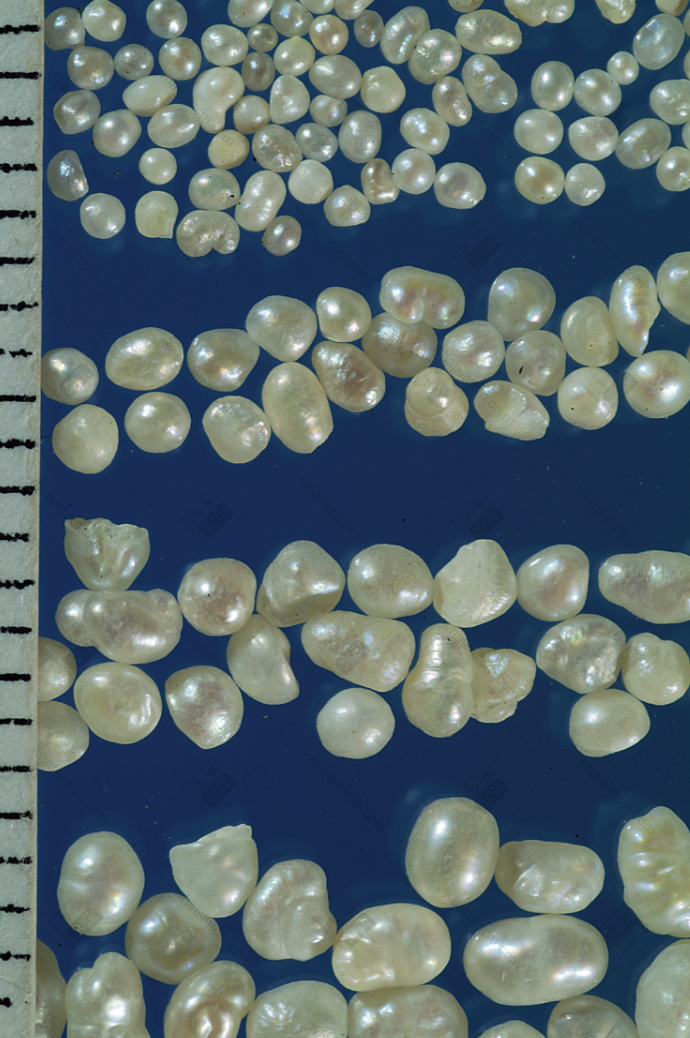 Pearl One, Three, Four, Five Mao
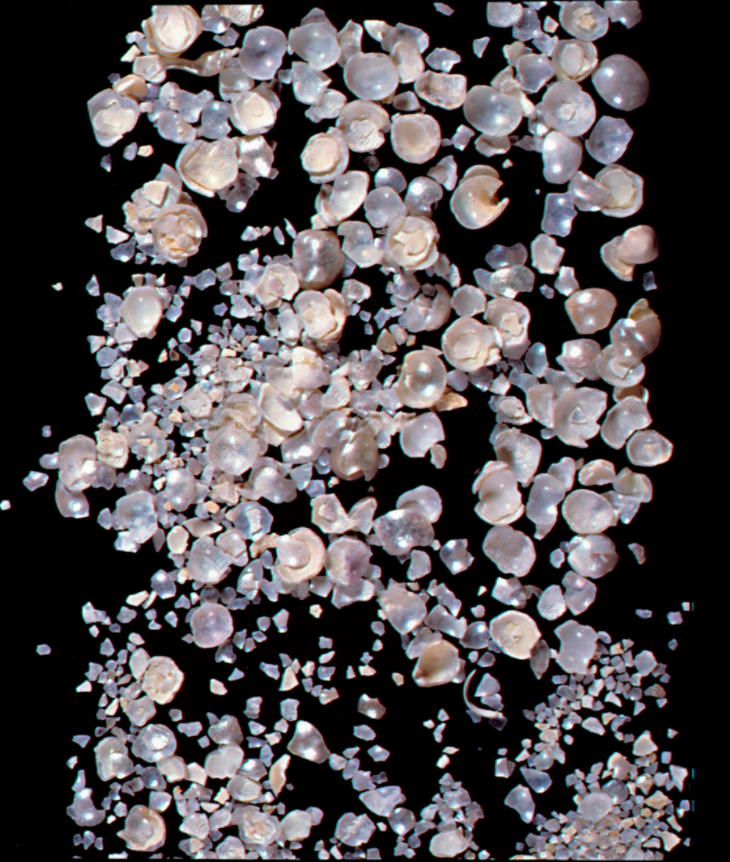 Pearl Fragments
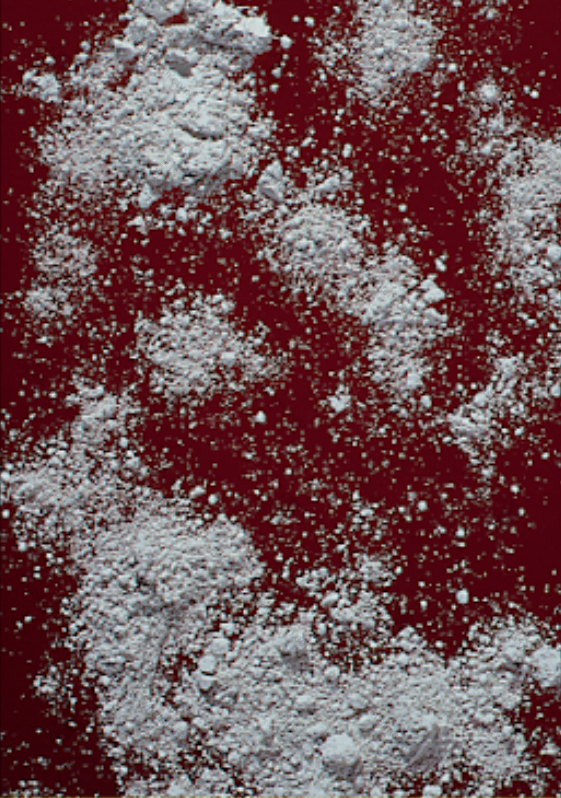 Water-Ground Pearl Powder
【Naming】
【Source】
Song Kaibao
【Common Use Level】
B
【Botanical Source】
The granular pearls produced within the shells of the pearl oyster Pteria martensii (Dunker), the pearl oyster Pteria margaritifera (L.), or the Freshwater Cockscomb Pearl Mussel Cristaria Plicata Leach of the Unionidae family, in response to irritation.
【Characteristics】
Spherical or oblong in shape, approximately 1-6mm in diameter. The surface exhibits a translucent silvery-white, yellowish-white, light pink, or light blue color, smooth and rounded, with a unique color and luster. Hard in texture, with concentric layers on the fractured surface, and sometimes a small amount of foreign matter in the center. When burned, it produces a popping sound. Under ultraviolet light, it exhibits a light bluish-purple or light greenish-yellow fluorescence, with a translucent outer periphery. Odorless, slightly salty taste. Burning produces a popping sound and leaves a silvery-gray ash. Pearl powder: a white, extremely fine powder.
【Processing】
【Identification】
“Materia Medica Illustrated”: “For medicinal use, newly formed pearls that have not been drilled are best.” “Compendium of Materia Medica”: “Ge Gu Lun says: South Seas pearls that are white, round, and radiant are superior.” “Zeng Yao Bian”: “For medicinal use, river pearls are the most valuable.” The best pearls are large, round, white, with a sparkling luster, smooth and delicate, with layered patterns on the broken surface, and without a hard core.
【Identification Terms】
1. Dirty Pearl: Refers to a pearl whose surface is contaminated with substances other than mud.
2. Mud Pearl: Refers to a pearl contaminated with mud.
3. Hollow Pearl: Refers to a pearl that is hollow inside.
4. Attached-Shell Pearl: Refers to a pearl that grows attached to the shell, and the scar of the attached shell can be seen on the surface.
5. Pearlescence: Refers to the smooth, translucent surface of a pearl or mother-of-pearl, with a jade-white or light pink, light yellow-green, and other unique colorful luster.
6. Branch Pearl: Refers to a pearl with an uneven surface, shaped like a lychee.
7. Bone Pearl: Refers to a pearl with a pale white surface, the color of bone, with a slight luster.
8. Congested Pearl: Refers to a pearl that is heavier than normal. The surface is the color of mud.
9. Shaped Pearl: Refers to a pearl that is not round but has various shapes.
10. Tender Pearl: Refers to a pearl that is harvested before it is fully mature.
11. Rigid Pearl: Refers to a pearl harvested from a diseased or dead mussel.
12. Mao: A unit of measurement for small pearls, 1-8 mao.
Experience is often used to identify the quality based on the following points:
1. Granules: The best are whole round pearls with round and intact granules and good luster, the so-called “round pearls and jade-like luster.” The larger the pearl, the better. Generally, beautiful round pearls larger than 3mm are selected for jewelry, and finer ones are used for medicinal purposes. Other good types include “earring pearls” shaped like light bulbs, “mantou pearls” shaped like steamed buns, and “glossy pearls” shaped like gongs. However, if the whole round pearl is long and not round, the earring pearl is thin and not full, and the Xin Guang pearls used for floral arrangements are round and thick but not flat and thin, then these are secondary. Wild pearls have a fishy smell, while cultured pearls do not.
2. Color: Pink is the best, but it is rarely seen. White is generally the best, while yellow and cyan are inferior. Black pearls are discolored by limestone, or are excavated from coffins after being buried for a long time and turn bluish-black. The latter are not suitable for medicinal use. Commercial products include pink, yellow, and white. Pink is commonly called “baby face,” and the pearl‘s treasure light shows a color that is red within white and white within red, which is the most precious and fine product. Yellow is commonly called “golden skin and shiny.” It is the pearl of old mussels, and the pearl‘s treasure light is golden yellow, which is a superior product. White is slightly inferior to the above two in terms of treasure light and is a sub-product of pearls.
3. Surface: The skin is pure and mature, the texture is firm and strong, and the finer the surface, the better. If there are scars, white spots, blemishes, or marks on the surface, these are inferior goods.
There are many counterfeits of pearls and pearl powder, including the following:
1. Pearls are made by grinding the shells of mother-of-pearl into fine powder and adding a binder. These will disintegrate into fine powder after being soaked in solvents such as alcohol, ether, or hot water.
2. Made with mother-of-pearl shells or calcite as the core and carefully processed and counterfeited. The cross-section has no layered patterns. A comparison table is listed below:
Identification Table of Genuine Pearls and Counterfeit Products
Genuine Pearls Counterfeit Pearls (Mother-of-pearl as the core, carefully processed and counterfeited) Counterfeit Pearls (Calcite as the core, carefully processed and counterfeited)
Shape Quasi-spherical, oblong, or oval. The fractured surface has layered patterns, the surface is smooth with a sparkling pearlescence, and the fracture has concentric layers. The particle size is uniform, the surface is white without pearlescence, difficult to break, the fractured surface shows parallel textures, and is quasi-spherical, oblate, oblong, or irregular polyhedral. The fractured surface has no layered patterns.
Oblong, oblate, quasi-short cylindrical, or irregular shapes.
Diameter (mm) 1~8 1~3 1~3
Color The surface has five-color luster, the luster is uniform, and it is translucent. The surface is silvery-white with a metallic luster, the luster is uneven, and it is not translucent.
The surface is silvery-white and lustrous.
UV Light
Fluorescence Bright light blue or bright yellow-green or light purple fluorescence Yellow-green fluorescence or no fluorescence
None
Fracture Layered patterns No layered patterns
No layered patterns
Microscopic Features Ground sections have concentric layers, continuously forming rings. Ground sections have no concentric layers. No concentric layers
Spectral Analysis Results No lead salts detected Contains lead salts
Acetone or Ethyl Acetate Immersion The pearlescent layer cannot be washed off by acetone and retains its original luster. The metallic luster on the surface of the pearlescent layer can be completely washed off by acetone. After washing, the pearl core is milky white and lusterless, and some have dents or small circles. The acetone washings show a positive reaction for heavy metals. The surface luster layer can be washed off by acetone, losing its luster, and the washings are turbid like fish scales, without a positive reaction for heavy metals.
Burning The surface does not turn black, and there is a popping sound when burned, with concentric layered fracturing. The fractured pieces are countless thin and small pieces, which are silvery-gray and still have iridescent luster. The surface first turns black, then yellowish-white, and generally does not explode when burned, but occasionally breaks into two halves, with a white, lusterless fractured surface.
The surface color does not change much and generally does not explode, with little luster.
There are many kinds of fake pearl powder appearing on the market: (1) ground from pearl shells or shells, such as using the shells and prismatic layers of Pinctada radiata, Hyriopsis cumingii, Cristaria plicata, Anodonta woodiana animals, and shell powders of Arcidae, Cardiidae, Cypraeidae, and Ostreidae animals, (2) food additive calcium polyphosphate, (3) talc powder.
Identification:
(1) The main component of natural pearl powder is calcium carbonate. After adding water, it presents a milky white turbid liquid. After adding hydrochloric acid solution, it has a typical bubbling phenomenon. After filtration, the filtrate shows various reactions of calcium salts. The calcium carbonate content of pearls and mother-of-pearl is about 92%. This content measurement is used to distinguish talc powder and calcium polyphosphate.
(2) Talc powder and calcium polyphosphate do not have this reaction when added to hydrochloric acid solution, which is easy to identify. It can also be tested by its physicochemical properties.
(3) Under ultraviolet light, pearl powder has a special colored fluorescent reaction as shown in the comparison table above, while general shell powder does not.
Taiwanese commercially available pearl powder has been specially treated with acid-foaming agents, which will dissolve in water.
【Category】
Invertebrates